

A flat piece of paper cut into a right triangle has one side of length \(3 \, \text{cm}\) and another side of length \(4 \, \text{cm}\). The triangle has a non-uniform mass density \( \rho = C x \cdot y \), where \(C = 1 \,\text{kg/}\text{m}^4\).
a) Find the center of mass of the triangle.
b) How does the center of mass change if the density is now uniform?
a) Based on the definition of center of mass, the differential of the area must be one variable multiplied by the differential of the other variable. Relate the variables \(x\) and \(y\) by a linear function to perform the integral as a function of one variable. Remember the function of the density is given.
b) Same hint as part (a), but the density is uniform. After the center of mass is found, find the difference with respect to the result obtained in part (a).
a) The definition of center of mass for a solid object is:
\begin{equation*}
\vec{r}_{\text{cm}}=\frac{\int \vec{r}dm}{\int dm},
\end{equation*}
where the expression can be written independently for each variable \(x\) and \(y\). The differential of mass is \(dm = \rho dA\), where \(dA\) can be \(y dx\) or \(xdy\). Each integral can be written as:
\begin{equation*}
x_{\text{cm}}=\frac{\int x \rho y\,dx}{\int \rho y\,dx},
\end{equation*}
\begin{equation*}
y_{\text{cm}}=\frac{\int y \rho x\,dy}{\int \rho x\,dy},
\end{equation*}
where \(rho = C x y\). To relate the \(x\) and \(y\) variables, the equation of the line is:
\begin{equation*}
y=-\frac{a}{b}x+a.
\end{equation*}
Using the last expression, the \({x-}\)-integral will become:
\begin{equation*}
x_{\text{cm}}=\dfrac{\int_0^{b} x^2 \left(-\frac{a}{b}x+a\right)^2\,dx}{\int_0^{b}x \left(-\frac{a}{b}x+a\right)^2\,dx},
\end{equation*}
which results in:
\begin{equation*}
x_{\text{cm}}=\frac{2b}{5},
\end{equation*}
which, rewritten with numerical values, gives:
\begin{equation*}
x_{\text{cm}}=1.6 \, \text{cm}.
\end{equation*}
By symmetry, the result in \({y}\) is:
\begin{equation*}
y_{\text{cm}}=\frac{2a}{5},
\end{equation*}
which, with numerical values, is:
\begin{equation*}
y_{\text{cm}}=1.2 \, \text{cm}.
\end{equation*}
b) With uniform density, this variable can be cancelled out to become:
\begin{equation*}
x_{\text{cm}}^{\text{uniform}}=\frac{\int_0^{b} x \left(-\frac{a}{b}x+a\right)\,dx}{\int_0^{b} \left(-\frac{a}{b}x+a\right)\,dx}.
\end{equation*}
Performing the integral, we get:
\begin{equation*}
x_{\text{cm}}^{\text{uniform}}= \frac{b}{3},
\end{equation*}
which, with numerical values, yields:
\begin{equation*}
x_{\text{cm}}^{\text{uniform}}= 1.33 \,\text{m}.
\end{equation*}
By symmetry, the \({y-}\)component is:
\begin{equation*}
y_{\text{cm}}^{\text{uniform}}= \frac{a}{3},
\end{equation*}
which, with numerical values, yields:
\begin{equation*}
y_{\text{cm}}^{\text{uniform}}= 1 \,\text{cm}.
\end{equation*}
The change in the center of mass (\( \Delta \vec{r} = \vec{r}_{\text{cm}} – \vec{r}_{\text{cm}}^{\text{uniform}} \)) is:
\begin{equation*}
\Delta \vec{r}= 0.27 \, \text{cm} \, \hat{\textbf{i}}- 0.2 \, \text{cm} \, \hat{\textbf{j}}.
\end{equation*}
For a more detailed explanation of any of these steps, click on “Detailed Solution”.
a) To find the position of the center of mass \(\vec{r}_{\text{cm}}\) of a solid body, we must use the following expression
\begin{equation}
\label{cmvec}
\vec{r}_{\text{cm}}=\frac{\int \vec{r}dm}{\int dm},
\end{equation}
where \(dm\) is mass differential and \(\vec{r}\) is its position with respect to a coordinate system. The integrals are taken over the solid body, in our case the triangle. Because we are working with a two dimensional object, we will be interested only on two components of the vector equation \eqref{cmvec}. We will choose the axis X and Y and put one vertex of the right triangle at the origin.
If the vector \(\vec{r}=x \,\hat{\textbf{i}}+y\,\hat{\textbf{j}}\) and the position of the center of mass is \(\vec{r}_{\text{cm}}=x_{\text{cm}}\,\hat{\textbf{i}}+y_{\text{cm}}\,\hat{\textbf{j}}\), we can write equation \eqref{cmvec} as
\begin{equation}
x_{\text{cm}}\,\hat{\textbf{i}}+y_{\text{cm}}\,\hat{\textbf{j}}=\frac{\int (x\,\hat{\textbf{i}}+y\,\hat{\textbf{j}})dm}{\int dm},
\end{equation}
which translates into two independent equations by matching the components in \(\hat{\textbf{i}}\) and in \(\hat{\textbf{j}}\) on both sides. Explicitly,
\begin{equation}
\label{xcm}
x_{\text{cm}}=\frac{\int x\,dm}{\int dm},
\end{equation}
\begin{equation}
\label{ycm}
y_{\text{cm}}=\frac{\int y\, dm}{\int dm}.
\end{equation}
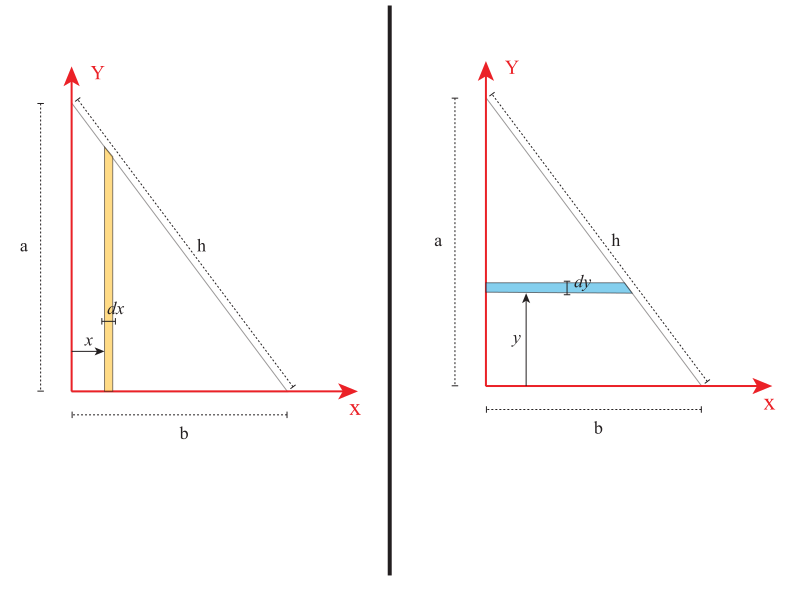
Figure 1: On the left, the area differential is chosen to find the position of the center of mass along the X axis. On the right, the area differential is chosen to find the position of the center of mass along the Y axis.
The mass density \(\rho\) is defined, for this two dimensional case as
\begin{equation}
\label{rho}
\rho=\frac{dm}{dA},
\end{equation}
where \(dA\) is the area differential. In the figure above, we see two area differentials. The one on the left has height \(y\) and width \(dx\) and is located at a distance \(x\) from the Y axis. This area differential is used in the equation to calculate \(x_{\text{cm}}\). The one on the right has height \(dy\) and width \(x\) and is located at a distance \(y\) from the X axis. This area differential is used in the equation to calculate \(y_{\text{cm}}\). Therefore, the area differentials are
\begin{equation}
dA_x=y\,dx,
\end{equation}
for \(x_{\text{cm}}\) and
\begin{equation}
dA_y=xdy.,
\end{equation}
for \(y_{\text{cm}}\).
We can use the equation for the area differentials given above into the expression for the mass density \eqref{rho} to obtain
\begin{equation}
\rho=\frac{dm}{y\,dx},
\end{equation}
for \(x_{\text{cm}}\) and
\begin{equation}
\rho=\frac{dm}{x\,dy}
\end{equation}
for \(y_{\text{cm}}\). Solving for the mass differential \(dm\) is
\begin{equation}
dm=\rho y\,dx,
\end{equation}
for \(x_{\text{cm}}\) and
\begin{equation}
dm=\rho x\,dy,
\end{equation}
for \(y_{\text{cm}}\). Using the expression for \(dm\) above into the expressions for the position of the center of mass given in equations \eqref{xcm} and \eqref{ycm}, we get
\begin{equation}
\label{xcm2}
x_{\text{cm}}=\frac{\int x \rho y\,dx}{\int \rho y\,dx},
\end{equation}
\begin{equation}
\label{ycm2}
y_{\text{cm}}=\frac{\int y \rho x\,dy}{\int \rho x\,dy}.
\end{equation}
Using the explicit expression for \(\rho\) in both equations \eqref{xcm2} and \eqref{ycm2}, we obtain
\begin{equation}
\label{xcm2.5}
x_{\text{cm}}=\frac{\int_{0}^{b} x^2y^2\,dx}{\int_{0}^{b} x y^2\,dx},
\end{equation}
\begin{equation}
\label{ycm2.5}
y_{\text{cm}}=\frac{\int_{0}^{a} y^2 x^2\,dy}{\int_0^{a} x^2 y\,dy},
\end{equation}
where the limits for \(x\) and \(y\) are the length of the respective leg of the triangle.
From the symmetry of the problem, notice that the roles of \(x\) and \(y\) can be interchanged in equations \eqref{xcm2.5} and \eqref{ycm2.5} if we just change \(a\) and \(b\). This will allow us to calculate only one of the expressions, for example the one for \(x_{\text{cm}}\) and deduce the expression for \(y_{\text{cm}}\) just by changing all the \(b\)’s by \(a\)’s in the result. Let’s then calculate \(x_{\text{cm}}\).
From the first figure, we notice that the value of the height \(y\) depends on the position \(x\). We can calculate the relation if we find the equation for the line \(h\), as given in the first figure. The equation will be in terms of \(a=3\,\text{cm}\) and \(b=4\,\text{cm}\), the legs of the triangle, namely
\begin{equation}
\label{ye}
y=-\frac{a}{b}x+a.
\end{equation}
We can then use the explicit expression for \(y\) given in equation \eqref{ye} into equation \eqref{xcm2} to obtain
\begin{equation}
\label{xcm4}
x_{\text{cm}}=\dfrac{\int_0^{b} x^2 \left(-\frac{a}{b}x+a\right)^2\,dx}{\int_0^{b}x \left(-\frac{a}{b}x+a\right)^2\,dx}.
\end{equation}
Now, we may perform the integrals. Let’s start with the integral in the denominator of equation \eqref{xcm4}
\begin{equation}
\int_0^{b} x \left(-\frac{a}{b}x+a\right)^2\,dx=\int_0^{b} x \left(\frac{a^2}{b^2}x^2-2\frac{a^2}{b}x+a^2\right)\,dx,
\end{equation}
where we have expanded the squared parenthesis. Using the distributive law, we now obtain the equation
\begin{equation}
\int_0^{b} x \left(-\frac{a}{b}x+a\right)^2\,dx=\int_0^{b}\left(\frac{a^2}{b^2}x^3-2\frac{a^2}{b}x^2+a^2x\right)\,dx,
\end{equation}
where we can perform the integral for each term individually to obtain
\begin{equation}
\int_0^{b} x \left(-\frac{a}{b}x+a\right)^2\,dx=\left(\frac{a^2}{b^2}\frac{x^4}{4}-2\frac{a^2}{b}\frac{x^3}{3}+a^2\frac{x^2}{2}\right)\Big|_{0}^{b}.
\end{equation}
Evaluating the limits in the equation above, we have
\begin{equation}
\int_0^{b} x \left(-\frac{a}{b}x+a\right)^2\,dx=\frac{a^2}{b^2}\frac{b^4}{4}-2\frac{a^2}{b}\frac{b^3}{3}+a^2\frac{b^2}{2},
\end{equation}
which simplifies to
\begin{equation}
\int_0^{b} x \left(-\frac{a}{b}x+a\right)^2\,dx=\frac{a^2b^2}{4}-2\frac{a^2b^2}{3}+\frac{a^2b^2}{2},
\end{equation}
\begin{equation}
\label{denominator}
\int_0^{b} x \left(-\frac{a}{b}x+a\right)^2\,dx=\frac{a^2b^2}{12}.
\end{equation}
Now, let’s calculate the integral in the numerator of equation \eqref{xcm4}
\begin{equation}
\int_0^{b} x^2 \left(-\frac{a}{b}x+a\right)^2\,dx=\int_0^{b} x^2 \left(\frac{a^2}{b^2}x^2-2\frac{a^2}{b}x+a^2\right)\,dx,
\end{equation}
where we have expanded the squared parenthesis. Using the distributive law, we now obtain the equation
\begin{equation}
\int_0^{b} x^2 \left(-\frac{a}{b}x+a\right)^2\,dx=\int_0^{b}\left(\frac{a^2}{b^2}x^4-2\frac{a^2}{b}x^3+a^2x^2\right)\,dx,
\end{equation}
where we can perform the integral for each term individually to obtain
\begin{equation}
\int_0^{b} x^2 \left(-\frac{a}{b}x+a\right)^2\,dx=\left(\frac{a^2}{b^2}\frac{x^5}{5}-2\frac{a^2}{b}\frac{x^4}{4}+a^2\frac{x^3}{3}\right)\Big|_{0}^{b}.
\end{equation}
Evaluating the limits in the equation above, we have
\begin{equation}
\int_0^{b} x^2 \left(-\frac{a}{b}x+a\right)^2\,dx=\frac{a^2}{b^2}\frac{b^5}{5}-2\frac{a^2}{b}\frac{b^4}{4}+a^2\frac{b^3}{3},
\end{equation}
which simplifies to
\begin{equation}
\int_0^{b} x^2 \left(-\frac{a}{b}x+a\right)^2\,dx=\frac{a^2b^3}{5}-2\frac{a^2b^3}{4}+\frac{a^2b^3}{3},
\end{equation}
\begin{equation}
\label{numeratorx}
\int_0^{b} x^2 \left(-\frac{a}{b}x+a\right)^2\,dx=\frac{a^2b^3}{30}.
\end{equation}
Using the results for denominator and numerator given by equations \eqref{denominator} and \eqref{numeratorx} into expression \eqref{xcm4}, we obtain
\begin{equation}
x_{\text{cm}}=\frac{\frac{a^2b^3}{30}}{\frac{a^2b^2}{12}},
\end{equation}
which simplifies to
\begin{equation}
\label{xcmrho}
x_{\text{cm}}=\frac{2b}{5}.
\end{equation}
Using the numerical values
\begin{equation}
x_{\text{cm}}=\frac{2(4\,\text{cm})}{5}=1.6\,\text{cm}.
\end{equation}
From the symmetry argument mentioned previously, we can deduce from equation \eqref{xcmrho} that
\begin{equation}
y_{\text{cm}}=\frac{2a}{5},
\end{equation}
which numerically is
\begin{equation}
y_{\text{cm}}=\frac{2(3\,\text{cm})}{5}=1.2\,\text{cm}.
\end{equation}
The position of the center of mass for this given \(\rho\) is then
\begin{equation}
\label{rcmcasoa}
\vec{r}_{\text{cm}}=1.6\,\text{cm}\,\hat{\textbf{i}}+1.2\,\text{cm}\,\hat{\textbf{j}}.
\end{equation}
b) Now let’s consider the density as uniform and calculate the new center of mass. In this case, we will still use the area of integration given on the left of the first figure. If the density is uniform, then \(\rho\) is a constant that we can take out of the numerator and denominator of equation \eqref{xcm4}; explicitly,
\begin{equation}
\label{xcm5}
x_{\text{cm}}=\dfrac{\rho\int_0^{b} x \left(-\frac{a}{b}x+a\right)\,dx}{\rho\int_0^{b} \left(-\frac{a}{b}x+a\right)\,dx}.
\end{equation}
After cancelling out the term \(\rho\) in the equation above, we obtain
\begin{equation}
\label{xcm6}
x_{\text{cm}}=\dfrac{\int_0^{b} x \left(-\frac{a}{b}x+a\right)\,dx}{\int_0^{b} \left(-\frac{a}{b}x+a\right)\,dx}.
\end{equation}
Let’s start by calculating the integral in the denominator of equation \eqref{xcm6}, namely
\begin{equation}
\int_0^{b} \left(-\frac{a}{b}x+a\right)\,dx=\left(-\frac{a}{b}\frac{x^2}{2}+ax\right)\Big|_{0}^{b},
\end{equation}
which evaluating the limits becomes
\begin{equation}
\int_0^{b} \left(-\frac{a}{b}x+a\right)\,dx=-\frac{a}{b}\frac{b^2}{2}+ab,
\end{equation}
\begin{equation}
\label{denominator2}
\int_0^{b} \left(-\frac{a}{b}x+a\right)\,dx=\frac{ab}{2},
\end{equation}
which is the area of the triangle.
Now let’s evaluate the integral in the numerator of \eqref{xcm6}; explicitly,
\begin{equation}
\int_0^{b} x \left(-\frac{a}{b}x+a\right)\,dx=\int_{0}^{b}\left(-\frac{a}{b}x^2+ax\right)\,dx,
\end{equation}
where we have used the distributive law. Now we can make the integral for each term to obtain
\begin{equation}
\int_0^{b} x \left(-\frac{a}{b}x+a\right)\,dx=\left(-\frac{a}{b}\frac{x^3}{3}+a\frac{x^2}{2}\right)\Big|_{0}^{b}.
\end{equation}
Evaluating the limits we have
\begin{equation}
\int_0^{b} x \left(-\frac{a}{b}x+a\right)\,dx=-\frac{a}{b}\frac{b^3}{3}+a\frac{b^2}{2},
\end{equation}
\begin{equation}
\label{numeratorx2}
\int_0^{b} x \left(-\frac{a}{b}x+a\right)\,dx=\frac{ab^2}{6}.
\end{equation}
Using the result for the denominator and numerator given by equations \eqref{denominator2} and \eqref{numeratorx2} into equation \eqref{xcm6}, we obtain
\begin{equation}
x_{\text{cm}}=\frac{\frac{ab^2}{6}}{\frac{ab}{2}},
\end{equation}
which simplifies to
\begin{equation}
\label{centroidx}
x_{\text{cm}}=\frac{b}{3}.
\end{equation}
Using the numerical values, we obtain
\begin{equation}
x_{\text{cm}}=\frac{(4\,\text{cm})}{3}\approx 1.33\,\text{cm}.
\end{equation}
From the symmetry argument used before, we can deduce that
\begin{equation}
y_{\text{cm}}=\frac{a}{3},
\end{equation}
which numerically is
\begin{equation}
y_{\text{cm}}=\frac{3\,\text{cm}}{3}=1\,\text{cm}.
\end{equation}
The position of the center of mass for the uniform \(\rho\) is then
\begin{equation}
\label{rcmcasob}
\vec{r}_{\text{cm}}^{\text{uniform}}=1.33\,\text{cm}\,\hat{\textbf{i}}+1\,\text{cm}\,\hat{\textbf{j}}.
\end{equation}
The change in the position of the center of mass \(\Delta \vec{r}\) with respect to the previous case will be the difference between the expression given in \eqref{rcmcasoa} and \eqref{rcmcasob}; explicitly,
\begin{equation}
\Delta\vec{r}=\vec{r}_{\text{cm}}-\vec{r}_{\text{cm}}^{\text{uniform}},
\end{equation}
or numerically
\begin{equation}
\Delta \vec{r}=0.27\,\text{cm}\,\hat{\textbf{i}}+0.2\,\text{cm}\,\hat{\textbf{j}}.
\end{equation}
Thus, the center of mass is moved by \(0.27\,\text{cm}\) in the X axis and \(0.2\,\text{cm}\) in the Y axis as seen in figure 2.

Figure 2: On the left, the position of the center of mass for the mass density \(\rho=Cxy\) and on the right the position of the center of mass for a constant mass density.


Leave A Comment