
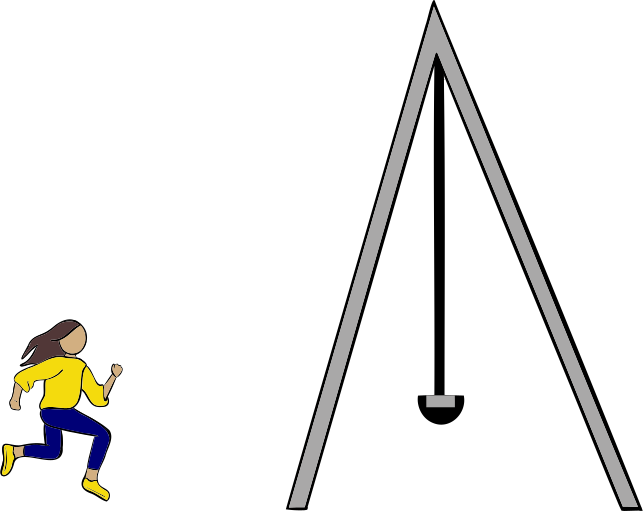
\({Recess \: \: time!}\) Classes have ended, and the kids run as fast as they can toward the playground. A \(50 \, \text{kg}\) child runs to hop on an empty swing, as shown in the picture. The swing weighs half a kilogram, and the ropes holding it each have a length of \(2 \, \text{m}\). After she jumps on it, the swing rises to a \(30^\circ\) angle with respect to the vertical axis. Calculate the initial speed of the child. (Treat the initial interaction between the child and the swing as a completely inelastic collision.)
Apply both Conservation of Momentum and Conservation of Energy. Consider that the height can be written in terms of the length and the angle.
The Law of Conservation of Momentum (\(\vec{p}_i=\vec{p}_f\)) can be written as:
\begin{equation*}
m_kv_0=(m_k+m_s)v_i,
\end{equation*}
where we can solve for \(v_i\) in terms of \(v_0\).
The Law of Conservation of Energy after the collision can be written as:
\begin{equation*}
\frac{1}{2}(m_k+m_s)v_i^2 = (m_k+m_s)gh,
\end{equation*}
where \(h\) can be determined using the geometry of the situation as:
\begin{equation*}
h = L (1 – \cos \theta ).
\end{equation*}
Substituting \(h\) and \(v_i\) into the equation for the Conservation of Energy, solving for \(v_0\), and using some algebra, we get:
\begin{equation*}
v_0=\frac{m_k+m_s}{m_k}\sqrt{2gL(1-\cos(\theta))},
\end{equation*}
which, with numerical values, is:
\begin{equation*}
v_0\approx 2.31 \, \text{m/s}.
\end{equation*}
For a more detailed explanation of any of these steps, click on “Detailed Solution”.
We need to find the speed of the child before she jumped on the swing. Let’s divide the problem in two steps:
- We’ll use the conservation of linear momentum between the instant before the child runs onto the swing and right after their inelastic collision. From this step, we’ll find a relation between the velocity of the child before the collision with the swing and the velocity of both the child and swing after the collision.
- After the collision, the child and swing move together as a whole. We’ll use the conservation of mechanical energy to relate the initial kinetic energy with the potential energy at the maximum angle. Using the result of the previous step, we’ll be able to find the initial speed of the child.
Let’s start by writing the conservation of linear momentum law for the collision:
\begin{equation}
\label{cons}
\vec{p}_i=\vec{p}_f,
\end{equation}
where \(\vec{p}_i\) is the linear momentum of the child and swing before their collision and \(\vec{p}_f\) will be the lineal momentum of child and swing right after the collision. Because all the motion occurs along one axis, say X, we can use the following equation to find the momentum before the collision
\begin{equation}
\vec{p}_i=m_kv_0\,\hat{\textbf{i}}+m_sv_S\,\hat{\textbf{i}},
\end{equation}
where \(m_k\) and \(m_s\) are the masses of the child and swing respectively and \(v_0\) and \(v_S\) their velocities. Because the swing does not move before the collision, \(v_s=0\,\text{m/s}\) and the expression for the linear momentum before the collision becomes
\begin{equation}
\label{pi}
\vec{p}_i=m_kv_0\,\hat{\textbf{i}}.
\end{equation}
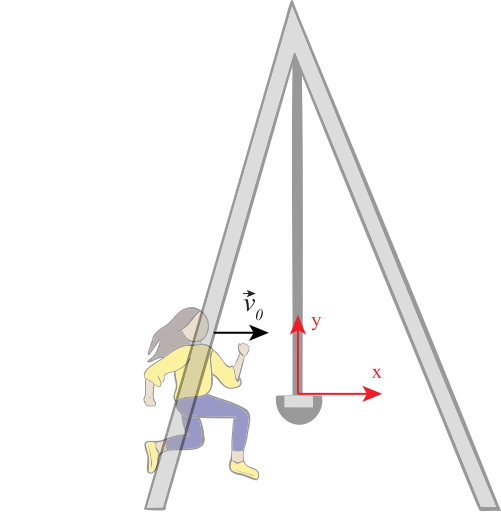
Figure 1: We place the coordinate system such that the initial velocity of the child \(\vec{v}_0\) is along the X axis. Initially, the swing is at rest.
Considering that the child and swing now move as a whole, the expression for the momentum right after the collision is
\begin{equation}
\label{pf}
\vec{p}_f=(m_k+m_s)v_i\,\hat{\textbf{i}},
\end{equation}
where \(v_i\) is their speed right after the collision.

Figure 2: Moment right after the collision of the kid and the swing. The kid-swing system starts to move with velocity \(\vec{v}_i\).
Using the expressions for the momentum before and after the collision given by equations \eqref{pi} and \eqref{pf} into equation \eqref{cons}, we obtain
\begin{equation}
m_kv_0\,\hat{\textbf{i}}=(m_k+m_s)v_i\,\hat{\textbf{i}},
\end{equation}
which, after dropping the vector notation and focusing on the magnitudes, becomes
\begin{equation}
m_kv_0=(m_k+m_s)v_i.
\end{equation}
We can solve for \(v_i\), the speed of the child-swing system after the collision, to get
\begin{equation}
\label{vi}
v_i=\frac{m_c v_0}{(m_c+m_f)}.
\end{equation}
Now, let’s start the second step. We’ll use the conservation of mechanical energy between two points in the child-swing system’s trajectory. The first point is right after the collision, where all the mechanical energy \(E_1\) is just kinetic energy \(K_1\). There is no potential energy \(U_1\) at this point because we define the origin of our coordinate system precisely at this point. Thus, we can use the following equation for the initial mechanical energy
\begin{equation}
E_1=K_1,
\end{equation}
which after using the explicit expression for the kinetic energy becomes
\begin{equation}
\label{e1}
E_1=\frac{1}{2}(m_k+m_s)v_i^2.
\end{equation}
The second point will be at the maximum height that the child and swing reach. At this point, the kinetic energy \(K_2\) is zero because the velocity is zero. Thus, the mechanical energy \(E_2\) is all potential energy \(U_2\). We can then write
\begin{equation}
E_2=U_2,
\end{equation}
which after using the explicit expression for the gravitational potential energy becomes
\begin{equation}
\label{e2}
E_2=(m_k+m_s)gh,
\end{equation}
where \(g\) is the gravitational acceleration on Earth and \(h\) is the height with respect to the system of coordinates previously defined. This height \(h\) can be given in terms of the length of the ropes holding the swing \(L\) and the maximum angle \(\theta\) , as can be seen in figure 3.
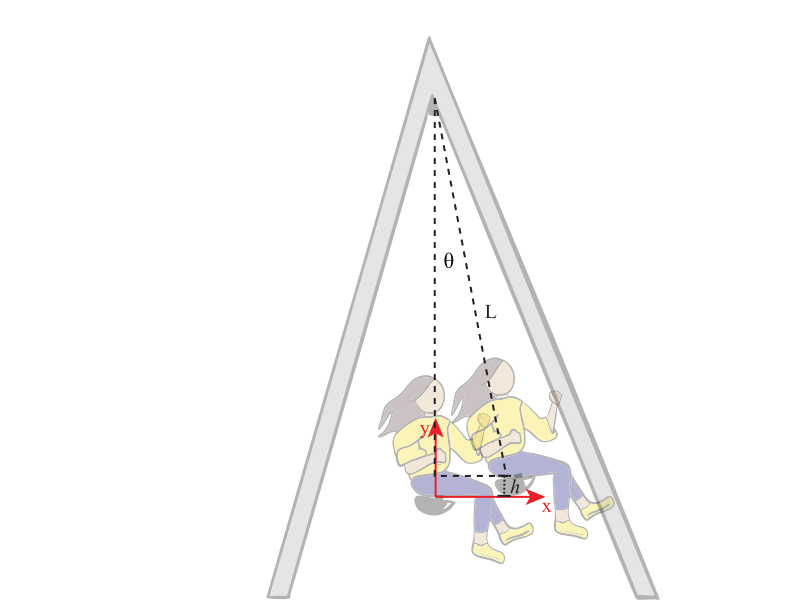
Figure 3: When the child and swing describe an angle \(\theta\) with respect to the vertical, they have elevated a distance h from their initial position along the Y axis.
From the Figure above, we see that the height \(h\) can express the difference between \(L\) and the adjacent leg of the triangle formed by the swing, whose length is \(L\cos(\theta)\). Then, we have
\begin{equation}
h=L-L\cos(\theta),
\end{equation}
and factorizing the \(L\)
\begin{equation}
h=L(1-\cos(\theta)).
\end{equation}
Therefore, the mechanical energy on the second point is (from equation \eqref{e2}):
\begin{equation}
\label{e22}
E_2=(m_k+m_s)gL(1-\cos(\theta)).
\end{equation}
The conservation of mechanical energy between points 1 and 2 is then
\begin{equation}
E_1=E_2.
\end{equation}
Using the explicit expressions for the mechanical energy at points 1 and 2 given by equations \eqref{e1} and \eqref{e22} we get
\begin{equation}
\frac{1}{2}(m_k+m_s)v_i^2=(m_k+m_s)gL(1-\cos(\theta)),
\end{equation}
where we can cancel out the masses and have
\begin{equation}
\frac{1}{2}v_i^2=gL(1-\cos(\theta)).
\end{equation}
Using the expression for \(v_i\) found on equation \eqref{vi} in the equation above we get
\begin{equation}
\frac{1}{2}\left(\frac{m_kv_0}{m_k+m_s}\right)^2=gL(1-\cos(\theta)).
\end{equation}
The only unknown in this last equation is the initial speed of the child \(v_0\). We can solve for it as follows
\begin{equation}
\left(\frac{m_kv_0}{m_k+m_s}\right)^2=2gL(1-\cos(\theta)),
\end{equation}
and taking the square-root on both sides
\begin{equation}
\frac{m_kv_0}{m_k+m_s}=\sqrt{2gL(1-\cos(\theta))},
\end{equation}
and finally
\begin{equation}
v_0=\frac{m_k+m_s}{m_k}\sqrt{2gL(1-\cos(\theta))}.
\end{equation}
Using the numerical values we have
\begin{equation}
v_0=\frac{50\,\text{kg}+0.5\,\text{kg}}{50\,\text{kg}}\sqrt{2(9.8\,\text{m/s}^2)(2\,\text{m})(1-\cos(30^{\circ}))},
\end{equation}
\begin{equation}
v_0\approx 2.31\,\text{m/s}.
\end{equation}


Leave A Comment