
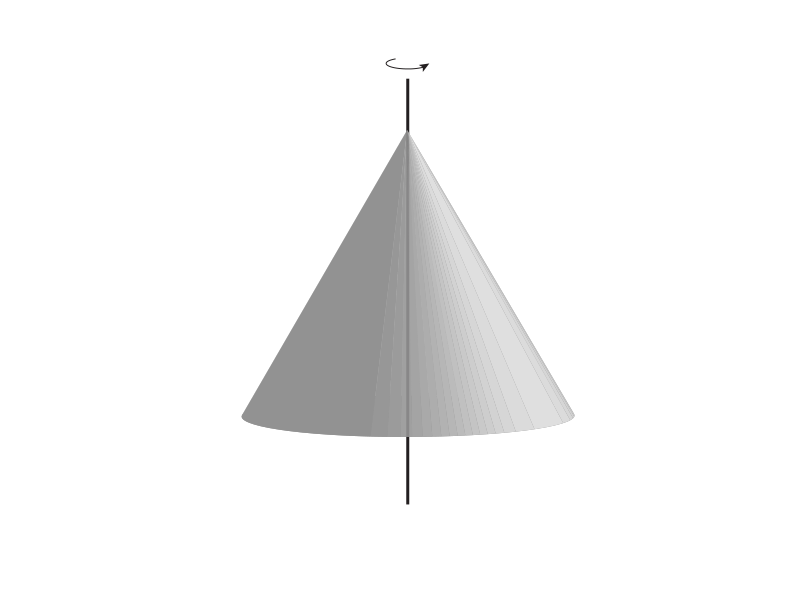
A 250 g solid cone with a 10 cm radius and height of 50 cm rotates around its center (see the figure above). Calculate the cone’s moment of inertia. Assume that the mass is uniformly distributed.
The definition of the moment of inertia describes the mass as a function of the density and the dimensions in differential terms. To relate these dimensions, Thales’s Theorem may be useful.
The moment of inertia \(I\) for a solid object is given as:
\begin{equation*}
I = \int r^2 dm,
\end{equation*}
where \(dm\) is a function of the density, and the dimensions can be written as:
\begin{equation*}
dm = \left( \frac{m}{ \frac{1}{3} \pi R^2 H} \right) 2 \pi r dr dh,
\end{equation*}
where the expression in parentheses is the density. Using Thales’s Theorem (or by similar triangles), we can obtain the relation:
\begin{equation*}
r(h) = R \left( 1 – \frac{h}{H} \right).
\end{equation*}
The integral becomes:
\begin{equation*}
I = \frac{6m}{R^2 H} \int_0^H \int_0^{r(h)} r^3 dr dh.
\end{equation*}
After performing the integral, the moment of inertia is finally:
\begin{equation*}
I = \frac{3}{10} mR^2,
\end{equation*}
which, with numerical values, is:
\begin{equation*}
I = 7.5 \times 10^{-4} \, \text{kg m}^2.
\end{equation*}
For a more detailed explanation of any of these steps, click on “Detailed Solution”.
We need to find the rotating cone’s moment of inertia. To solve this problem, we’ll use the definition of the moment of inertia for a continuous distribution of mass to calculate the moment of inertia of the solid cone as a sum of several disks of different radii.
The moment of inertia \(I\) for a solid object is given by
\begin{equation}
\label{inertia}
I=\int r^2 dm,
\end{equation}
where \(dm\) is a differential of mass on the object and \(r_i\) the perpendicular distance from such mass differential to the axis of rotation. For a disk of mass \(m\), radius \(R\), and height \(dh\), we can define the mass \(dm\), which is at a distance \(r\) from the axis of rotation, as the one in figure 1.

Figure 1: Coordinate system on the cone. We place the origin on the base of the cone and the Z axis along its symmetry axis. On the left, we see the X and Z axis on the cone. On the right, we see the cone from above, the mass differential \(dm\) or radius \(r\) and width \(dr\) is also shown.
We can now define the volumetric mass density \(\rho\) as
\begin{equation}
\label{sigma1}
\rho=\frac{dm}{dV},
\end{equation}
where \(dV\) is the volume differential associated to \(dm\). This volume differential is the perimeter \(2\pi r\) multiplied by the width \(dr\) multiplied by the height \(dh\) (See figure below), that is
\begin{equation}
dV=2\pi r dr dh.
\end{equation}
Using the expression above in the definition of \(\rho\) given in equation \eqref{sigma1}, we obtain
\begin{equation}
\rho=\frac{dm}{2\pi r dr dh},
\end{equation}
which after solving for \(dm\), we get
\begin{equation}
\label{dm1}
dm=\rho 2 \pi r dr dh.
\end{equation}
Because of the uniformity of the mass distribution, we can also write and expression for \(\rho\) that reads
\begin{equation}
\label{sigma2}
\rho=\frac{m}{\frac{1}{3}\pi R^2 H},
\end{equation}
where \(\frac{1}{3}\pi R^2 H\) is the total volume of the cone of total height \(H\). Using equation \eqref{sigma2} into the expression for \(dm\) given in equation \eqref{dm1}, we have
\begin{equation}
dm=\left(\frac{m}{\frac{1}{3}\pi R^2 H}\right)2\pi r dr dh,
\end{equation}
which simplifies to
\begin{equation}
\label{dm2}
dm=\frac{6m}{R^2H}rdrdh.
\end{equation}
Using the explicit expression for \(dm\) given above in the equation of the moment of inertia given in \eqref{inertia}, we have
\begin{equation}
\label{inertia2}
I=\int\int r^2\left(\frac{6m}{R^2H}\right)rdrdh,
\end{equation}
where we identify the variables of integration: \(r\) and \(h\). Thus, we must choose some appropriate limits for the integrals. Notice that as \(h\) changes, so does \(r\); so, we must find the relation \(r(h)\) between these variables to perform the integral. From the geometry of the cone, the relation between \(r\) and \(h\) must be linear. This is clear from figure 2.

Figure 2: On the left: Disk of radius \(r\) at a height \(h\) from the base of the cone. On the right: a transverse view of the cone showing the two triangles: the one above the disk of radius \(r\) and the one formed by the whole cone. The ratio of the horizontal distances of the triangles must be equal to the ratio of the vertical distances.
Using this figure as a guide, we can verify that the relation is
\begin{equation}
\label{relation}
r(h)=R\left(1-\frac{h}{H}\right),
\end{equation}
where \(r(0)=R\) is the radius at the base and \(r(H)=0\) is the radius at the top. Then the limits for \(r\) are 0 and \(r(h)\), and for \(h\) the limits are between \(0\) and \(H\). Hence, the integral in equation \eqref{inertia2} becomes
\begin{equation}
\label{inertia3}
I=\frac{6m}{R^2H}\int_{0}^{H}\int_0^{r(h)} r^3 drdh,
\end{equation}
where we have taken out of the integral the constant terms.
Performing the \(r\) integral, we obtain
\begin{equation}
I=\frac{6m}{R^2H}\int_{0}^{H}\left(\frac{r^4}{4}\right)\Big|_{0}^{r(h)}dh,
\end{equation}
\begin{equation}
I=\frac{6m}{R^2H}\int_{0}^{H}\frac{r(h)^4}{4}dh.
\end{equation}
Using the relation of equation \eqref{relation} to write explicitly \(r(h)\) in the integral above we get
\begin{equation}
I=\frac{6m}{4R^2H}\int_{0}^{H}R^4\left(1-\frac{h}{H}\right)^4dh.
\end{equation}
Using the substitution \(u=1-\frac{h}{H}\), \(du=-\frac{dh}{H}\) into the integral above, we get
\begin{equation}
I=\frac{6mR^4}{4R^2H}\int_{1}^{0}u^4(-Hdu),
\end{equation}
where we have also changed the limits accordingly and taken out the \(R^4\) constant factor. The minus sign inverts the limits in the integral, and the \(H\) can be taken out of the integral above, namely
\begin{equation}
I=\frac{6mR^4H}{4R^2H}\int_{0}^{1}u^4du.
\end{equation}
Performing the integral above, we obtain
\begin{equation}
I=\frac{6mR^4H}{4R^2H}\left(\frac{u^5}{5}\right)\Big|_{0}^{1},
\end{equation}
\begin{equation}
\label{int}
I=\frac{6mR^4H}{4R^2H}\left(\frac{1}{5}\right).
\end{equation}
After some simplifications, the expression given in equation \eqref{int} becomes
\begin{equation}
I=\frac{3}{10}mR^2.
\end{equation}
Using the numerical values in SI units \(m=0.250\,\text{kg}\) and \(R=0.10\,\text{m}\), we can then write
\begin{equation}
I=\frac{3}{10}(0.250\,\text{kg})(0.10\,\text{m})^2,
\end{equation}
\begin{equation}
I=7.5\times 10^{-4}\,\text{kg m}^2.
\end{equation}



Leave A Comment