

A cube has a 700 g particle placed at each of its corners. The particles are connected to each other with a wire of negligible mass that has a length of 8 cm.
a) Find the position of the center of mass.
b) If a single particle is removed, how much does its center of mass change?
a) Place your coordinate system, and use the equation for the center of mass.
b) Same hint as part (a), but consider there will be one less particle find the difference between the two vectors.
a) The position of the center of mass is given as:
\begin{equation*}
\vec{r}_\text{cm}=\frac{\sum_i m_i \vec{r}_i}{\sum_i m_i},
\end{equation*}
where the masses (\m_i \) are all equal, so the masses can be canceled out. Choosing the coordinate system to be centered at one of the particles, their positions will be \(s\) dimensions or 0 along each axis. Plugging in numerical values, we get:
\begin{equation*}
\vec{r}_\text{cm}=4\,\text{cm}\,\hat{\textbf{i}}+4\,\text{cm}\,\hat{\textbf{j}}+4\,\text{cm}\,\hat{\textbf{k}}.
\end{equation*}
b) Doing the same work as performed in part (a), but for one less particle, we get:
\begin{equation*}
\vec{r}’_\text{cm}=4.57\,\text{cm}\,\hat{\textbf{i}}+4.57\,\text{cm}\,\hat{\textbf{j}}+4.57\,\text{cm}\,\hat{\textbf{k}}.
\end{equation*}
The change in position for the center of mass is the magnitude of the difference of the vectors \(\vec{r}_\text{cm}\) and \(\vec{r}_{\text{cm}}’\):
\begin{equation*}
|\vec{r}_\text{cm}-\vec{r}_{\text{cm}}’|\approx 1.00\,\text{cm}.
\end{equation*}
For a more detailed explanation of any of these steps, click on “Detailed Solution”.
a) They’ve asked us to find the position of the center of mass. Let’s first place a coordinate system at one of the corners of the cube, as seen in figure 1.
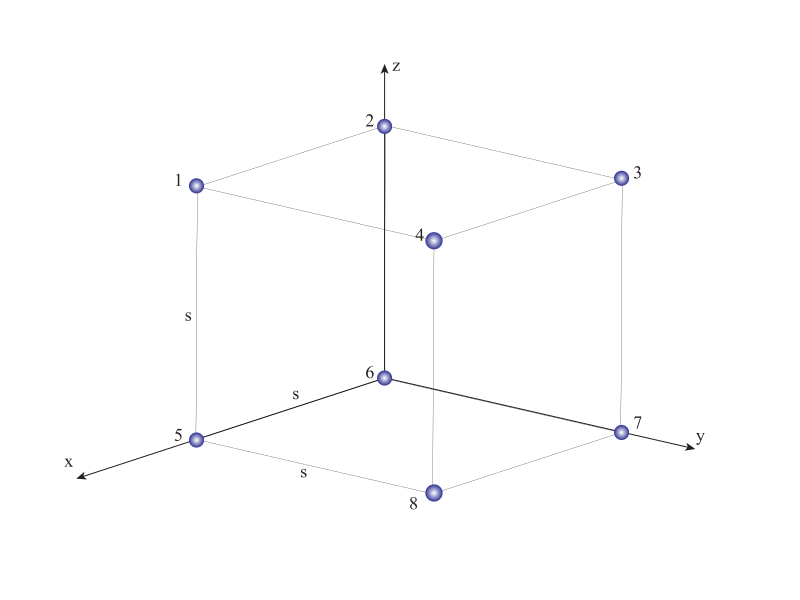
Figure 1: We place the coordinate system on one of the vertices of the cubic array of masses, specifically in the vertex where mass 6 is placed.
Notice that we have labeled the masses and we used \(s\) for the edges (the length of one edge is \(s=8\,\text{cm}\).
To find the position of the center of mass \(\vec{r}_\text{cm}\), we must use the following expression, valid for a finite array of point masses
\begin{equation}
\label{ecmass}
\vec{r}_\text{cm}=\frac{\sum_i m_i \vec{r}_i}{\sum_i m_i},
\end{equation}
where \(m_i\) is the mass of the \(i\)-th particle and \(\vec{r}_i\) its position vector. In our case, we have 8 masses, so the explicit expression for the position of the center of mass becomes (using equation \eqref{ecmass})
\begin{equation}
\label{explicit}
\vec{r}_\text{cm}=\frac{m_1\vec{r}_1+m_2\vec{r}_2+m_3\vec{r}_3+m_4\vec{r}_4+m_5\vec{r}_5+m_6\vec{r}_6+m_7\vec{r}_7+m_8\vec{r}_8}{m_1+m_2+m_3+m_4+m_5+m_6+m_7+m_8}.
\end{equation}
Because all the masses are equal to \(m\), the expression above simplifies to
\begin{equation}
\vec{r}_\text{cm}=\frac{m(\vec{r}_1+\vec{r}_2+\vec{r}_3+\vec{r}_4+\vec{r}_5+\vec{r}_6+\vec{r}_7+\vec{r}_8)}{8m},
\end{equation}
\begin{equation}
\label{rcm}
\vec{r}_\text{cm}=\frac{\vec{r}_1+\vec{r}_2+\vec{r}_3+\vec{r}_4+\vec{r}_5+\vec{r}_6+\vec{r}_7+\vec{r}_8}{8}.
\end{equation}
Thus, we need the position vector for each mass. According to the coordinate system shown in the previous figure, we can write the positions of the masses in terms of the unitary vectors along the X, Y, and Z axes, as illustrated in figure 2.

Figure 2: The position vector for each mass can be seen as a linear combination of unitary vectors along the X, Y, and Z axis multiplied by \(s\). To obtain the position vector of a specific mass, start at the origin and add up the vectors necessary to reach the desired mass. For example, for the position vector of mass 4, we must add up the red, blue, and light green vectors.
Hence, we see that:
\begin{equation}
\label{a1}
\vec{r}_1=s\,\hat{\textbf{i}}+s\,\hat{\textbf{k}},
\end{equation}
\begin{equation}
\vec{r}_2=s\,\hat{\textbf{k}},
\end{equation}
\begin{equation}
\vec{r}_3=s\,\hat{\textbf{j}}+s\,\hat{\textbf{k}},
\end{equation}
\begin{equation}
\vec{r}_4=s\,\hat{\textbf{i}}+s\,\hat{\textbf{j}}+s\,\hat{\textbf{k}},
\end{equation}
\begin{equation}
\vec{r}_5=s\,\hat{\textbf{i}},
\end{equation}
\begin{equation}
\vec{r}_6=\vec{0},
\end{equation}
\begin{equation}
\vec{r}_7=s\,\hat{\textbf{j}},
\end{equation}
\begin{equation}
\label{a8}
\vec{r}_8=s\,\hat{\textbf{i}}+s\,\hat{\textbf{j}}.
\end{equation}
Using the explicit expressions for the position vectors given in equations \eqref{a1}-\eqref{a8} into equation \eqref{rcm}, we get
\begin{equation}
\vec{r}_{cm}=\frac{(s\,\hat{\textbf{i}}+s\,\hat{\textbf{k}})+(s\,\hat{\textbf{k}})+(s\,\hat{\textbf{j}}+s\,\hat{\textbf{k}})+(s\,\hat{\textbf{i}}+s\,\hat{\textbf{j}}+s\,\hat{\textbf{k}})+(s\,\hat{\textbf{i}})+(\vec{0})+(s\,\hat{\textbf{j}})+(s\,\hat{\textbf{i}}+s\,\hat{\textbf{j}})}{8},
\end{equation}
which, after grouping terms that go in the same direction, becomes
\begin{equation}
\vec{r}_\text{cm}=\frac{(s+s+s+s)\,\hat{\textbf{i}}+(s+s+s+s)\,\hat{\textbf{j}}+(s+s+s+s)\,\hat{\textbf{k}}}{8},
\end{equation}
which is
\begin{equation}
\vec{r}_\text{cm}=\frac{4s}{8}\,\hat{\textbf{i}}+\frac{4s}{8}\,\hat{\textbf{j}}+\frac{4s}{8}\,\hat{\textbf{k}},
\end{equation}
\begin{equation}
\label{rcm1}
\vec{r}_\text{cm}=\frac{s}{2}\,\hat{\textbf{i}}+\frac{s}{2}\,\hat{\textbf{j}}+\frac{s}{2}\,\hat{\textbf{k}}.
\end{equation}
Using the numerical value for \(s\), we get
\begin{equation}
\vec{r}_\text{cm}=\frac{8\,\text{cm}}{2}\,\hat{\textbf{i}}+\frac{8\,\text{cm}}{2}\,\hat{\textbf{j}}+\frac{8\,\text{cm}}{2}\,\hat{\textbf{k}},
\end{equation}
\begin{equation}
\vec{r}_\text{cm}=4\,\text{cm}\,\hat{\textbf{i}}+4\,\text{cm}\,\hat{\textbf{j}}+4\,\text{cm}\,\hat{\textbf{k}},
\end{equation}
which is the position for the center of the cube.
b) Now let us remove one of the particles, let us remove for simplicity particle 6 whose position vector is \(\vec{r}_6=\vec{0}\). We can then write the new position for the center of mass \(\vec{r}_\text{cm}’\), using equation \eqref{rcm} as
\begin{equation}
\vec{r}_\text{cm}’=\frac{m_1\vec{r}_1+m_2\vec{r}_2+m_3\vec{r}_3+m_4\vec{r}_4+m_5\vec{r}_5++m_7\vec{r}_7+m_8\vec{r}_8}{m_1+m_2+m_3+m_4+m_5+m_7+m_8}.
\end{equation}
Because all the masses are equal to \(m\), the expression above simplifies to
\begin{equation}
\vec{r}_\text{cm}’=\frac{m(\vec{r}_1+\vec{r}_2+\vec{r}_3+\vec{r}_4+\vec{r}_5+\vec{r}_7+\vec{r}_8)}{7m},
\end{equation}
\begin{equation}
\label{rcm2}
\vec{r}_\text{cm}’=\frac{\vec{r}_1+\vec{r}_2+\vec{r}_3+\vec{r}_4+\vec{r}_5+\vec{r}_6+\vec{r}_7+\vec{r}_8}{7}.
\end{equation}
Using the explicit expressions for the position vectors given in equations \eqref{a1}-\eqref{a8} into equation \eqref{rcm2}, we get
\begin{equation}
\vec{r}_{cm}’=\frac{(s\,\hat{\textbf{i}}+s\,\hat{\textbf{k}})+(s\,\hat{\textbf{k}})+(s\,\hat{\textbf{j}}+s\,\hat{\textbf{k}})+(s\,\hat{\textbf{i}}+s\,\hat{\textbf{j}}+s\,\hat{\textbf{k}})+(s\,\hat{\textbf{i}})+(s\,\hat{\textbf{j}})+(s\,\hat{\textbf{i}}+s\,\hat{\textbf{j}})}{7},
\end{equation}
which, after grouping terms that go in the same direction, becomes
\begin{equation}
\vec{r}_\text{cm}’=\frac{(s+s+s+s)\,\hat{\textbf{i}}+(s+s+s+s)\,\hat{\textbf{j}}+(s+s+s+s)\,\hat{\textbf{k}}}{7},
\end{equation}
which is
\begin{equation}
\label{rcmp}
\vec{r}_\text{cm}’=\frac{4s}{7}\,\hat{\textbf{i}}+\frac{4s}{7}\,\hat{\textbf{j}}+\frac{4s}{7}\,\hat{\textbf{k}}.
\end{equation}
Using the numerical value for \(s\), we get
\begin{equation}
\vec{r}_\text{cm}’=\frac{4(8\,\text{cm})}{7}\,\hat{\textbf{i}}+\frac{4(8\,\text{cm})}{7}\,\hat{\textbf{j}}+\frac{4(8\,\text{cm})}{7}\,\hat{\textbf{k}},
\end{equation}
\begin{equation}
\vec{r}_\text{cm}’=4.57\,\text{cm}\,\hat{\textbf{i}}+4.57\,\text{cm}\,\hat{\textbf{j}}+4.57\,\text{cm}\,\hat{\textbf{k}}.
\end{equation}
The change in the position of the center of mass can be calculated by taking the magnitude of the difference between the vectors \(\vec{r}_{\text{cm}}\) and \(\vec{r}_{\text{cm}’}\), namely
\begin{equation}
|\vec{r}_\text{cm}-\vec{r}_{\text{cm}}’|=\left|\frac{s}{2}\,\hat{\textbf{i}}+\frac{s}{2}\,\hat{\textbf{j}}+\frac{s}{2}\,\hat{\textbf{k}}-\left(\frac{4s}{7}\,\hat{\textbf{i}}+\frac{4s}{7}\,\hat{\textbf{j}}+\frac{4s}{7}\,\hat{\textbf{k}}\right)\right|,
\end{equation}
where we have used the results of equations \eqref{rcm1} and \eqref{rcmp}. Simplifying the result in the equation above, we get
\begin{equation}
|\vec{r}_\text{cm}-\vec{r}_{\text{cm}}’|=\left|-\frac{s}{14}\,\hat{\textbf{i}}-\frac{s}{14}\,\hat{\textbf{j}}-\frac{s}{14}\,\hat{\textbf{k}}\right|,
\end{equation}
and taking \(\frac{s}{14}\) as a common factor
\begin{equation}
|\vec{r}_\text{cm}-\vec{r}_{\text{cm}}’|=\frac{s}{14}\left|\hat{\textbf{i}}+\hat{\textbf{j}}+\hat{\textbf{k}}\right|.
\end{equation}
Calculating the magnitude of the vector \(\hat{\textbf{i}}+\hat{\textbf{j}}+\hat{\textbf{k}}\) we obtain for the distance that the center of mass is displaced
\begin{equation}
|\vec{r}_\text{cm}-\vec{r}_{\text{cm}}’|=\frac{s}{14}\sqrt{1^1+1^1+1^1},
\end{equation}
\begin{equation}
|\vec{r}_\text{cm}-\vec{r}_{\text{cm}}’|=\frac{\sqrt{3}s}{14}.
\end{equation}
Using the numerical value for \(s\), we obtain
\begin{equation}
|\vec{r}_\text{cm}-\vec{r}_{\text{cm}}’|=\frac{\sqrt{3}(8\,\text{cm})}{14},
\end{equation}
\begin{equation}
|\vec{r}_\text{cm}-\vec{r}_{\text{cm}}’|\approx 1.00\,\text{cm}.
\end{equation}


Leave A Comment