

Consider a square parallel plate capacitor with dielectrics materials like the one shown in the figure. Assume \(l\) = 1.5 cm, d = 0.5 mm, \(k_1 = 10 \), \(k_2 = 20\) and \(k_3 = 22\).
a) Find the equivalent capacitance.
b) If the red and blue wires are connected to a 45V battery, what is the charge on each section of the capacitor?
c) How much energy is stored on each section of the capacitor?
a) With the given dimensions, find the capacitance for each capacitor. The equivalent capacitance can be found by seeing that each dielectric is a capacitor, for which connected next to each other means parallel, and over each other means series.
b) Use the formula for the charge in terms of the capacitance and the voltage. Consider each case for the series and parallel capacitors and the relations with its charges.
c) Use directly the formula for the storage energy since all the variables are already found.
a) For a parallel plate capacitor with a dielectric, the capacitance can be calculated as
\begin{equation*}
C=\kappa \frac{\epsilon_0 A}{d}.
\end{equation*}
By seeing the dimension we have:
\begin{equation*}
C_1= \frac{\kappa_1\epsilon_0 l^2}{3d},
\end{equation*}
\begin{equation*}
C_2=\frac{\kappa_2\epsilon_0 4l^2}{3d},
\end{equation*}
and
\begin{equation*}
C_3=\frac{\kappa_3\epsilon_0 4l^2}{3d}.
\end{equation*}
In this case, the capacitors can be drawn as is shown in the following figure:

As is shown, \(C_2\) and \(C_3\) are in series. Then:
\begin{equation*}
\frac{1}{C_{23}}=\frac{1}{C_2}+\frac{1}{C_3}.
\end{equation*}
Then, \(C_{23}\) is in parallel with \(C_1\). Then:
\begin{equation*}
C_{\text{eq}}=C_1+C_{23}.
\end{equation*}
With the variables for each capacitor, \(C_{\text{eq}}\) can be written as:
\begin{equation*}
C_{\text{eq}}=\frac{\epsilon_0 l^2}{d}\left(\kappa_1+\frac{4}{\frac{1}{\kappa_2}+\frac{1}{\kappa_3}}\right),
\end{equation*}
or with numerical values:
\begin{equation*}
C_{\text{eq}}\approx 6.89\times 10^{-11}\,\text{F}.
\end{equation*}
b) Since \(Q = CV \), then:
\begin{equation*}
Q_1=C_1V = \frac{\kappa_1\epsilon_0l^2}{3d} V,
\end{equation*}
or:
\begin{equation*}
Q_1 \approx 5.98\times 10^{-10}\,\text{C}.
\end{equation*}
Since \(Q_2\) and \(Q_3\) are in series, then the charge is the same. Then:
\begin{equation*}
Q_{23}= C_{23} V = \frac{\epsilon_04l^2}{3d}\frac{V}{\frac{1}{\kappa_2}+\frac{1}{\kappa_3}},
\end{equation*}
or
\begin{equation*}
Q_{23} \approx 2.50 \times 10^{-9}\,\text{C}.
\end{equation*}
c) The energy stored on each capacitor is:
\begin{equation*}
U=\frac{1}{2}\frac{Q^2}{C}.
\end{equation*}
For \(C_1\) we get:
\begin{equation*}
U_1=\frac{1}{2}\frac{Q_1^2}{\frac{\kappa_1\epsilon_0l^2}{3d}},
\end{equation*}
which numerically becomes
\begin{equation*}
U_1 \approx 1.35\times 10^{-8}\,\text{J}.
\end{equation*}
For \(C_2\) we have:
\begin{equation*}
U_2=\frac{1}{2}\frac{Q_2^2}{\frac{\kappa_2\epsilon_04l^2}{3d}},
\end{equation*}
and numerically
\begin{equation*}
U_2 \approx 1.18\times 10^{-7}\,\text{J}.
\end{equation*}
And for \(C_3\) we obtain:
\begin{equation*}
U_3=\frac{1}{2}\frac{Q_3^2}{\frac{\kappa_3\epsilon_0 4 l^2}{3d}},
\end{equation*}
and numerically
\begin{equation*}
U_3 \approx 1.07\times 10^{-7}\,\text{J}.
\end{equation*}
For a more detailed explanation of any of these steps, click on “Detailed Solution”.
a) They ask us to find the equivalent capacitance. When we approach a system of dielectrics like the one shown in the figure, we can simplify the array as a combination of capacitors in series and in parallel. The way to deduce if they are in series or in parallel is summarized in figures 1 and 2.

Figure 1: The array of parallel plates capacitor with a dielectric on only half its area is equivalent to two capacitors in parallel with the same separation but with half the area, one without dielectric and one with dielectric.

Figure 2: The array of parallel plates capacitor with a dielectric on only 1/3 of its length is equivalent to two capacitors in series with the same area but with different separation between plates, one without dielectric and one with dielectric.
If the dielectrics are placed such that the same voltage is applied to both dielectrics, as seen in figure 1, then the capacitors are in parallel. If the dielectrics are placed in the direction in which the voltage changes, as in figure 2, then the capacitors are in series.
The array of dielectrics can be modeled as shown in figure 3
Figure 3: Simplification of the total array of dielectrics. First separating the dielectrics in parallel and then on the right side separating the dielectrics in series.
For a parallel plate capacitor with a dielectric, the capacitance can be calculated as
\begin{equation}
\label{capacitor}
C=\kappa \frac{\epsilon_0 A}{d},
\end{equation}
where \(\kappa\) is the dielectric constant, \(A\) is the effective area of the dielectric between the plates, transverse to the electric field between the plates, and \(d\) is the effective width of the dielectric. The term \(\epsilon_0\) is known as the permittivity of free space and is a constant. Let us then, using the definition in equation \eqref{capacitor}, calculate the capacitance for each equivalent capacitor shown in figure 3.
For \(C_1\) the effective area is \(A_1=\frac{l}{3}l=\frac{l^2}{3}\) and the width of the dielectric is \(d_1=d\). Then using equation \eqref{capacitor} we have
\begin{equation}
\label{cap1}
C_1=\kappa_1\frac{\epsilon_0\frac{l^2}{3}}{d}=\frac{\kappa_1\epsilon_0 l^2}{3d}.
\end{equation}
In the case of \(C_2\) with dielectric constant \(\kappa_2\) the effective area is \(A_2=\frac{2l}{3}l=\frac{2l^2}{3}\) and the effective width is \(d/2\). Then according to equation \eqref{capacitor}
\begin{equation}
\label{cap2}
C_2=\kappa_2\frac{\epsilon_0\frac{2l^2}{3}}{d/2}=\frac{\kappa_2\epsilon_0 4l^2}{3d}.
\end{equation}
Finally, in the case of \(C_3\), with dielectric constant \(\kappa_3\), the effective area is \(A_3=\frac{2l}{3}l=\frac{2l^2}{3}\) and the effective width is \(d/2\). Thus using equation \eqref{capacitor} we have
\begin{equation}
\label{cap3}
C_3=\kappa_3\frac{\epsilon_0 \frac{2l^2}{3}}{d/2}=\frac{\kappa_3\epsilon_0 4l^2}{3d}.
\end{equation}
Now we must find the equivalent capacitance. In order to do that we notice that \(C_2\) and \(C_3\) are in series, therefore we can find first an equivalent capacitance \(C_{23}\) for these two. Using the rules to add up capacitors in series we obtain
\begin{equation}
\label{capacitance}
\frac{1}{C_{23}}=\frac{1}{C_2}+\frac{1}{C_3}.
\end{equation}
Solving for \(C_{23}\) in equation \eqref{capacitance} we obtain
\begin{equation}
\label{cap23}
C_{23}=\frac{1}{\frac{1}{C_2}+\frac{1}{C_3}}.
\end{equation}
The circuit is then simplified to the one shown in figure 4.
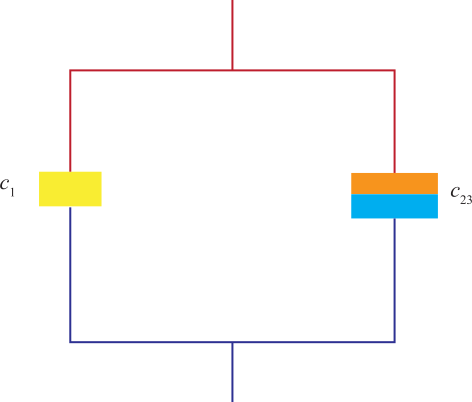
Figure 4: Using the rule to add up capacitors in series the right hand side of the capacitor array is simplified to an equivalent capacitance \(C_{23}\).
From figure 4 it is clear the the capacitors \(C_1\) and \(C_{23}\) are in parallel, then using the rules to add up capacitors in parallel we finally obtain the equivalent capacitance \(C_{\text{eq}}\), namely
\begin{equation}
\label{capeq}
C_{\text{eq}}=C_1+C_{23}.
\end{equation}
Using the expression of equation \eqref{cap23} into equation \eqref{capeq} we get
\begin{equation}
C_{\text{eq}}=C_1+\frac{1}{\frac{1}{C_2}+\frac{1}{C_3}}.
\end{equation}
If we use the explicit expressions for each capacitor given by equations \eqref{cap1}, \eqref{cap2} and \eqref{cap3} we then have
\begin{equation}
\label{ceq}
C_{\text{eq}}=\frac{\kappa_1\epsilon_0l^2}{3d}+\frac{1}{\frac{3d}{\kappa_2\epsilon_04l^2}+\frac{3d}{\kappa_3\epsilon_04l^2}}.
\end{equation}
Factorizing the term \(\frac{3d}{\epsilon_0 4l^2}\) in the denominator of the second term in \eqref{ceq} we get
\begin{equation}
C_{\text{eq}}=\frac{\kappa_1\epsilon_0l^2}{3d}+\frac{1}{\frac{3d}{\epsilon_0 4l^2}\left(\frac{1}{\kappa_2}+\frac{1}{\kappa_3}\right)}.
\end{equation}
If we simplify further we obtain
\begin{equation}
C_{\text{eq}}=\frac{\kappa_1\epsilon_0l^2}{3d}+\frac{\epsilon_0 4l^2}{3d}\frac{1}{\frac{1}{\kappa_2}+\frac{1}{\kappa_3}}.
\end{equation}
Factorizing \(\frac{\epsilon_0 l^2}{3d}\) from both terms we finally get
\begin{equation}
C_{\text{eq}}=\frac{\epsilon_0 l^2}{d}\left(\kappa_1+\frac{4}{\frac{1}{\kappa_2}+\frac{1}{\kappa_3}}\right).
\end{equation}
Using the numerical values \(\epsilon_0= 8.854\times 10^{-12}\,\text{F/m}\), \(l=1.5\,\text{cm}=0.015\,\text{m}\) and \(d=0.5\,\text{mm}=5\times 10^{-4}\,\text{m}\):
\begin{equation}
C_{\text{eq}}=\frac{(8.854\times 10^{-12}\,\text{F/m})(0.015\,\text{m})^2}{3(5\times 10^{-4}\,\text{m})}\left(10+\frac{4}{\frac{1}{20}+\frac{1}{22}}\right),
\end{equation}
\begin{equation}
C_{\text{eq}}\approx 6.89\times 10^{-11}\,\text{F}.
\end{equation}
b) To find the charge on each capacitor we must use the relation between charge \(Q\), capacitance \(C\) and voltage \(V\) that reads
\begin{equation}
\label{cargacap}
Q=CV.
\end{equation}
From figure 4 we can see that since \(C_1\) and \(C_{23}\) are in parallel, then the have the same voltage. Thus we can use equation \eqref{cargacap} to find the charges in capacitor \(C_1\) and in the combination of 2 and 3 \(C_{23}\) as follows
\begin{equation}
\label{charge1}
Q_1=C_1V,
\end{equation}
and
\begin{equation}
\label{charge23}
Q_{23}=C_{23}V.
\end{equation}
Because capacitors \(C_2\) and \(C_3\) are in series, they have the same charge, then
\begin{equation}
Q_{23}=Q_2=Q_3,
\end{equation}
where \(Q_2\) and \(Q_3\) is the charge on dielectrics 2 and 3 respectively. Using the result for \(C_1\) given by equation \eqref{cap1} we obtain
\begin{equation}
Q_1=\frac{\kappa_1\epsilon_0l^2}{3d}V,
\end{equation}
or numerically
\begin{equation}
Q_1=\frac{10(8.854\times 10^{-12}\,\text{F/m})(0.015\,\text{m})^2}{3(5\times 10^{-4}\,\text{m})}45\,\text{V}\approx 5.98\times 10^{-10}\,\text{C}.
\end{equation}
Following equation \eqref{charge23} and using the expression given by equation \eqref{cap23} we get for the charge in dielectrics 2 and 3
\begin{equation}
Q_{23}=\frac{1}{\frac{1}{C_2}+\frac{1}{C_3}}V,
\end{equation}
where we can use the explicit expressions of equations \eqref{cap2} and \eqref{cap3} to obtain
\begin{equation}
Q_{23}=\frac{1}{\frac{3d}{\kappa_2\epsilon_0 4l^2}+\frac{3d}{\kappa_3\epsilon_04l^2}}V.
\end{equation}
After factorizing the term \(\frac{3d}{\epsilon_04l^2}\) we finally get
\begin{equation}
Q_{23}= \frac{\epsilon_04l^2}{3d}\frac{V}{\frac{1}{\kappa_2}+\frac{1}{\kappa_3}}.
\end{equation}
Using the numerical values for each variable we obtain
\begin{equation}
Q_{23}=\frac{(8.854\times 10^{-12}\,\text{F/m})4(0.015\,\text{m})^2}{3(5\times 10^{-4}\,\text{m})}\frac{45\,\text{V}}{\frac{1}{20}+\frac{1}{22}},
\end{equation}
then
\begin{equation}
Q_{23}=Q_{2}=Q_{3}\approx2.50\times 10^{-9}\,\text{C}.
\end{equation}
c) To find the energy stored on each capacitor \(U\) we must use that
\begin{equation}
U=\frac{1}{2}\frac{Q^2}{C}.
\end{equation}
Because we know the charge for each dielectric \(Q\) and the value of its capacitance \(C\) we can calculate the energy stored on each one.
For \(C_1\) we have
\begin{equation}
\label{u1}
U_1=\frac{1}{2}\frac{Q_1^2}{C_1},
\end{equation}
which using expression in equation \eqref{cap1} into equation \eqref{u1} we get
\begin{equation}
U_1=\frac{1}{2}\frac{Q_1^2}{\frac{\kappa_1\epsilon_0l^2}{3d}},
\end{equation}
which numerically becomes
\begin{equation}
U_1=\frac{1}{2}\frac{(5.98\times10^{-10}\,\text{C})^2}{\frac{10(8.854\times 10^{-12}\,\text{F/m})(0.015\,\text{m})^2}{3(5\times 10^-4\,\text{m})}}\approx 1.35\times 10^{-8}\,\text{J}.
\end{equation}
In the case of \(C_2\) we have
\begin{equation}
U_2=\frac{1}{2}\frac{Q_2^2}{C_2},
\end{equation}
and using the expression of equation \eqref{cap2} it becomes
\begin{equation}
U_2=\frac{1}{2}\frac{Q_2^2}{\frac{\kappa_2\epsilon_04l^2}{3d}},
\end{equation}
and numerically
\begin{equation}
U_2=\frac{1}{2}\frac{(2.50\times10^{-9}\,\text{C})^2}{\frac{20(8.854\times 10^{-12}\,\text{F/m})4(0.015\,\text{m})^2}{3(5\times 10^{-4}\,\text{m})}}\approx 1.18\times 10^{-7}\,\text{J}.
\end{equation}
Finally, for \(C_3\) we have the following expression for the energy stored in the dielectric
\begin{equation}
U_3=\frac{1}{2}\frac{Q_3^2}{C_3},
\end{equation}
which, after using the result of equation \eqref{cap3} becomes
\begin{equation}
U_3=\frac{1}{2}\frac{Q_3^2}{\frac{\kappa_3\epsilon_0 4 l^2}{3d}},
\end{equation}
and numerically
\begin{equation}
U_3=\frac{1}{2}\frac{(2.50\times10^{-9}\,\text{C})^2}{\frac{22(8.854\times 10^{-12}\,\text{F/m})4(0.015\,\text{m})^2}{3(5\times 10^{-4}\,\text{m})}}\approx 1.07\times 10^{-7}\,\text{J}.
\end{equation}

Leave A Comment