

Three long parallel wires carry 2 A of current out of the page (see figure).
a) Using Ampere’s law, find the expression for the magnetic field generated by the wires at a distance \(x\) located on the same axis as the one shared by the wires.
b) Find the total magnetic field on the \(x \) axis at: \(x = -10 \, \text{cm,} \) \(x = 10 \, \text {cm,}\) \(x = 30 \, \text{cm}\) and \(x = 50 \, \text{cm}\).
c) If the wire located at \(x = 40 \, \text{cm} \) carries now the current into the page, what would be the new magnetic field at the same positions of (b)?
a) Use Ampere’s law to solve for the magnetic field around a wire. Use the superposition principle to solve for the total magnetic field.
b) Use the equation found in part (a) and the values for each case.
c) Use the equation found in part (a) again, but make a small change to find the answer.
a) Ampere’s Law gives:
\begin{equation*}
\oint_C \vec{B}\cdot d\vec{l}=\mu_0 I_{\text{enc}},
\end{equation*}
where, in this case, the right side of the equation is \(2 \pi r\), and the enclosed current is \(I\). Solving for \(B\), we get:
\begin{equation*}
B = \frac{\mu_0 I}{2 \pi r}.
\end{equation*}
Placing a coordinate system and using the superposition principle, we have:
\begin{equation*}
\vec{B}(x)=\frac{\mu_0 I}{2\pi}\left(\frac{1}{x-x_1}+\frac{1}{x-x_2}+\frac{1}{x_3}\right)\,\hat{\textbf{j}}.
\end{equation*}
b) Using the last equation found in part (a) and replacing each point, we get
\begin{equation*}
\vec{B}(-0.1\,\text{m})\approx -6.13\times 10^{-6}\,\text{T}\,\hat{\textbf{j}},
\end{equation*}
\begin{equation*}
\vec{B}(0.1\,\text{m})\approx -1.33\times 10^{-6}\,\text{T}\,\hat{\textbf{j}},
\end{equation*}
\begin{equation*}
\vec{B}(0.3\,\text{m})\approx 1.33\times 10^{-6}\,\text{T}\,\hat{\textbf{j}},
\end{equation*}
\begin{equation*}
\vec{B}(0.5\,\text{m})\approx 6.13\times 10^{-6}\,\text{T}\,\hat{\textbf{j}}.
\end{equation*}
c) If the current on one wire is reversed, then:
\begin{equation*}
\vec{B}(x)=\frac{\mu_0 I}{2\pi (x-x_1)}\,\hat{\textbf{j}}+\frac{\mu_0 I}{2\pi (x-x_2)}\,\hat{\textbf{j}}+\frac{\mu_0 (-I)}{2\pi (x-x_3)}\,\hat{\textbf{j}}.
\end{equation*}
The expression above can be simplified to
\begin{equation*}
\vec{B}(x)=\frac{\mu_0 I}{2\pi}\left(\frac{1}{x-x_1}+\frac{1}{x-x_2}-\frac{1}{x_3}\right)\,\hat{\textbf{j}}.
\end{equation*}
We can now calculate, again, the total magnetic field for each point.
\begin{equation*}
\vec{B}(-0.1\,\text{m})\approx -4.53\times 10^{-6}\,\text{T}\,\hat{\textbf{j}},
\end{equation*}
\begin{equation*}
\vec{B}(0.1\,\text{m})\approx 1.33\times 10^{-6}\,\text{T}\,\hat{\textbf{j}},
\end{equation*}
\begin{equation*}
\vec{B}(0.3\,\text{m})\approx 9.33\times 10^{-6}\,\text{T}\,\hat{\textbf{j}},
\end{equation*}
\begin{equation*}
\vec{B}(0.5\,\text{m})\approx -1.87\times 10^{-6}\,\text{T}\,\hat{\textbf{j}}.
\end{equation*}
For a more detailed explanation of any of these steps, click on “Detailed Solution”.
a) We are asked to use Ampere’s Law to find the expression for the magnetic field generated by the three wires at a distance \(x\). First, we will use Ampere’s law to calculate the magnetic field \(\vec{B}\) produced by a single long cable. Then, we will use the superposition principle to find the magnetic field for an arbitrary \(r\).
Let’s then start by writing Ampere’s law
\begin{equation}
\label{ampere}
\oint_C \vec{B}\cdot d\vec{l}=\mu_0 I_{\text{enc}},
\end{equation}
where the line integral is taken over an arbitrary closed path \(C\) with line element \(d\vec{l}\). The term \(I_{\text{enc}}\) is the current that passes through the area defined by \(C\) (that is, the current that is enclosed by the path) and \(\mu_0\) is a physical constant known as the permeability of free space.
The magnetic field that a cable produces makes a loop around it, and its magnitude is constant along the loop. We can use the right-hand rule to find the direction of the magnetic field, as illustrated in figure 1.

Figure 1: We use the right-hand’s rule to find out the direction of the magnetic field.
Now, let’s exploit the symmetries of the magnetic field and choose a circular path \(C\) of radius \(r\) in the same direction of the magnetic field, as shown in figure 2.
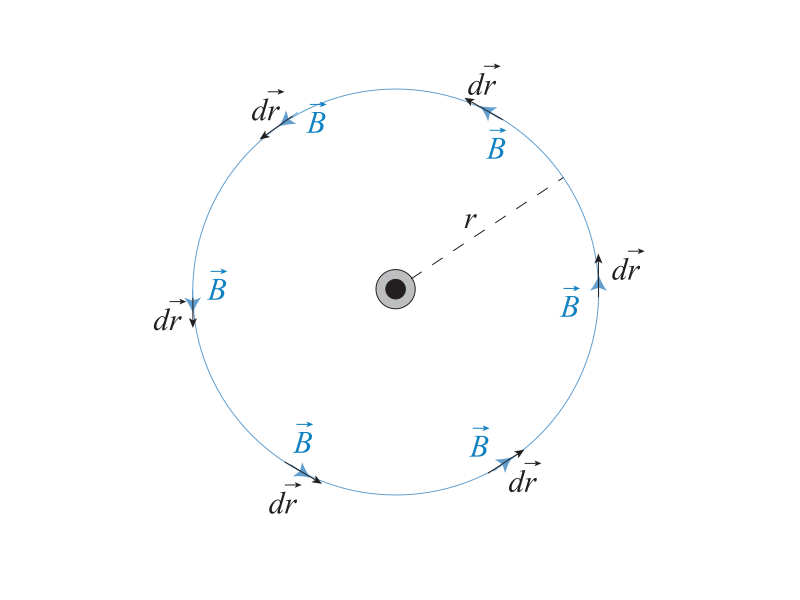
Figure 2: Magnetic field vectors for the rod.
From figure 2, we can see that the field and the line differential are always parallel (they both go counter-clockwise), and so the internal product \(\vec{B}\cdot d\vec{l}\) is simply
\begin{equation}
\vec{B}\cdot d\vec{l}=Bdl,
\end{equation}
where \(B\) is the magnitude of the magnetic field and \(dl\) the path differential. Using this result in equation \eqref{ampere}, we get
\begin{equation}
\label{ampere2}
B\oint_{C}dl=\mu_0I_{\text{enc}},
\end{equation}
where we have taken \(B\) outside the integral since it is constant along the path \(C\). The integral in equation \eqref{ampere2} is then just the length of the circle, that is,
\begin{equation}
\label{ampere3}
B(2\pi r)=\mu_0 I_{\text{enc}}.
\end{equation}
If the enclosed current is the current that passes through the cable \(I\), then equation \eqref{ampere3} becomes
\begin{equation}
\label{ampere4}
B2\pi r=\mu_0I.
\end{equation}
We can solve for \(B\) to get
\begin{equation}
B=\frac{\mu_0 I}{2\pi r}.
\end{equation}
We can now draw the direction of the magnetic field produced by each wire as shown in figure 3.

Figure 3: Magnetic fields for each wire.
Notice from figure 3 that over the X axis, the field is directed either upwards or downwards on the Y axis. To the right of each wire, the magnetic field generated by such wire points upwards. To the left of the wire, the magnetic field produced by the wire points downwards. This pattern can be summarized in the following expression for the magnetic field of any of the wires:
\begin{equation}
\vec{B}_i=\frac{\mu_0 I}{2\pi (x-x_i)}\,\hat{\textbf{j}},
\end{equation}
where the sub-index \(i\) is used to denote the \(i\)th wire, \(x_i\) is the position of the wire and \(x\) is an arbitrary coordinate over the X axis. If we label the wires from left to right with the numbers 1,2 and 3, we then have
\begin{equation}
\label{b1}
\vec{B}_1=\frac{\mu_0 I}{2\pi (x-x_1)}\,\hat{\textbf{j}},
\end{equation}
where \(x_1=0\,\text{m}\);
\begin{equation}
\label{b2}
\vec{B}_2=\frac{\mu_0 I}{2\pi (x-x_2)}\,\hat{\textbf{j}},
\end{equation}
where \(x_2=0.2\,\text{m}\);
\begin{equation}
\label{b3}
\vec{B}_3=\frac{\mu_0 I}{2\pi (x-x_3)}\,\hat{\textbf{j}},
\end{equation}
where \(x_3=0.4\,\text{m}\).
From the superposition principle, the total magnetic field at a point \(x\) is the sum of the fields produced by each wire. Hence, we can write
\begin{equation}
\vec{B}(x)=\vec{B}_1+\vec{B}_2+\vec{B}_3,
\end{equation}
\begin{equation}
\label{bx1}
\vec{B}(x)=\frac{\mu_0 I}{2\pi (x-x_1)}\,\hat{\textbf{j}}+\frac{\mu_0 I}{2\pi (x-x_2)}\,\hat{\textbf{j}}+\frac{\mu_0 I}{2\pi (x-x_3)}\,\hat{\textbf{j}}.
\end{equation}
The expression in equation \eqref{bx1} can be simplified to
\begin{equation}
\label{final}
\vec{B}(x)=\frac{\mu_0 I}{2\pi}\left(\frac{1}{x-x_1}+\frac{1}{x-x_2}+\frac{1}{x_3}\right)\,\hat{\textbf{j}}.
\end{equation}
b) To find the magnetic field at different positions, we must use \eqref{final} along with the numerical values in SI units. Doing that for each point, we get
\begin{equation}
\vec{B}(-0.1\,\text{m})=\frac{(4\pi\times10^{-7}\,\text{T m A}^{-1})(2\,\text{A})}{2\pi}\left(\frac{1}{-0.1\,\text{m}}+\frac{1}{-0.1\,\text{m}-0.2\,\text{m}}+\frac{1}{-0.1\,\text{m}-0.4\,\text{m}}\right)\,\hat{\textbf{j}},
\end{equation}
\begin{equation}
\vec{B}(-0.1\,\text{m})\approx -6.13\times 10^{-6}\,\text{T}\,\hat{\textbf{j}}.
\end{equation}
\begin{equation}
\vec{B}(0.1\,\text{m})=\frac{(4\pi\times10^{-7}\,\text{T m A}^{-1})(2\,\text{A})}{2\pi}\left(\frac{1}{0.1\,\text{m}}+\frac{1}{0.1\,\text{m}-0.2\,\text{m}}+\frac{1}{0.1\,\text{m}-0.4\,\text{m}}\right)\,\hat{\textbf{j}},
\end{equation}
\begin{equation}
\vec{B}(0.1\,\text{m})\approx -1.33\times 10^{-6}\,\text{T}\,\hat{\textbf{j}}.
\end{equation}
\begin{equation}
\vec{B}(0.3\,\text{m})=\frac{(4\pi\times10^{-7}\,\text{T m A}^{-1})(2\,\text{A})}{2\pi}\left(\frac{1}{0.3\,\text{m}}+\frac{1}{0.3\,\text{m}-0.2\,\text{m}}+\frac{1}{0.3\,\text{m}-0.4\,\text{m}}\right)\,\hat{\textbf{j}},
\end{equation}
\begin{equation}
\vec{B}(0.3\,\text{m})\approx 1.33\times 10^{-6}\,\text{T}\,\hat{\textbf{j}}.
\end{equation}
\begin{equation}
\vec{B}(0.5\,\text{m})=\frac{(4\pi\times10^{-7}\,\text{T m A}^{-1})(2\,\text{A})}{2\pi}\left(\frac{1}{0.5\,\text{m}}+\frac{1}{0.5\,\text{m}-0.2\,\text{m}}+\frac{1}{0.5\,\text{m}-0.4\,\text{m}}\right)\,\hat{\textbf{j}},
\end{equation}
\begin{equation}
\vec{B}(0.5\,\text{m})\approx 6.13\times 10^{-6}\,\text{T}\,\hat{\textbf{j}}.
\end{equation}
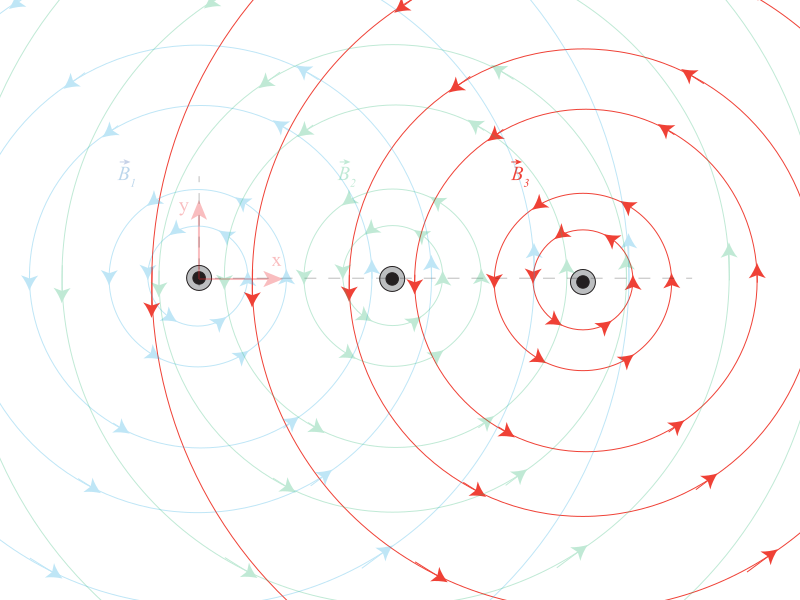
Figure 4: Another perspective illustrating the magnetic fields for each wire.
c) If the current in the wire located at \(x=0.4\,\text{m}\) is now reversed, the only thing we must do is change the sign in equation \eqref{bx1}, obtaining
\begin{equation}
\label{bx2}
\vec{B}(x)=\frac{\mu_0 I}{2\pi (x-x_1)}\,\hat{\textbf{j}}+\frac{\mu_0 I}{2\pi (x-x_2)}\,\hat{\textbf{j}}+\frac{\mu_0 (-I)}{2\pi (x-x_3)}\,\hat{\textbf{j}}.
\end{equation}

Figure 5: Magnetic fields for each wire when one of the current’s direction is opposite with respect to the other ones.
The expression above can be simplified to
\begin{equation}
\label{final2}
\vec{B}(x)=\frac{\mu_0 I}{2\pi}\left(\frac{1}{x-x_1}+\frac{1}{x-x_2}-\frac{1}{x_3}\right)\,\hat{\textbf{j}}.
\end{equation}
We can now calculate, again, the total magnetic field in this case for all the previous values of \(x\) just as we did in (b) but now using equation \eqref{final2}. Explicitly, we get
\begin{equation}
\vec{B}(-0.1\,\text{m})=\frac{(4\pi\times10^{-7}\,\text{T m A}^{-1})(2\,\text{A})}{2\pi}\left(\frac{1}{-0.1\,\text{m}}+\frac{1}{-0.1\,\text{m}-0.2\,\text{m}}-\frac{1}{-0.1\,\text{m}-0.4\,\text{m}}\right)\,\hat{\textbf{j}},
\end{equation}
\begin{equation}
\vec{B}(-0.1\,\text{m})\approx -4.53\times 10^{-6}\,\text{T}\,\hat{\textbf{j}}.
\end{equation}
\begin{equation}
\vec{B}(0.1\,\text{m})=\frac{(4\pi\times10^{-7}\,\text{T m A}^{-1})(2\,\text{A})}{2\pi}\left(\frac{1}{0.1\,\text{m}}+\frac{1}{0.1\,\text{m}-0.2\,\text{m}}-\frac{1}{0.1\,\text{m}-0.4\,\text{m}}\right)\,\hat{\textbf{j}},
\end{equation}
\begin{equation}
\vec{B}(0.1\,\text{m})\approx 1.33\times 10^{-6}\,\text{T}\,\hat{\textbf{j}}.
\end{equation}
\begin{equation}
\vec{B}(0.3\,\text{m})=\frac{(4\pi\times10^{-7}\,\text{T m A}^{-1})(2\,\text{A})}{2\pi}\left(\frac{1}{0.3\,\text{m}}+\frac{1}{0.3\,\text{m}-0.2\,\text{m}}-\frac{1}{0.3\,\text{m}-0.4\,\text{m}}\right)\,\hat{\textbf{j}},
\end{equation}
\begin{equation}
\vec{B}(0.3\,\text{m})\approx 9.33\times 10^{-6}\,\text{T}\,\hat{\textbf{j}}.
\end{equation}
And finally,
\begin{equation}
\vec{B}(0.5\,\text{m})=\frac{(4\pi\times10^{-7}\,\text{T m A}^{-1})(2\,\text{A})}{2\pi}\left(\frac{1}{0.5\,\text{m}}+\frac{1}{0.5\,\text{m}-0.2\,\text{m}}-\frac{1}{0.5\,\text{m}-0.4\,\text{m}}\right)\,\hat{\textbf{j}},
\end{equation}
\begin{equation}
\vec{B}(0.5\,\text{m})\approx -1.87\times 10^{-6}\,\text{T}\,\hat{\textbf{j}}.
\end{equation}

Leave A Comment