

A proton with speed \(v = 2 \times 10^{6} \, \text{m/s} \) enters a region with a 2.7 T magnetic field, as shown in the figure. Find the distance \(h\) so that the proton barely reaches the other side.
Find the magnetic force, and use Newton’s Second Law along with the circular motion equations to solve for the radius.
The magnetic force is:
\begin{equation*}
\vec{F}=q\vec{v}\times\vec{B},
\end{equation*}
and by Newton’s Second Law, we can write it as:
\begin{equation*}
qvB = ma.
\end{equation*}
The centripetal acceleration can be written as \(a = \frac{v^2}{R}\). The radius is precisely the maximum distance (\(R= h_{\text{max}}\). Solving for the distance, we get:
\begin{equation*}
h_{\text{max}} = \frac{mv}{qB},
\end{equation*}
or with numerical values:
\begin{equation*}
h_{\text{max}} \approx 7.72 \times 10^{-3} \, \text{m}.
\end{equation*}
For a more detailed explanation of any of these steps, click on “Detailed Solution”.
We need to find the distance between the plates so that the proton barely reaches the other side. In order to better understand what exactly this means, we must first find the proton’s trajectory when it is inside the region that has the magnetic field \(\vec{B}\). And to do that, we will use Lorentz force equation together with Newton’s second law. The Lorentz force is
\begin{equation}
\vec{F}=q\vec{v}\times\vec{B},
\end{equation}
where \(\vec{v}\) is the velocity of the particle and \(\vec{B}\) the magnetic field.
On the other hand, Newton’s second law states that the acceleration times the mass gives the total force over the object:
\begin{equation}
\sum \vec{F}=m\vec{a}.
\end{equation}
Since the Lorentz force is the only force exerted on the proton, then Newton’s second law yields
\begin{equation}
\label{lorentz}
m\vec{a}=q\vec{v}\times \vec{B},
\end{equation}
where \(m\) is the mass of the proton and \(q\) its charge.
From this last equation, we can see the the acceleration vector \(\vec{a}\) is always perpendicular to both the velocity \(\vec{{v}}\) and the magnetic field \(\vec{B}\) (the cross product between two vectors \(\vec{A}\) and \(\vec{B}\) always gives a vector perpendicular to both of the initial vectors). Because the magnitude of \(\vec{v}\) and \(\vec{B}\) is constant, and because the acceleration is perpendicular to the velocity at all points, we infer that the motion must be uniformly circular (notice that in a uniform circular motion, the velocity is always perpendicular to the velocity vector and since the circle is on the plane of the screen, then it is also perpendicular to the magnetic field that is going out of the screen). This is illustrated in figure 1.
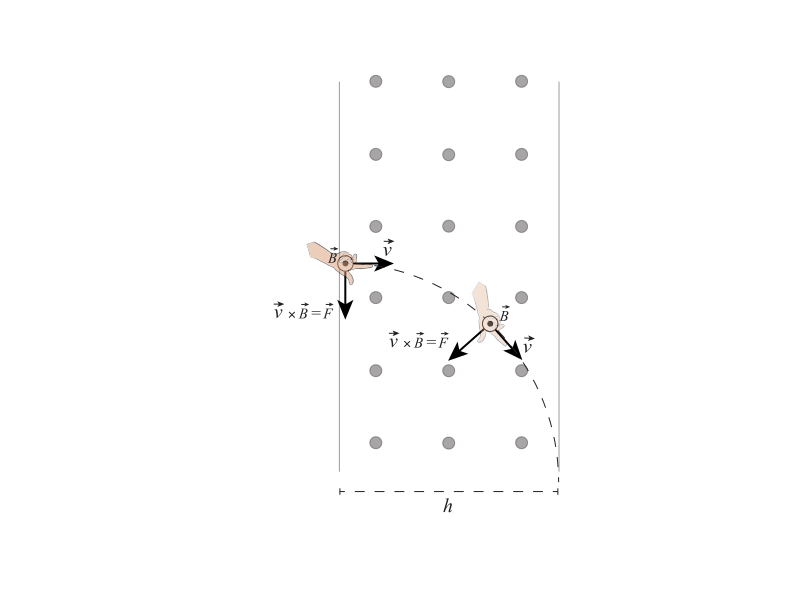
Figure 1: Circular trajectory described by the charged particle as it enters the region of non-zero magnetic field of width \(h\). The velocity \(\vec{v}\), magnetic field \(\vec{B}\) and force \(\vec{F}\) are all perpendicular.
Now, the key to the problem is to realize that if the plates are too close to one another, then the proton will not be able to turn in time, and will just crash against the right plate. If, on the other hand, the plates are too far away, then the proton will turn around way before getting close to the right plate. But we need the distance such that the proton barely turns around. This is illustrated in figure 2.
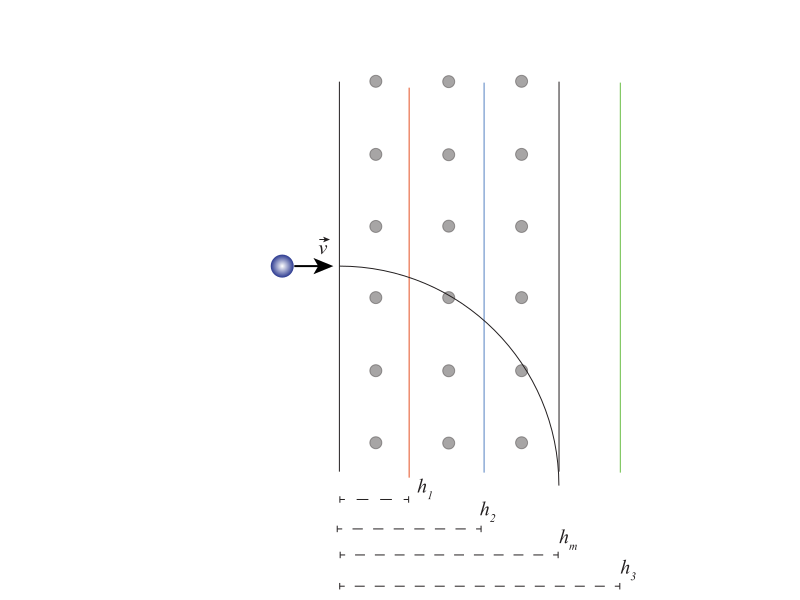
Figure 2: Illustration of different distances \(h\) at which the plates can be. Notice that if the plate is too close, as in \(h_1\), then the particle cannot turn on time. On the other hand, if the distance is too big, as with \(h_3\), then the particle turns too soon. Notice that \(h_m\) is the exact distance at which the particle barely turns.
Notice that in the case where the distance is \(h_m\), the radius of the circular trajectory \(R\) is just \(h\). Then, we can write
\begin{equation}
\label{hmax}
h_{\text{max}}=R.
\end{equation}
Thus, if we find the radius of the circular trajectory we can find \(h_m\). If we focus only on the magnitude of equation \eqref{lorentz}, we can write
\begin{equation}
\label{lorentz2}
ma=qvB\sin(\theta),
\end{equation}
where \(\theta\) is the angle between the vectors \(\vec{v}\) and \(\vec{B}\). At all points of the trajectory this angle is \(90^{\circ}\) (the vectors are perpendicular) and \(\sin(90^{\circ})=1\). Hence, we can write equation \eqref{lorentz2} as
\begin{equation}
\label{lorentz3}
ma=qvB.
\end{equation}
Because the trajectory is uniformly circular, the acceleration is the centripetal acceleration. Its magnitude depends on the velocity \(v\) and radius \(R\), as expressed here
\begin{equation}
\label{centripetal}
a=\frac{v^2}{R}.
\end{equation}
Using this expression for \(a\) into equation \eqref{lorentz3}, we obtain
\begin{equation}
\label{lorentz4}
m\frac{v^2}{R}=qvB.
\end{equation}
Solving for \(R\), we get
\begin{equation}
R=m\frac{v^2}{qvB},
\end{equation}
which can be simplified to
\begin{equation}
R=\frac{mv}{qB}.
\end{equation}
Using equation \eqref{hmax}, we can then write an explicit expression for \(h_m\) such that the proton barely hits the plate:
\begin{equation}
h_{\text{m}}=\frac{mv}{qB}.
\end{equation}
Using the numerical values, we get
\begin{equation}
h_{\text{m}}=\frac{(1.67\times 10^{-27}\,\text{kg})(2\times 10^{6}\,\text{m/s})}{(1.602\times 10^{-19}\,\text{C})(2.7\,\text{T})},
\end{equation}
\begin{equation}
h_{\text{max}}\approx 7.72\times 10^{-3}\,\text{m}=7.72\,\text{mm}.
\end{equation}

Leave A Comment