
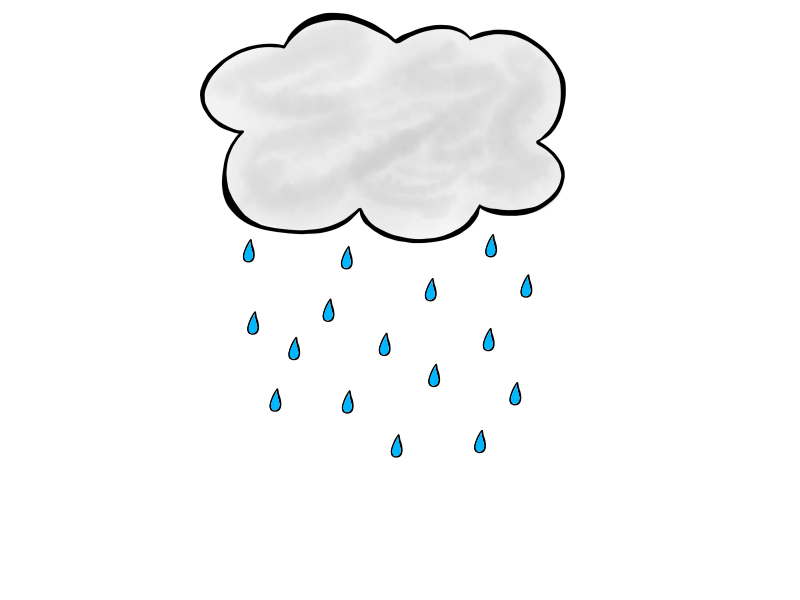
The mass of an average raindrop is about 30 mg. Rain clouds are roughly 60,000 ft (18.3 km) high.
a) Calculate the speed of a raindrop just before touching the ground assuming air resistance is negligible.
b) In reality, air resistance is not negligible and should be taken into account. If the terminal speed of a raindrop is generally close to \(5 \,\text{m}/\text{s}\), how much mechanical energy usually decreases due to air resistance?
a) Apply Conservation of Energy to solve for the velocity.
b) The mechanical energy is \({not}\) conserved in this case. You need to consider the work done by other forces which may dissipate the mechanical energy.
a) The Law of Conservation of Energy can be written as:
\begin{equation*}
mgh=\frac{1}{2}mv^2.
\end{equation*}
Solving for \(v\), we get:
\begin{equation*}
v=\sqrt{2gh}.
\end{equation*}
Plugging in numerical values, we finally get:
\begin{equation*}
v\approx 600\,\text{m/s}.
\end{equation*}
b) Including the work done by other forces, the equation can be written as:
\begin{equation*}
E_f=E_i+W_{f},
\end{equation*}
where \(E_f = \frac{1}{2}mv^2\) and \(E_i = mgh\). Solving for \(W_f\) with numerical values gives us:
\begin{equation}
W_{f} \approx -5.38 \, \text{J}.
\end{equation}
For a more detailed explanation of any of these steps, click on “Detailed Solution”.
a) To find the speed of the raindrop just before touching the ground, we will use the conservation of mechanical energy. In this case, the only relevant force will be gravity because we are ignoring the air friction, and so we know that the mechanical energy is conserved (the weight is a conservative force). At the beginning of its motion, the drop only has potential gravitational energy, and no kinetic energy because it is not moving. Then, the expression for the initial mechanical energy is
\begin{equation}
\label{ei}
E_i=mgh,
\end{equation}
where \(m\) is the mass of the droplet, \(g=9.8\,\text{m/s}^2\) the gravitational acceleration on Earth and \(h=18.3\,\text{km}=18300\,\text{m}\) the initial height of the drop, as illustrated in figure 1.

Figure 1: Illustration of the trajectory followed by one raindrop. The coordinate system is placed on the ground such that the initial position of the raindrop along the Y-axis is \(h\).
The mechanical energy when the drop touches the ground is purely kinetic because it has a non-zero speed, and its height is zero. For the mechanical energy, we can then write, for the moment just before the drop hits the ground, the following:
\begin{equation}
\label{ef}
E_f=\frac{1}{2}mv^2,
\end{equation}
where \(v\) is the drop’s speed at that point. The conservation of mechanical energy allows us to write
\begin{equation}
E_i=E_f,
\end{equation}
and explicitly, using the expressions of equations \eqref{ei} and \eqref{ef}, we can write
\begin{equation}
mgh=\frac{1}{2}mv^2.
\end{equation}
Cancelling out the mass \(m\), we obtain
\begin{equation}
gh=\frac{1}{2}v^2.
\end{equation}
We can solve for the speed \(v\) as follows:
\begin{equation}
v^2=2gh.
\end{equation}
Now take the square-root on both sides to get
\begin{equation}
v=\sqrt{2gh}.
\end{equation}
Using the numerical values, we finally get
\begin{equation}
v=\sqrt{2(9.8\,\text{m/s}^2)(18300\,\text{m})},
\end{equation}
\begin{equation}
v\approx 600\,\text{m/s},
\end{equation}
which is almost twice the speed of sound in the air! This is not plausible, so in the next point we will calculate the work done by the friction force that makes the drop reach a terminal velocity.
b) If we now include friction due to the interaction of the raindrop with the air, we know that the friction is a non-conservative force, meaning that it will change the mechanical energy of the drop (the mechanical energy of the drop will no longer be conserved). In particular, the final mechanical energy of the drop will be the same as the initial mechanical energy plus all the work (energy) added or subtracted by the non-conservative forces acting on the drop. In this case, the only non-conservative force is friction, and so we can write
\begin{equation}
E_f=E_i+W_{f}.
\end{equation}
Notice that since the work of friction is negative (because the friction is anti-parallel to the displacement), then \(W_{f}\) will be negative and so \(E_f\) will be less than \(E_i\). If we solve for the work by friction, we get
\begin{equation}
W_{f}=E_f-E_i.
\end{equation}
Now we can still use the same expressions for the initial and final energies \(E_i\) and \(E_f\) found earlier (the expressions for the potential and kinetic energies), to obtain
\begin{equation}
W_{f}=\frac{1}{2}mv^2-mgh.
\end{equation}
Using the numerical values in SI units (\(m=30\,\text{mg}=3\times 10^{-5}\,\text{kg}\)), we obtain
\begin{equation}
W_{f}=\frac{1}{2}(3\times 10^{-5})(5\,\text{m/s})^2-(3\times 10^{-5})(9.8\,\text{m/s}^2)(18300\,\text{m}),
\end{equation}
\begin{equation}
W_{f}\approx -5.38\,\text{J}.
\end{equation}
As we expected, the result of the work done by the friction is negative, because the friction opposes the direction of motion. The magnitude \(5.38\,\text{J}\) of this work gives us the energy lost due to friction. Because the terminal speed and the speed obtained ignoring friction differ by two orders of magnitude, we can see how important it is to take into account air friction when modeling the behavior of a drop. And notice that the amount of energy lost as the raindrop falls due to friction is roughly the same amount of energy released by the explosion of 1 gram of TNT.


Leave A Comment