

A machine used in an assembly line exerts different forces (see figure) on a 50 kg metal piece that moves parallel to the direction of the force.
Calculate the work done by the machine between the following points:
a) \(x=0 \,\text{m}\) and \(x=5 \,\text{m}\).
b) \(x=5 \,\text{m}\) and \(x=8 \,\text{m}\).
c) \(x=8 \,\text{m}\) and \(x=12 \,\text{m}\).
d) \(x=12 \,\text{m}\) and \(x=15 \,\text{m}\).
e) \(x=0 \,\text{m}\) and \(x=15 \,\text{m}\).
Assume the piece is at rest when is at \(x=0 \,\text{m}\). Using the work-energy theorem, calculate the speed of the metal piece at the following points:
f) \(x=8 \,\text{m}\).
g) \(x=12 \,\text{m}\).
h) \(x=15 \,\text{m}\).
For parts (a), (b), (c), and (d), the area under the curve will give you the work done.
For part (e), this is the accumulated area. You already found the work.
For parts (f), (g), and (h), you already know each work done, so you can use the Work-Energy Theorem to calculate the final velocity in each case.
a) The integral form of the work done is:
\begin{equation*}
W_{x_i\to x_f}=\int_{x_i}^{x_f}F_x\,dx,
\end{equation*}
where, according to a force vs. displacement graph, means that the work can be found from the area under the curve. Geometrically, it is easy to find any area by breaking up the shape into rectangles and triangles, and considering the sign by checking if the shape is placed on the positive \({x-}\)axis or the negative \({x-}\)axis.
From \(x=0\,\text{m}\) to \(x=5\,\text{m}\), there is a triangle. Then:
\begin{equation*}
W_{0\to5}=\frac{(5\,\text{m}-0\,\text{m})20\,\text{N}}{2}=50\,\text{J}.
\end{equation*}
b) From \(x=5\,\text{m}\) to \(x=8\,\text{m}\) there is a rectangle. Then:
\begin{equation*}
W_{5\to8}=(8\,\text{m}-5\,\text{m})20\,\text{N}=60\,\text{J}.
\end{equation*}
c) From \(x=8\,\text{m}\) to \(x=12\,\text{m}\) there are two triangles. Then:
\begin{equation*}
W_{8\to12}=\frac{(10\,\text{m}-8\,\text{m})20\,\text{N}}{2}+\frac{(12\,\text{m}-10\,\text{m})(-20\,\text{N})}{2}=0\,\text{J}.
\end{equation*}
d) From \(x=12\,\text{m}\) to \(x=15\,\text{m}\) there is only one triangle. Then:
\begin{equation*}
W_{12\to15}=\frac{(15\,\text{m}-12\,\text{m})(-20\,\text{N})}{2}=-30\,\text{J}.
\end{equation*}
e) From \(x=0\,\text{m}\) to \(x=15\,\text{m}\), it is easy to sum the works found in each previous part. This summation gives:
\begin{equation*}
W_{0\to15}=80\,\text{J}.
\end{equation*}
f) Use the Work-Energy Theorem (\( W = \Delta K\)) to solve for \(v_f\), considering that \(v_i=0\) in \(x=0\). This gives us the following relationship:
\begin{equation*}
v_f=\sqrt{\frac{2W_{0\to x_f}}{m}}.
\end{equation*}
The work done from \(x=0\,\text{m}\) to \(x=8\,\text{m}\) is \(110\, \text{J}\). Therefore, the speed at \(x_f = 8 \, \text{m}\) is:
\begin{equation*}
v_f \approx 2.1 \, \text{m/s}.
\end{equation*}
g) The work done from \(x=0\,\text{m}\) to \(x=12\,\text{m}\) is \(110\, \text{J}\) too. Therefore, the speed at \(x_f = 12 \, \text{m}\) is also:
\begin{equation*}
v_f \approx 2.1 \, \text{m/s}.
\end{equation*}
h) The work done from \(x=0\,\text{m}\) to \(x=15\,\text{m}\) is \(80\, \text{J}\). Therefore, the speed at \(x_f = 15 \, \text{m}\) is:
\begin{equation*}
v_f \approx 1.8 \, \text{m/s}.
\end{equation*}
(a) To calculate the work \(W\) between any two points \(x_i\) and \(x_f\), we must use the fact that the work performed by a force is given by the area enclosed by the force curve in a force vs displacement plot. More specifically, the work by a force along a displacement along the X axis is defined as
\begin{equation}
W_{x_i\to x_f}=\int_{x_i}^{x_f}F_x\,dx,
\end{equation}
where \(F_x\) is the force applied along the X axis. This integral equals the area under the curve given on the graph \(F\) vs \(x\), where the area is taken positive for \(F>0\) and negative for \(F<0\). From \(x=0\,\text{m}\) to \(x=5\,\text{m}\), we have to find the area of the triangle of height \(20\,\text{N}\) and base \((5\,\text{m}-0\,\text{m})\) as shown in figure 1.
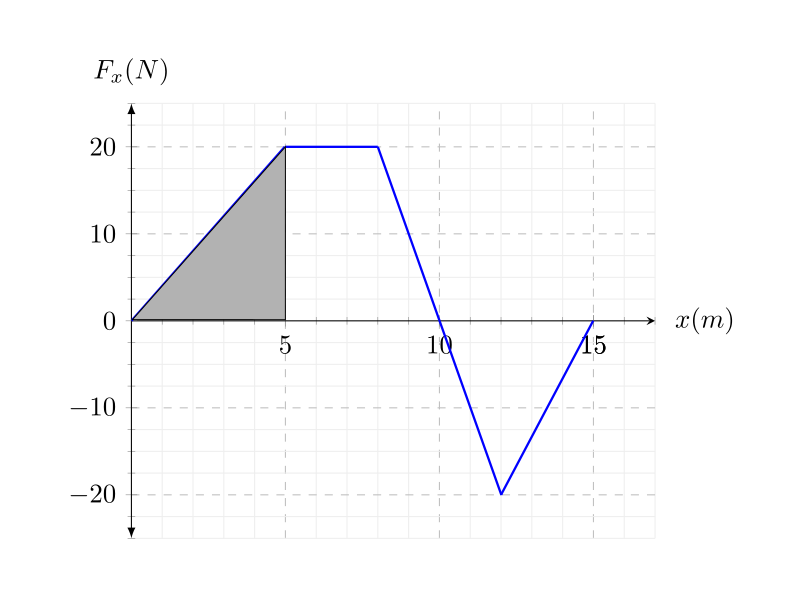
Figure 1: The work for the first segment corresponds to the area of the triangle in gray.
Explicitly, the area in question is
\begin{equation}
\label{w05}
W_{0\to5}=\frac{(5\,\text{m}-0\,\text{m})20\,\text{N}}{2}=50\,\text{J}.
\end{equation}
(b) From \(x=5\,\text{m}\) to \(x=8\,\text{m}\), we must find the area of the rectangle of base \((8\,\text{m}-5\,\text{m})\) and height \(20\,\text{N}\), illustrated in figure 2.
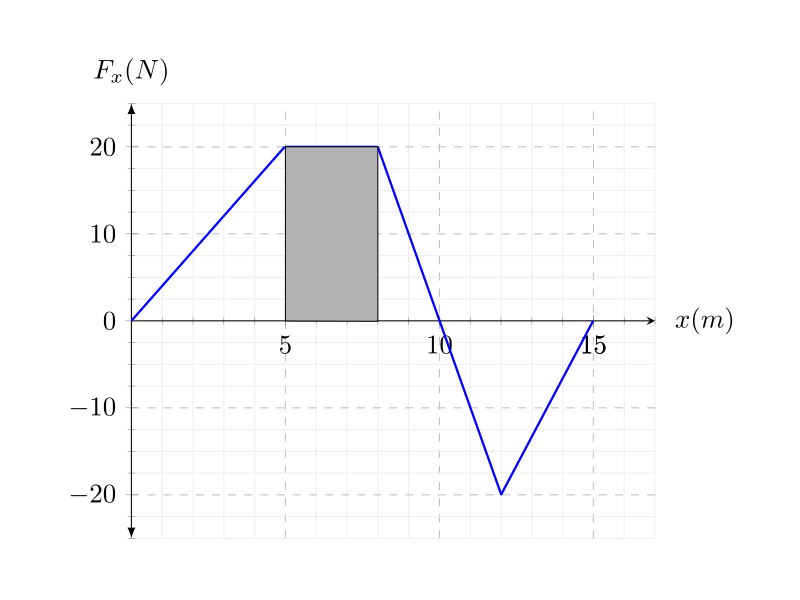
Figure 2: The work for the second segment corresponds to the area of the rectangle in gray.
This area is clearly given by
\begin{equation}
\label{w58}
W_{5\to8}=(8\,\text{m}-5\,\text{m})20\,\text{N}=60\,\text{J}.
\end{equation}
(c) From \(x=8\,\text{m}\) to \(x=12\,\text{m}\) we must find the area of two triangles: the first, from \(x=8\,\text{m}\) to \(x=10\,\text{m}\), and the second from \(x=10\,\text{m}\) to \(x=12\,\text{m}\). These two triangles are shown in figure 3 and 4.

Figure 3: This is the first triangle we need to find the area for the work on this segment.
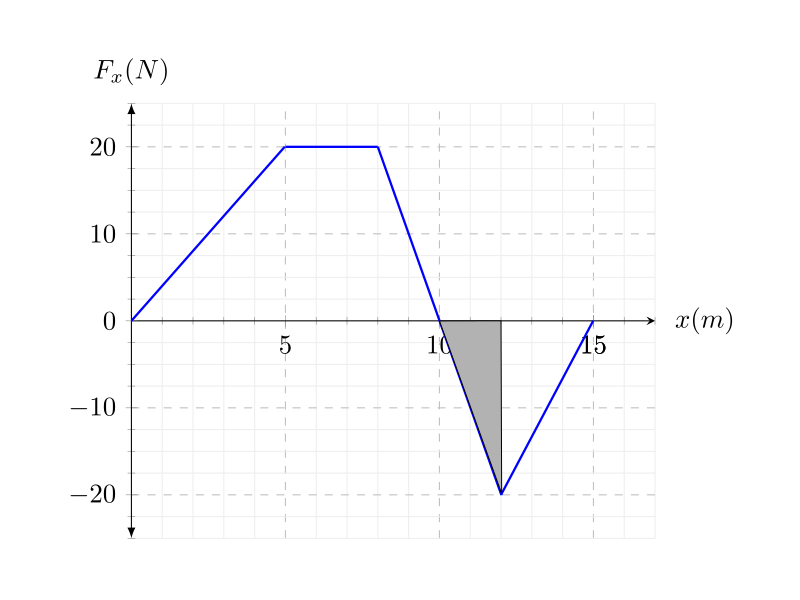
Figure 4: This is the second triangle we need to find the area for. The total work for this segment will be the sum of the area of both triangles
The work is then the sum of the areas, taking into account that the first is positive and the second is negative. The first triangle has a height of \(20\,\text{N}\) and a base of \((10\,\text{m}-8\,\text{m})\). The second triangle has a height of \(-20\,\text{N}\) and a base of \((12\,\text{m}-10\,\text{m})\). Hence the work between \(x=8\,\text{m}\) and \(x=12\,\text{m}\) is
\begin{equation}
\label{w812}
W_{8\to12}=\frac{(10\,\text{m}-8\,\text{m})20\,\text{N}}{2}+\frac{(12\,\text{m}-10\,\text{m})(-20\,\text{N})}{2}=0\,\text{J}.
\end{equation}
(d) From \(x=12\,\text{m}\) to \(x=15\,\text{m}\), we must find the area of the triangle of base \((15\,\text{m}-12\,\text{m})\) and height \(-20\,\text{N}\) shown in figure 5.

Figure 5: The area of this triangle will be the work performed during this last segment
\begin{equation}
\label{w1215}
W_{12\to15}=\frac{(15\,\text{m}-12\,\text{m})(-20\,\text{N})}{2}=-30\,\text{J}.
\end{equation}
(e) To find the total work from \(x=0\,\text{m}\) to \(x=15\,\text{m}\), we can sum all the previous works, which is equivalent to summing all the areas under the curve between \(x=0\,\text{m}\) and \(x=15\,\text{m}\). Explicitly, the total area is
\begin{equation}
W_{0\to15}=W_{0\to5}+W_{5\to8}+W_{8\to12}+W_{12\to15},
\end{equation}
which, after using the explicit expressions given by equations \eqref{w05}, \eqref{w58}, \eqref{w812} and \eqref{w1215}, becomes
\begin{equation}
\label{w015}
W_{0\to 15}=50\,\text{J}+60\,\text{J}+0\,\text{J}+(-30\,\text{J})=80\,\text{J}.
\end{equation}
(f) The work energy-theorem relates the total work done on a particle with its change in kinetic energy \(K\) via the expression
\begin{equation}
\label{workenergy}
W_{x_i\to x_f}=K_f-K_i,
\end{equation}
where \(K_i\) and \(K_f\) are the kinetic energies at positions \(x_i\) and \(x_f\) respectively. The expression for the kinetic energy in terms of mass \(m\) and speed \(v\) is
\begin{equation}
K=\frac{1}{2}mv^2.
\end{equation}
Thus equation \eqref{workenergy} can be written then
\begin{equation}
W_{x_i\to x_f}=\frac{1}{2}mv_f^2-\frac{1}{2}mv_i^2.
\end{equation}
Since at \(x_i=0\,\text{m}\) the speed is \(v_i=0\,\text{m/s}\), we can then write
\begin{equation}
W_{0\to x_f}=\frac{1}{2}mv_f^2.
\end{equation}
Now solve for the speed at \(x_f\),
\begin{equation}
v_f^2=\frac{2W_{0\to x_f}}{m},
\end{equation}
and take the square-root on both sides to get
\begin{equation}
\label{vf}
v_f=\sqrt{\frac{2W_{0\to x_f}}{m}}.
\end{equation}
For this case \(x_f=8\,\text{m}\). Thus, in order to find the speed at this point we must find \(W_{0\to8}\) . The work done from \(0\,\text{m}\) to \(8\,\text{m}\) is then given by the following sum
\begin{equation}
W_{0\to8}=W_{0\to5}+W_{5\to 8},
\end{equation}
which, after using the numerical values given in equations \eqref{w05} and \eqref{w58}, yields
\begin{equation}
W_{0\to 8}=50\,\text{J}+60\,\text{J}=110\,\text{J}.
\end{equation}
We can then use equation \eqref{vf} to get
\begin{equation}
v_8=\sqrt{\frac{2W_{0\to8}}{m}},
\end{equation}
where \(v_8\) is the speed at \(x_f=8\,\text{m}\). Using the numerical values, we have
\begin{equation}
v_8=\sqrt{\frac{2(110\,\text{J})}{50\,\text{kg}}},
\end{equation}
\begin{equation}
v_8\approx 2.1 \,\text{m/s}.
\end{equation}
(g) In this case \(x_f=12\,\text{m}\). In order to find the speed at this point, we must find \(W_{0\to12}\) . The work done from \(0\,\text{m}\) to \(12\,\text{m}\) is then the following sum:
\begin{equation}
W_{0\to12}=W_{0\to5}+W_{5\to 8}+W_{8\to 12},
\end{equation}
which after using the numerical values given in equations \eqref{w05}, \eqref{w58} and \eqref{w812}, becomes
\begin{equation}
W_{0\to 8}=50\,\text{J}+60\,\text{J}+0\,\text{J}=110\,\text{J}.
\end{equation}
We can then use equation \eqref{vf} to get
\begin{equation}
v_{12}=\sqrt{\frac{2W_{0\to12}}{m}},
\end{equation}
where \(v_{12}\) is the speed at \(x_f=12\,\text{m}\). Using the numerical values, we have
\begin{equation}
v_{12}=\sqrt{\frac{2(110\,\text{J})}{50\,\text{kg}}},
\end{equation}
\begin{equation}
v_{12}\approx 2.1 \,\text{m/s}.
\end{equation}
(h) Now we have \(x_f=15\,\text{m}\). We must use the result for \(W_{0\to15}\) in order to find the speed at this point. We can then use equation \eqref{vf} to get
\begin{equation}
v_{15}=\sqrt{\frac{2W_{0\to15}}{m}},
\end{equation}
where \(v_{15}\) is the speed at \(x_f=15\,\text{m}\). Using the numerical value for \(W_{0\to15}\) given by equation \eqref{w015}, we get
\begin{equation}
v_{12}=\sqrt{\frac{2(80\,\text{J})}{50\,\text{kg}}},
\end{equation}
\begin{equation}
v_{12}\approx 1.8 \,\text{m/s}.
\end{equation}


Leave A Comment