

Two long straight wires carry currents of \(10 \ A\) (vertically) and \(20 \ A\) (horizontally), as shown in the figure. Find the magnitude and direction of the total magnetic field at points A, B, C, and D.
Use Ampere’s Law to solve for the magnetic field around each wire. The distances will determine the magnitude of the magnetic field, and the right-hand-rule will determine, by superposition, if the fields should add or subtract.
Ampere’s Law states:
\begin{equation*}
\oint \vec{B} \cdot d \vec{r} = \mu_0 I_c,
\end{equation*}
where the right-hand side of the equation becomes \(B2 \pi r\), and the enclosed current is \(I_c\). Solving for \(B\), we get:
\begin{equation*}
B = \frac{\mu_0 I_c}{2 \pi r}.
\end{equation*}
By the right-hand-rule, the fields for each point become:
\begin{equation*}
\vec{B}_A = – B_{1,A} \hat{k} + B_{2,A} \hat{k},
\end{equation*}
\begin{equation*}
\vec{B}_B = + B_{1,B} \hat{k} + B_{2,B} \hat{k},
\end{equation*}
\begin{equation*}
\vec{B}_C = + B_{1,C}\hat{k} – B_{2,C}\hat{k},
\end{equation*}
\begin{equation*}
\vec{B}_D = – B_{1,D}\hat{k} – B_{2,D}\hat{k}.
\end{equation*}
With the magnetic field found using Ampere’s Law, we can write the magnetic fields for each point as:
\begin{equation*}
\vec{B}_A =\frac{\mu_0}{2\pi} \left(-\frac{i_1}{r_{1,A}} +\frac{i_2}{r_{2,A}}\right)\hat{k},
\end{equation*}
\begin{equation*}
\vec{B}_B =\frac{\mu_0}{2\pi} \left(+\frac{i_1}{r_{1,B}} +\frac{i_2}{r_{2,B}}\right)\hat{k},
\end{equation*}
\begin{equation*}
\vec{B}_C =\frac{\mu_0}{2\pi} \left(+\frac{i_1}{r_{1,C}} -\frac{i_2}{r_{2,C}}\right)\hat{k},
\end{equation*}
\begin{equation*}
\vec{B}_D =\frac{\mu_0}{2\pi} \left(-\frac{i_1}{r_{1,D}} -\frac{i_2}{r_{2,D}}\right)\hat{k}.
\end{equation*}
Plugging in numerical values yields:
\begin{equation*}
\vec{B}_A = + 1.50 \ \mu \text{T}\,\hat{k},
\end{equation*}
\begin{equation*}
\vec{B}_B = + 2.33 \ \mu \text{T}\,\hat{k},
\end{equation*}
\begin{equation*}
\vec{B}_C = 0 \ \mu \text{T}\,\hat{k},
\end{equation*}
\begin{equation*}
\vec{B}_D = – 1.50 \ \mu \text{T}\,\hat{k}.
\end{equation*}
For a more detailed explanation of any of these steps, click on “Detailed Solution”.
Our strategy for finding the magnitude and direction of the magnetic field at different points is simple: first, we will need to find the magnetic field produced by any long straight wire carrying a constant current; then, we will apply that result to the configuration of the two wires separately, in order to get the different directions and magnitudes of the magnetic field produced by each wire; and finally, we can use the superposition principle and add the contributions of both wires to get the final answer for the magnetic field at each point.
Let’s then first consider a long, straight wire carrying a current \(I\). First, we will use the fact that the magnetic field lines always go in circles around a straight wire, and the direction can be obtained from the right-hand rule. In particular, point the thumb of your right hand in the direction of the current, and then wrap the wire with the other fingers. The way in which your fingers are wrapped determines the direction of the field around the wire, as illustrated in figure 1.
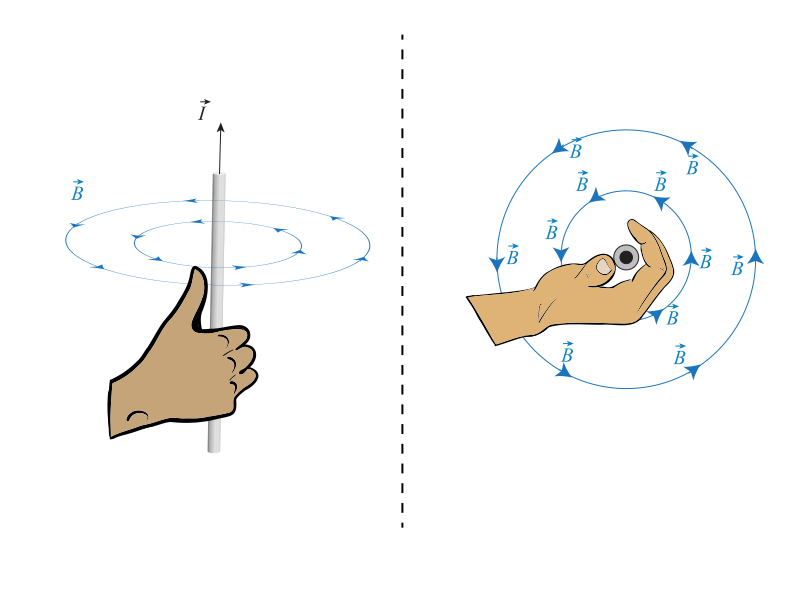
Figure 1: On the left: Magnetic field lines \(\vec{B}\) produced by a wire with current \(\vec{I}\). Notice that we use the right-hand rule to find the direction of the magnetic field. If you place the thumb of your right hand in the direction of the current and wrap the wire with the other fingers, then the direction in which the other fingers point indicate whether the magnetic field is clockwise or counter-clockwise. On the right: A view from above, with the current flowing out of the screen. Notice that the magnetic field is counter-clockwise
Notice from figure 1 that each circle of radius \(r\) has magnetic field lines of constant magnitude, always pointing in the tangential direction (always pointing counter-clockwise). Now, the right-hand rule gave us the direction, but to find the magnitude of the field we will use Ampère’s Law, which is given by
\begin{equation}
\label{ampere1}
\oint \vec{B} \cdot d \vec{r} = \mu_0 I_c.
\end{equation}
This integral is a path integral along a closed path P that encloses a current \(I_c\). Here, \(d \vec{r}\) is a differential length element that points along the path of integration and \(\mu_0\) is the permeability constant (also known as the ‘magnetic constant’). In other words, the equation tells us that the magnetic field along a given closed path, no matter the shape of the path, is proportional to the current that the path encloses. Hence, we can use this equation to find the magnetic field, provided we know the current.
In this case, we can easily perform the integration because of the symmetry of the magnetic field, which always goes in circles, as explained before. In order to perform the integration, we first need to choose a path. Clearly, we want a path such that \(\vec{B} \cdot d \vec{r}\) (the term to be integrated) is as simple as possible. So in our case, we choose the path of integration to be a circle of radius \(r\) around the cable. As we can see in figure 2, this path is convenient because the field \(\vec{B}\) and the path differential \(d \vec{r}\) are always parallel to one another:
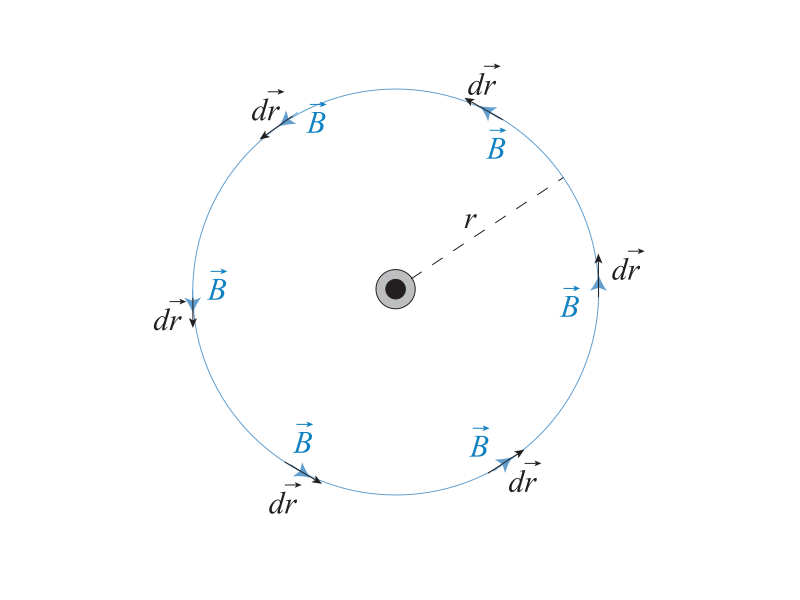
Figure 2: To apply Ampère’s Law, we choose as a path a circle that encloses the cable (the current) at its middle point. Notice that this path guarantees that the magnetic field vector is always (at any point on the circle) parallel to the line differential \(d \vec{r}\) (since they are parallel, and since the magnetic field has the same magnitude all around the circle, then the product \(\vec{B} \cdot d \vec{r}\) is a constant that can be written as \(Bdr\)).
Thus, Ampère’s Law becomes
\begin{equation}
\label{ampere2}
\oint \vec{B} \cdot d \vec{r} = \oint B dr = B \oint dr = \mu_0 I_c,
\end{equation}
where we used the fact that that the current enclosed by this circle is \(I_c\), and where we also took \(B\) out of the integration because it is constant at any point around the circle. Finally, all we need to compute is \(\oint dr \), which is the path integral of the line differential along the circle. In other words, this integration corresponds the total length of the path in question (if you add all the line differentials of a path, you end up with the total length of that path). Hence
\begin{equation}
\label{ampere2b}
B \oint dr = B2\pi r,
\end{equation}
given that the total path is just the longitude of the circular path. Thus
\begin{equation}
\label{ampere3}
B 2 \pi r = \mu_0 I_c,
\end{equation}
and solving for B, we get
\begin{equation}
\label{wirefield1}
B = \frac{\mu_0 I_c}{2 \pi r}.
\end{equation}
We have then found the magnitude of the wire’s magnetic field at a distance \(r\). Given that we now know the direction and the magnitude of the field produced by a wire at some distance \(r\), we can then use these results to the problem at hand.
Let us then focus on the vertical wire that carries a current \(i_1 = 10 \ \text{A}\). Figure 3 shows the magnetic field produced by this wire, using the right-hand rule as explained earlier. For example, at point A, the field produced by wire 1 goes into the screen (represented with a cross), while at point B the field of that same cable goes outside the screen (represented with a dot):
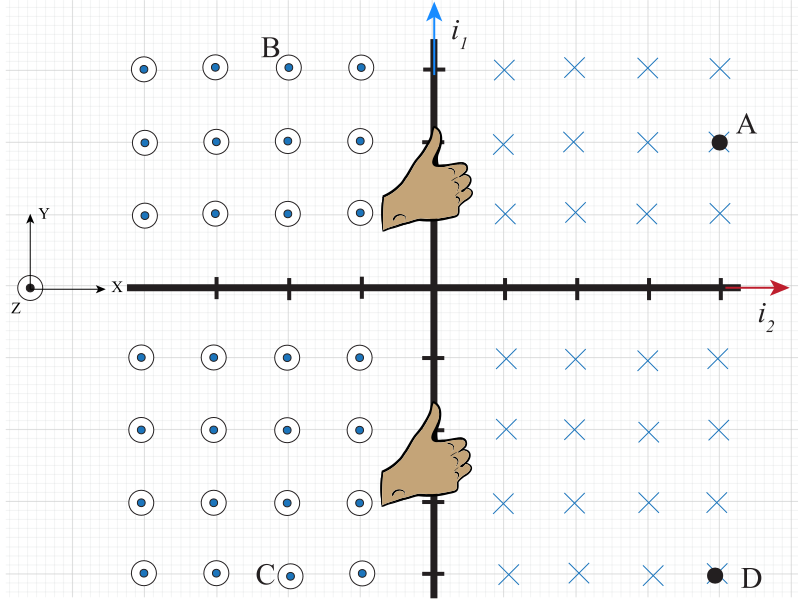
Figure 3: Magnetic field lines produced by the vertical cable carrying a current \(i_1\). The dot indicates that the magnetic field comes out of the screen while the cross indicates that the magnetic field enters the screen. The field in question goes along circles, just as in figure 1, but here we only see a cross-sectional area. We also have indicated a coordinate system where X points to the right, Y upwards and Z out of the screen.
Similarly, for the other wire, we also apply the right-hand rule and obtain the following field (see figure 4).
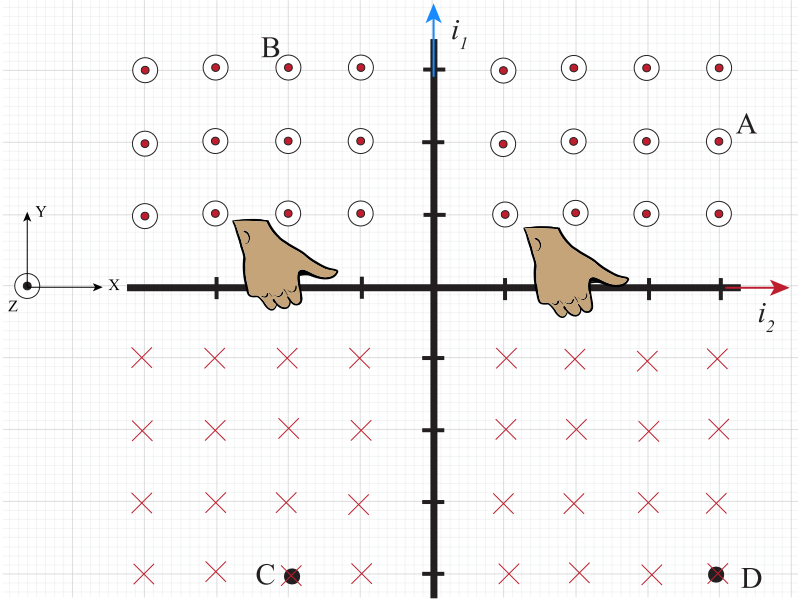
Figure 4: Magnetic field lines produced by the horizontal cable carrying a current \(i_2\). The dot indicates that the magnetic field comes out of the screen while the cross indicates that the magnetic field enters the screen. Again, the field goes along circles, this time centered around the horizontal cable.
Because of the superposition principle, one can always find the total magnetic field produced by different objects by summing the magnetic field produced by each object individually. Hence, the total magnetic field is given by the sum of the magnetic fields produced by each wire. Pictorially, we get something like this

Figure 5: Magnetic field lines produced by both cables. The dot indicates that the magnetic field comes out of the screen while the cross indicates that the magnetic field enters the screen. In the region where points A and C are found, we have a superposition of opposing magnetic fields (the field lines of one wire are going out of the screen while the field lines of the other wire are going into the screen, and so we have crosses and circles superposed to one another).
Choosing a cartesian coordinate system as shown in figure 5, we can then calculate the total magnetic field at each point (taking into account that the magnetic field is either positive in Z if it goes outside the screen or negative in Z if it goes inside the screen):
\begin{equation}
\vec{B}_A = \vec{B}_{1,A} + \vec{B}_{2,A} = – B_{1,A} \hat{k} + B_{2,A} \hat{k},
\end{equation}
\begin{equation}
\vec{B}_B = \vec{B}_{1,B} + \vec{B}_{2,B} = + B_{1,B} \hat{k} + B_{2,B} \hat{k},
\end{equation}
\begin{equation}
\vec{B}_C = \vec{B}_{1,C} + \vec{B}_{2,C} = + B_{1,C}\hat{k} – B_{2,C}\hat{k},
\end{equation}
\begin{equation}
\vec{B}_D = \vec{B}_{1,D} + \vec{B}_{2,D} = – B_{1,D}\hat{k} – B_{2,D}\hat{k}.
\end{equation}
To calculate each particular field, we use our deduced formula \eqref{wirefield1}, replacing the respective current and distance, as shown in figure 6.
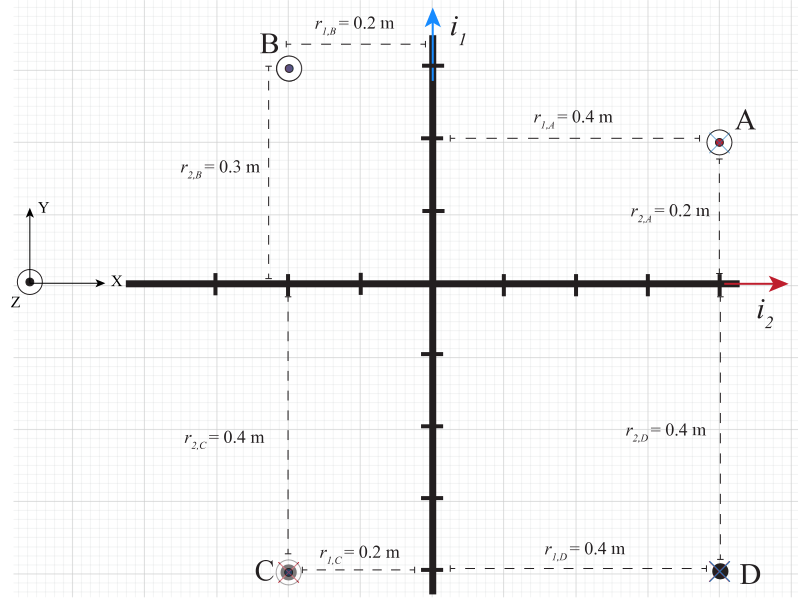
Figure 6: Distance from the vertical and horizontal cable to the points A,B,C and D.
Using the distances in figure 6, we can use equation \eqref{wirefield1} to write the magnetic field at the different points as follows:
\begin{equation}
\vec{B}_A = -\frac{\mu_0 i_1}{2\pi r_{1,A}}\hat{k} +\frac{\mu_0 i_2}{2\pi r_{2,A}}\hat{k},
\end{equation}
\begin{equation}
\vec{B}_B = +\frac{\mu_0 i_1}{2\pi r_{1,B}}\hat{k} +\frac{\mu_0 i_2}{2\pi r_{2,B}}\hat{k},
\end{equation}
\begin{equation}
\vec{B}_C = +\frac{\mu_0 i_1}{2\pi r_{1,C}}\hat{k} -\frac{\mu_0 i_2}{2\pi r_{2,C}}\hat{k},
\end{equation}
and
\begin{equation}
\vec{B}_D = -\frac{\mu_0 i_1}{2\pi r_{1,D}}\hat{k} -\frac{\mu_0 i_2}{2\pi r_{2,D}}\hat{k}.
\end{equation}
We can factorize a bit, and get
\begin{equation}
\vec{B}_A =\frac{\mu_0}{2\pi} \left(-\frac{i_1}{r_{1,A}} +\frac{i_2}{r_{2,A}}\right)\hat{k},
\end{equation}
\begin{equation}
\vec{B}_B =\frac{\mu_0}{2\pi} \left(+\frac{i_1}{r_{1,B}} +\frac{i_2}{r_{2,B}}\right)\hat{k},
\end{equation}
\begin{equation}
\vec{B}_C =\frac{\mu_0}{2\pi} \left(+\frac{i_1}{r_{1,C}} -\frac{i_2}{r_{2,C}}\right)\hat{k},
\end{equation}
and
\begin{equation}
\vec{B}_D =\frac{\mu_0}{2\pi} \left(-\frac{i_1}{r_{1,D}} -\frac{i_2}{r_{2,D}}\right)\hat{k}.
\end{equation}
Finally we insert all the numerical values, including that \( \left(\mu_0 = 4 \pi \times 10^{-7} \frac{\text{H}}{\text{m}}\right)\). Hence, we get
\begin{equation}
\vec{B}_A = + 1.50 \ \mu \text{T}\,\hat{k},
\end{equation}
\begin{equation}
\vec{B}_B = + 2.33 \ \mu \text{T}\,\hat{k},
\end{equation}
\begin{equation}
\vec{B}_C = 0 \ \mu \text{T}\,\hat{k},
\end{equation}
and
\begin{equation}
\vec{B}_D = – 1.50 \ \mu \text{T}\,\hat{k}.
\end{equation}

Leave A Comment