
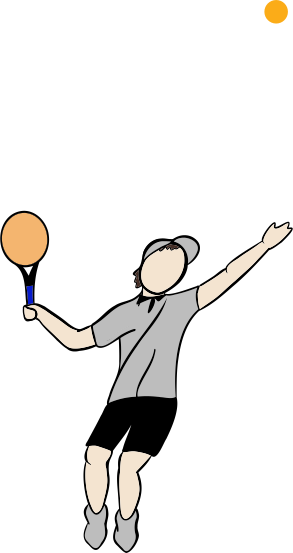
The official record for the fastest tennis serve, according to the Association of Tennis Professionals (ATP), is 157.2 mph (\(70.3 \,\text{m}/\text{s}\)). Slow motion cinematography has revealed that during a serve, the tennis racket and the ball (2 oz) are in contact for approximately 5 milliseconds.
(a) Calculate the force that the tennis player exerted on the tennis ball.
(b) How many kilograms could be lifted with this force?
a) Use Newton’s Second Law or the Impulse Equation to relate force, time, and change in momentum.
b) The weight of a given object can be used to solve for the mass of the given object.
a) The relationship between force and linear momentum is given by Newton’s Second Law in the form:
\begin{equation*}
\vec{F}=\frac{d\vec{p}}{dt},
\end{equation*}
where \(d\vec{p}\) or \(dt\) as finite changes can be written as \(\Delta \vec{p}\) and \( \Delta t \) respectively. Then
\begin{equation*}
\vec{F}=\frac{m \vec{v}_f – m \vec{v}_i}{dt}.
\end{equation*}
Plugging in numerical values, we get:
\begin{equation*}
F \approx 797 \, \text{N}.
\end{equation*}
b) Since the gravitational force is given as:
\begin{equation*}
F = Mg.
\end{equation*}
Solving for \(M\) and plugging in numerical values, we get:
\begin{equation*}
M \approx 81.3 \, \text{kg}.
\end{equation*}
For a more detailed explanation of any of these steps, click on “Detailed Solution”.
a) In order to solve this problem, we must relate the force exerted on the ball with the change of linear momentum in a time interval. For really small time intervals, the force \(\vec{F}\) applied can be approximated to
\begin{equation}
\label{force}
\vec{F}\approx \frac{\vec{p}_f-\vec{p}_i}{\Delta t},
\end{equation}
where \(\vec{p}_i\) and \(\vec{p}_f\) are the linear momentum of the ball before the tennis racket makes contact with the ball and after the ball loses contact with the racket, respectively. The time interval between these events is \(\Delta t=5\,\text{ms}=5\times10^{-3}\,\text{s}\).
We can express the linear momentum using the following equation
\begin{equation}
\vec{p}=m\vec{v},
\end{equation}
where \(m=2\,\text{oz}=56.7\,\text{g}\) is the mass of the object, in this case the ball, and \(\vec{v}\) is its velocity. We’ll assume that the ball’s velocity before the impact \(\vec{v}_i\) is approximately zero, so the linear momentum before the impact is
\begin{equation}
\vec{p}_i\approx \vec{0}.
\end{equation}
The magnitude of the velocity after the impact is \(v_f=70.3\,\text{m/s}\), so the magnitude of the linear momentum of the ball after it loses contact with the racket is
\begin{equation}
\label{pf}
p_f=mv_f.
\end{equation}
We can then write the equation for the force given in \eqref{force} as
\begin{equation}
\vec{F}\approx\frac{\vec{p}_f}{\Delta t},
\end{equation}
or focusing on the magnitudes
\begin{equation}
F\approx \frac{p_f}{\Delta t},
\end{equation}
which after using the result of equation \eqref{pf} becomes
\begin{equation}
F\approx \frac{mv_f}{\Delta t}.
\end{equation}
Using the numerical given values in SI units (\(m=0.0567\,\text{kg}\)), we obtain a force of:
\begin{equation}
F\approx \frac{(0.0567\,\text{kg})(70.3\,\text{m/s})}{5\times10^{-3}\,\text{s}},
\end{equation}
\begin{equation}
F\approx 797\,\text{N}.
\end{equation}
b) To find the amount of kilograms that this force will be able to lift, let’s compare it with the weight \(Mg\) of an object of mass \(M\). Here \(g\) is Earth’s gravitational acceleration, and it is equal to \(9.8\,\text{m/s}^2\). We can then write
\begin{equation}
F=Mg,
\end{equation}
and solve for \(M\), thus obtaining
\begin{equation}
M=\frac{F}{g}.
\end{equation}
Using the numerical values we get a mass of
\begin{equation}
M=\frac{797\,\text{N}}{9.8\,\text{m/s}^2},
\end{equation}
\begin{equation}
M\approx81.3\,\text{kg}.
\end{equation}
Thus, the force will be able to lift a mass of \(81.3\,\text{kg}\), which is close to the average weight of an adult!

Leave A Comment