

Three ants named Antonio, Ryant, and Bob leave their colony at the same time in the directions shown in the initial figure. Antonio starts his journey by traveling at a constant speed of \(3 \,\text{cm}/\text{s}\) and finds food that is located 2 meters away from the colony. Similarly, Ryant also travels at constant speed and initiates his outdoor adventure at \(5 \,\text{cm}/\text{s}\); Ryant finds food 3 meters away from the colony. Bob, the trickster of the trio, likes to alter how fast he goes. He watches his brothers leave the colony, then accelerates at \(1 \,\text{cm}/\text{s}^2\) for 10 seconds. He then stops to rest for 5 seconds before continuing his journey with the same initial acceleration. He is able to find food 2 meters away from the colony.
When all three of the ants find food, their instinct is to go back to the colony as fast as they can. Their maximum speed when carrying food is \(5 \,\text{cm}/\text{s}\), and they all travel back at this constant speed to feed their mates as quickly as possible.
(a) Calculate the time it takes for each ant to reach the food.
(b) Which ant arrives back to the colony with food first? Which one arrives last?
(a) Consider the equation of motion of each ant and solve for the time in the three cases. Notice that only one ant moves with constant acceleration.
(b) Solve for the time using the equation of motion for objects moving with constant velocity. Remember to add the time found in numeral (a) for each ant.
(a) In order to calculate the time it takes for each ant to reach food, we must use the equation for a constant acceleration motion, namely,
\begin{equation}
\vec{x}=\vec{x}_i+\vec{v}_i t+\frac{1}{2}\vec{a}t^2.
\end{equation}
Since Antonio travels with constant speed, then:
\begin{equation*}
t_A=\frac{x_A}{v_A}\approx66.7\,\text{s}.
\end{equation*}
For Ryant we get also:
\begin{equation*}
t_R=\frac{x_R}{v_R}=60\,\text{s}.
\end{equation*}
Bob advances \(0.5\,\text{m}\) during the 10 seconds he is moving at constant acceleration. Then he rests for 5 seconds and starts his trip again. Thus, at \(t=25\,\text{s}\) his position is \(x_B=1\,\text{m}\). He rests again for 5 seconds, thus giving us a total of \(30\) seconds. In the following 10 seconds, he travels an additional 0.5 meters, thus at \(t=40\,\text{s}\) his position is \(x_B=1.5\,\text{m}\). He rests again for 5 seconds and at \(t=45\,\text{s}\) starts to accelerate again for 10 seconds to finally arrive at \(x_B=2\,\text{m}\). The total amount of time Bob takes is then
\begin{equation*}
t_B=55\,\text{s}.
\end{equation*}
(b) From the equation of motion, the distance from the food to the colony is \(x\) and \(t’\) the time it takes each ant to get back to the colony. Solving for \(t’\), we obtain:
\begin{equation*}
t’=\frac{x}{v_{\text{max}}}.
\end{equation*}
Let’s then calculate the time for Antonio:
\begin{equation*}
t’_A=\frac{2\,\text{m}}{0.05\,\text{m/s}}=40\,\text{s}.
\end{equation*}
For Ryant we have
\begin{equation*}
t’_R=\frac{3\,\text{m}}{0.05\,\text{m/s}}=60\,\text{s}.
\end{equation*}
And for Bob we obtain
\begin{equation*}
t’_B=\frac{2\,\text{m}}{0.05\,\text{m/s}}=40\,\text{s}.
\end{equation*}
The total time \(T\) for each ant will then be the sum of the time it takes for the ant to arrive to the food and the time it takes for the ant to go back to the colony. For Antonio the total time \(T_A\) is
\begin{equation*}
T_A=t_A+t’_A=106.7\,\text{s}.
\end{equation*}
which, after using the numerical results given by equations \eqref{ta} and \eqref{tap}, is
\begin{equation*}
T_A=66.7\,\text{s}+40\,\text{s}=106.7\,\text{s}.
\end{equation*}
For Ryant the total time \(T_R\) is:
\begin{equation*}
T_R=t_R+t’_R=120\,\text{s}.
\end{equation*}
Finally, the total time for Bob \(T_B\) is:
\begin{equation*}
T_B=t_B+t’_B=95\,\text{s},
\end{equation*}
Hence, the ant that takes the least time to find food and then go back to the colony is Bob, followed by Antonio, and then Ryant.
For a more detailed explanation of any of these steps, click on “Detailed Solution”.
(a) In order to calculate the time it takes for each ant to reach food, we must use the equation for a constant acceleration motion, namely,
\begin{equation}
\vec{x}=\vec{x}_i+\vec{v}_i t+\frac{1}{2}\vec{a}t^2.
\end{equation}
Let’s start by applying this equation to Antonio, using the coordinate system shown in figure 1.
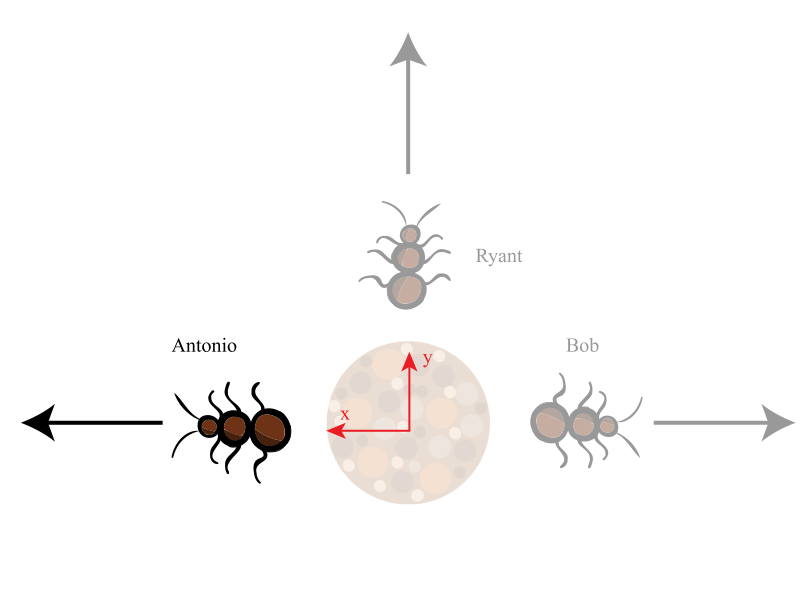
Figure 1: For Antonio’s equation of motion, we put the coordinate system at the colony with the positive X axis to the left.
Given this coordinate system, we can write Antonio’s position explicitly as
\begin{equation}
x\,\hat{\textbf{i}}=x_i\,\hat{\textbf{i}}+v_it\,\hat{\textbf{i}}+\frac{
1}{2}at^2\,\hat{\textbf{i}}.
\end{equation}
Dropping the vector notation (since everything occurs in a straight line), and concentrating on the components of each vector, we get
\begin{equation}
\label{motion}
x=x_i+v_it+\frac{1}{2}at^2.
\end{equation}
Since Antonio’s velocity is constant, his acceleration is zero. And since the origin of our coordinate system is located at the colony, the initial position \(x_i\) is also zero. We can then write an equation for the position of Antonio \(x_A\) using \eqref{motion} as
\begin{equation}
\label{xa}
x_A=v_At,
\end{equation}
where \(v_A=3\,\text{cm}/\text{s}=0.03\,\text{m/s}\) is Antonio’s speed at all times. If we take into account that \(x_A=2\,\text{m}\) is the position at which Antonio finds food, we can then solve for the time \(t_A\) from equation \eqref{xa}:
\begin{equation}
t_A=\frac{x_A}{v_A},
\end{equation}
which numerically is
\begin{equation}
\label{ta}
t_A=\frac{2\,\text{m}}{0.03\,\text{m/s}}\approx66.7\,\text{s}.
\end{equation}
Now, let’s make the same analysis for Ryant, using the coordinate system shown in figure 2.
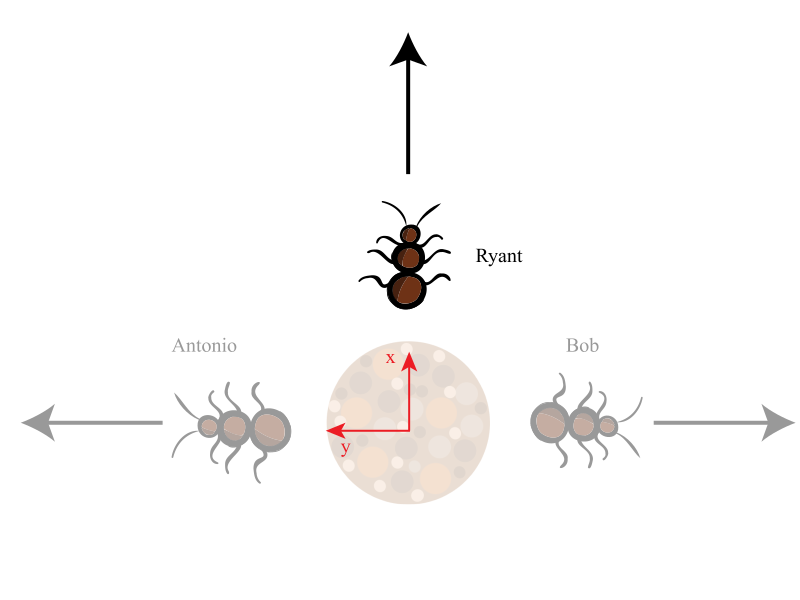
Figure 2: For Ryant’s equation of motion, we put the coordinate system at the colony with the positive X axis pointing upwards.
Again, because Ryant’s velocity is constant (Ryant has constant speed and moves in a straight line), the acceleration is zero. The origin of our coordinate system will be the colony, so the initial position \(x_i\) is also zero. So, we can use \eqref{motion} again to write an equation for the position of Ryant \(x_R\):
\begin{equation}
\label{xr}
x_R=v_Rt,
\end{equation}
where \(v_R=5\,\text{cm}/s=0.05\,\text{m/s}\) is Ryant’s speed at all times. If, in this equation, we use the fact that \(x_R=3\,\text{m}\) is the position at which Ryant finds food, then we can solve for the time \(t_R\) it takes Antonio to get that food:
\begin{equation}
t_R=\frac{x_R}{v_R},
\end{equation}
which numerically is
\begin{equation}
\label{tr}
t_R=\frac{3\,\text{m}}{0.05\,\text{m/s}}=60\,\text{s}.
\end{equation}
Finally, let’s calculate the time for Bob, using the coordinate system shown in figure 3.
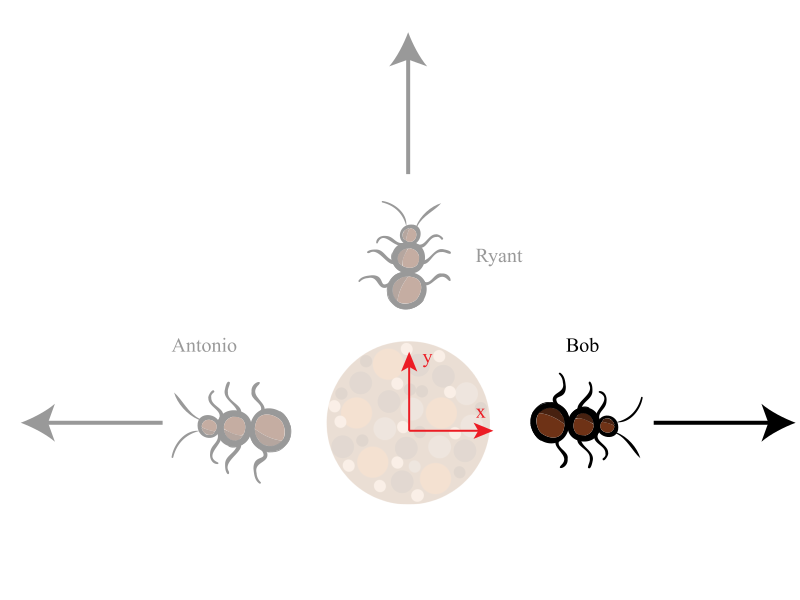
Figure 3: For Bob’s equation of motion, we put the coordinate system at the colony with the positive X axis to the right.
Because Bob likes to take his trips in steps, let’s first calculate his position after the first step, that is, after 10 seconds have passed. For this purpose, we will use equation \eqref{motion} with initial velocity equal to zero and initial position equal to zero, namely
\begin{equation}
x_B=\frac{1}{2}at^2,
\end{equation}
where \(a=1\,\text{cm/s}^2=0.01\,\text{cm/s}^2\). After 10 seconds, the position of Bob is
\begin{equation}
x_B=\frac{1}{2}(0.01\,\text{cm/s}^2)(10\,\text{s})^2=0.5\,\text{m},
\end{equation}
Thus, he advances \(0.5\,\text{m}\) during the 10 seconds he is moving at constant acceleration. Then he rests for 5 seconds and starts his trip again. Thus, at \(t=25\,\text{s}\) his position is \(x_B=1\,\text{m}\). He rests again for 5 seconds, thus giving us a total of \(30\) seconds. In the following 10 seconds, he travels an additional 0.5 meters, thus at \(t=40\,\text{s}\) his position is \(x_B=1.5\,\text{m}\). He rests again for 5 seconds and at \(t=45\,\text{s}\) starts to accelerate again for 10 seconds to finally arrive at \(x_B=2\,\text{m}\). The total amount of time Bob takes is then
\begin{equation}
\label{tb}
t_B=55\,\text{s}.
\end{equation}
b) For the final part of the problem, we need to find out which ant arrives first and which one arrives last.
Now that all the ants have found food, they go back to the colony, moving with a constant maximum speed of \(v_{\text{max}}=5\,\text{cm/s}=0.05\,\text{m/s}\). Thus, we will have to find the time \(t’\) it takes every ant to go back to the colony. For this purpose, and because acceleration is zero on the way back for all ants, we will use equation \eqref{motion} again to write
\begin{equation}
x=v_{\text{max}}t’,
\end{equation}
where \(x\) will be the distance from the food to the colony and \(t’\) the time it takes each ant to get back to the colony. Solving for \(t’\), we obtain
\begin{equation}
t’=\frac{x}{v_{\text{max}}}.
\end{equation}
Let’s then calculate the time for Antonio:
\begin{equation}
\label{tap}
t’_A=\frac{2\,\text{m}}{0.05\,\text{m/s}}=40\,\text{s}.
\end{equation}
For Ryant we have
\begin{equation}
\label{trp}
t’_R=\frac{3\,\text{m}}{0.05\,\text{m/s}}=60\,\text{s}.
\end{equation}
And for Bob we obtain
\begin{equation}
\label{tbp}
t’_B=\frac{2\,\text{m}}{0.05\,\text{m/s}}=40\,\text{s}.
\end{equation}
The total time \(T\) for each ant will then be the sum of the time it takes for the ant to arrive to the food and the time it takes for the ant to go back to the colony. For Antonio the total time \(T_A\) is
\begin{equation}
T_A=t_A+t’_A,
\end{equation}
which, after using the numerical results given by equations \eqref{ta} and \eqref{tap}, is
\begin{equation}
T_A=66.7\,\text{s}+40\,\text{s}=106.7\,\text{s}.
\end{equation}
For Ryant the total time \(T_R\) is
\begin{equation}
T_R=t_R+t’_R,
\end{equation}
which, after using the numerical results given by equations \eqref{tr} and \eqref{trp}, is
\begin{equation}
T_R=60\,\text{s}+60\,\text{s}=120\,\text{s}.
\end{equation}
Finally, the the total time for Bob \(T_B\) is
\begin{equation}
T_B=t_B+t’_B,
\end{equation}
which, after using the results given by equations \eqref{tb} and \eqref{tbp}, is
\begin{equation}
T_A=55\,\text{s}+40\,\text{s}=95\,\text{s}.
\end{equation}
Hence, the ant that takes the least time to find food and then go back to the colony is Bob, followed by Antonio, and then Ryant. That is, Bob arrives with food to the colony first, followed by Antonio, and the last one to arrive is Ryant.



Leave A Comment