
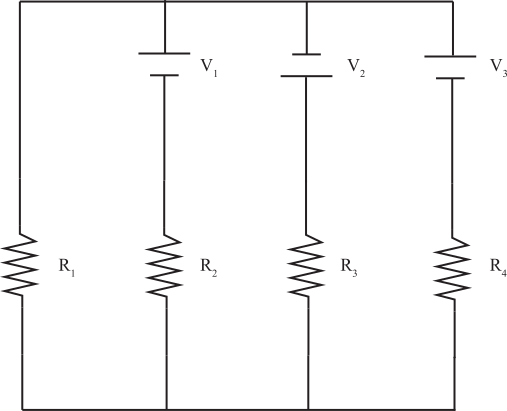
The circuit shown in the figure has the following batteries: \(V_1 = 55 \, \text{V}\), \(V_2 = 200 \, \text{V}\) and \(V_3 = 80 \, \text{V}\). The resistances are \(R_1 = 250 \, \Omega\), \(R_2 = 100 \, \Omega\), \(R_3 = 30 \, \Omega\) and \(R_4 = 80 \, \Omega\). Calculate:
a) The magnitude of the current flowing through each element and its direction.
b) The voltage drop on each element.
a) Assuming the direction of the current is determined by the battery, apply Kirchhoff’s Law and Ohm’s Law to solve for the current.
b) Apply Ohm’s Law to solve for the voltage given the known value for the current.
a) We can write:
\begin{equation*}
\sum V_{up} = \sum V_{down}.
\end{equation*}
For \(I_1\), and applying Ohm’s Law to each voltage:
\begin{equation*}
V_1 = I_1 R_1 + (I_1 – I_2) R_2.
\end{equation*}
For \(I_2\), and also applying Ohm’s Law to each voltage:
\begin{equation*}
0 = V_1 + V_2 + (I_2 – I_3) R_3 + (I_2 – I_1) R_2.
\end{equation*}
For \(I_3\), and also applying Ohm’s Law to each voltage:
\begin{equation*}
V_3 + V_2 = (I_3 – I_2) R_3 + I_3 R_4.
\end{equation*}
For the equations, \(I_1\), \(I_2\) and \(I_3\) are the unknown variables. Solving the \(3 \times 3\) system, we get:
\begin{equation*}
I_1 \approx -0.34 \, \text{A},
\end{equation*}
\begin{equation*}
I_2 \approx -1.74 \, \text{A},
\end{equation*}
and
\begin{equation*}
I_3 \approx 2.06\, \text{A}.
\end{equation*}
For \(R_1\), \(I_{R1} = 0.34 \, \text{A}\) upwards.
For \(V_1\) and \(R_2\), \(I_{R2} = 1.41 \, \text{A}\) upwards.
For \(V_2\) and \(R_3\), \(I_{R3} = 3.82 \, \text{A}\) downwards.
For \(V_3\) and \(R_4\), \(I_{R4} = 2.07 \, \text{A}\) upwards.
b) By Ohm’s law \(V = IR\) we have:
\begin{equation*}
V_{R_1}= 85\,\text{V}.
\end{equation*}
\begin{equation*}
V_{R_2} = 141 \,\text{V}.
\end{equation*}
\begin{equation*}
V_{R_3} = 114.6 \,\text{V}.
\end{equation*}
\begin{equation*}
V_{R_4} = 165.6 \,\text{V}.
\end{equation*}
For a more detailed explanation of any of these steps, click on “Detailed Solution”.
a) We need to find the magnitude and direction of the current for each element on the circuit. To solve this problem we must use Kirchhoff’s rules. Kirchhoff’s Voltage Law indicates that along any a closed path, the sum of voltages \(V_i\) must always equal zero. This gives us:
\begin{equation}
\label{kirch}
\sum_{\text{closed path}} V_i=0
\end{equation}
The first thing we will have to do is to choose the closed paths that cover the whole circuit and their orientation. For each path, we will assign a current \(I\) which is shown explicitly in Figure 1.

Figure 1: Three closed paths with currents \(I_1\), \(I_2\) and \(I_3\) to apply Kirchhoff’s voltage law.
To calculate the voltage of a source, the direction in which the path is taken is fundamental. If a path is taken from the negative terminal to the positive terminal of the voltage source, then the voltage would be positive. If the path taken goes from the positive terminal to the negative terminal of the voltage source, then the voltage would be negative.
For a resistor, there is always a voltage drop on the direction of the current, then according to Ohm’s law we can write
\begin{equation}
\label{ohm}
V_{R}=-IR,
\end{equation}
where \(I\) is the total current passing through the resistor and is taken positively in the direction of the path and negative in the direction opposite to the path.
Let us start with the first path, the left-most in figure 1. In this path, we have one source and two resistors. The direction of the path is such that it goes from the negative terminal to the positive terminal, then the voltage of the source \(V_1\) is taken positive, namely
\begin{equation}
\label{v1}
V_{V_1}^{\text{path 1}}=V_1.
\end{equation}
For resistor \(R_1\) the only current passing is \(I_1\) in the direction of the path, then using equation \eqref{ohm} we get
\begin{equation}
\label{r1}
V_{R_1}^{\text{path 1}}=-I_1R_1.
\end{equation}
For resistor \(R_2\) the total current is \(I_1-I_2\) where the signs are taken accordingly to the direction of the path, then using equation \eqref{ohm} we have
\begin{equation}
\label{r2}
V_{R_2}^{\text{path 1}}=-(I_1-I_2)R_2.
\end{equation}
Putting the results of equations \eqref{v1}, \eqref{r1} and \eqref{r2} into equation \eqref{kirch} we obtain
\begin{equation}
V_{V_1}^{\text{path 1}}+V_{R_1}^{\text{path 1}}+V_{R_2}^{\text{path 1}}=0,
\end{equation}
\begin{equation}
\label{sys1}
V_1-I_1R_1-(I_1-I_2)R_2=0.
\end{equation}
Equation \eqref{sys1} is the first of three equations necessary to solve the whole system. The other 2 equations must be obtained from the other 2 closed paths.
Focusing on the center path, we see that it involves two sources and two resistors. The direction of the path on both sources \(V_1\) and \(V_2\) is such that it goes from the positive terminal to the negative terminal, then the voltage must be taken as negative, namely
\begin{equation}
\label{v12}
V_{V_1}^{\text{path 2}}=-V_1,
\end{equation}
\begin{equation}
\label{v22}
V_{V_2}^{\text{path 2}}=-V_2.
\end{equation}
For resistor \(R_2\) the current passing through it is \(I_2-I_1\) following the sign convention established before. Thus using equation \eqref{ohm} we obtain
\begin{equation}
\label{r22}
V_{R_2}^{\text{path 2}}=-(I_2-I_1)R_2.
\end{equation}
For resistor \(R_3\) the current passing through it is \(I_2-I_3\) following the sign convention established before. Thus using equation \eqref{ohm} we have
\begin{equation}
\label{r32}
V_{R_3}^{\text{path 2}}=-(I_2-I_3)R_3.
\end{equation}
Putting the results of equations \eqref{v12}, \eqref{v22}, \eqref{r22} and \eqref{r32} into equation \eqref{kirch} we obtain
\begin{equation}
V_{V_1}^{\text{path 2}}+V_{V_2}^{\text{path 2}}+V_{R_2}^{\text{path 2}}+V_{R_3}^{\text{path 2}}=0,
\end{equation}
\begin{equation}
\label{sys2}
-V_1-V_2-(I_2-I_1)R_2-(I_2-I_3)R_3=0.
\end{equation}
Focusing on the path on the right, we see that it involves two sources and two resistors. The direction of the path on both sources \(V_2\) and \(V_3\) is such that it goes from the negative terminal to the positive terminal, then the voltage must be taken as positive, explicitly
\begin{equation}
\label{v23}
V_{V_2}^{\text{path 3}}=V_2,
\end{equation}
\begin{equation}
\label{v33}
V_{V_3}^{\text{path 3}}=V_3.
\end{equation}
For resistor \(R_3\) the current passing through it is \(I_3-I_2\) following the sign convention established before. Thus using equation \eqref{ohm} we obtain
\begin{equation}
\label{r33}
V_{R_3}^{\text{path 3}}=-(I_3-I_2)R_3.
\end{equation}
For resistor \(R_4\) the current passing through it is \(I_3\) where the sign is positive, following the path 3. Thus using equation \eqref{ohm} we have
\begin{equation}
\label{r43}
V_{R_4}^{\text{path 3}}=-I_3R_4.
\end{equation}
Putting the results of equations \eqref{v23}, \eqref{v33}, \eqref{r33} and \eqref{r43} into equation \eqref{kirch} we obtain
\begin{equation}
V_{V_2}^{\text{path 3}}+V_{V_3}^{\text{path 3}}+V_{R_3}^{\text{path 3}}+V_{R_4}^{\text{path 2}}=0,
\end{equation}
\begin{equation}
\label{sys3}
V_2+V_3-(I_3-I_2)R_3-I_3R_4=0.
\end{equation}
Equations \eqref{sys1}, \eqref{sys2} and \eqref{sys3} form a linear system of three equations with three unknowns, namely \(I_1,\, I_2\) and \(I_3\).
Using the numerical values of the voltage of the sources and the resistance in equations \eqref{sys1}, \eqref{sys2} and \eqref{sys3} we end up with
\begin{equation}
\label{sy1}
55-250 I_1-100(I_1-I_2)=0,
\end{equation}
\begin{equation}
\label{sy2}
-55-200-100(I_2-I_1)-30(I_2-I_3)=0,
\end{equation}
\begin{equation}
\label{sy3}
200+80-30(I_3-I_2)-80I_3=0,
\end{equation}
where we have omitted the units for simplicity of the calculations. However since we have used the units in the SI system, the answer for the currents will also be in the SI system. After some simple algebra equations \eqref{sy1}, \eqref{sy2} and \eqref{sy3} can be transformed to (respectively)
\begin{equation}
\label{s1}
350I_1-100I_2=55,
\end{equation}
\begin{equation}
\label{s2}
-100I_1+130I_2-30I_3=-255,
\end{equation}
\begin{equation}
\label{s3}
-30I_2+110I_3=280.
\end{equation}
Multiplying equation \eqref{s2} by 3.5 and adding it up with equation \eqref{s1} we get
\begin{equation}
350I_1-100I_2+3.5(-100I_1+130I_2-30I_3)=55+3.5(-255),
\end{equation}
which after simplification becomes
\begin{equation}
\label{s4}
355I_2-105I_3=-837.5,
\end{equation}
which together with equation \eqref{s3} makes a \(2\times 2\) system. Solving for \(I_3\) in equation \eqref{s3} we get
\begin{equation}
\label{i3}
I_3=\frac{280+30I_2}{110}.
\end{equation}
Using the expression of equation \eqref{i3} into equation \eqref{s4} we can write
\begin{equation}
355I_2-105\left(\frac{280+30I_2}{110}\right)=-837.5,
\end{equation}
which after some algebra becomes
\begin{equation}
326.36I_2-267.27=-837.5.
\end{equation}
The equation above can be solved for \(I_2\) to get
\begin{equation}
\label{i2}
I_2\approx -1.75\,\text{A}.
\end{equation}
Using the result in equation \eqref{i3} we obtain
\begin{equation}
\label{i33}
I_3=\frac{280+30(-1.75\,\text{A})}{110}\approx 2.07\,\text{A}.
\end{equation}
Finally, solving for \(I_1\) in equation \eqref{s1} we get
\begin{equation}
I_1=\frac{55+100I_2}{350},
\end{equation}
which after using the result of equation \eqref{i2} is
\begin{equation}
\label{i1}
I_1=\frac{55+100(-1.75\,\text{A})}{350}\approx -0.34\,\text{A}.
\end{equation}
Thus the current through each element can be calculated as follows.
For \(R_1\) the current is \(I_1=-0.34\,\text{A}\). The magnitude of the current is \(0.34\,\text{A}\) and its direction is upwards, contrary to what was drawn in figure 1 due to the negative sign in equation \eqref{i1}.
For \(R_2\) the current passing through is \(I_1-I_2=-0.34\,\text{A}-(-1.75\,\text{A})=1.41\,\text{A}\) as seen from path 1. Because its positive it follows path 1 upwards.
For \(R_3\) the current is \(I_3-I_2=2.07\,\text{A}-(-1.75\,\text{A})=3.82\,\text{A}\) as seen from path 3. Then because the result is positive it follows the same direction as path 3, that is downwards.
For \(R_4\) the current passing through is \(I_3=2.07\,\text{A}\) in the direction of path 3, that is, upwards.
For source \(V_1\) the current flows from the negative to the positive terminal due to the positive sign of \((I_1-I_2)\).
For source \(V_2\) the current flows from the negative terminal to the positive terminal because of the negative sign of \(I_2-I_3\), making the current flow downwards in that segment of the circuit.
For source \(V_3\) the current is \(I_3\) which is positive, then it flows in the same direction as path 3 in that segment of the circuit, thus flowing from the negative to the positive terminal.
b) The voltage drop for the sources is just the value of the source \(V_1\), \(V_2\) and \(V_3\). For the resistors we must use Ohm’s law in equation \eqref{ohm}. We just have to multiply the value of the current given previously by the resistance. Namely,
\begin{equation}
V_{R_1}=(0.34\,\text{A})250\,\Omega =85\,\text{V}.
\end{equation}
\begin{equation}
V_{R_2}=(1.41\,\text{A})100\,\Omega =141\,\text{V},
\end{equation}
\begin{equation}
V_{R_3}=(3.82\text{A})30\,\Omega=114.6\,\text{V},
\end{equation}
and finally
\begin{equation}
V_{R_4}=(2.07\,\text{A})80\,\Omega=165.6\,\text{V}.
\end{equation}

Leave A Comment