
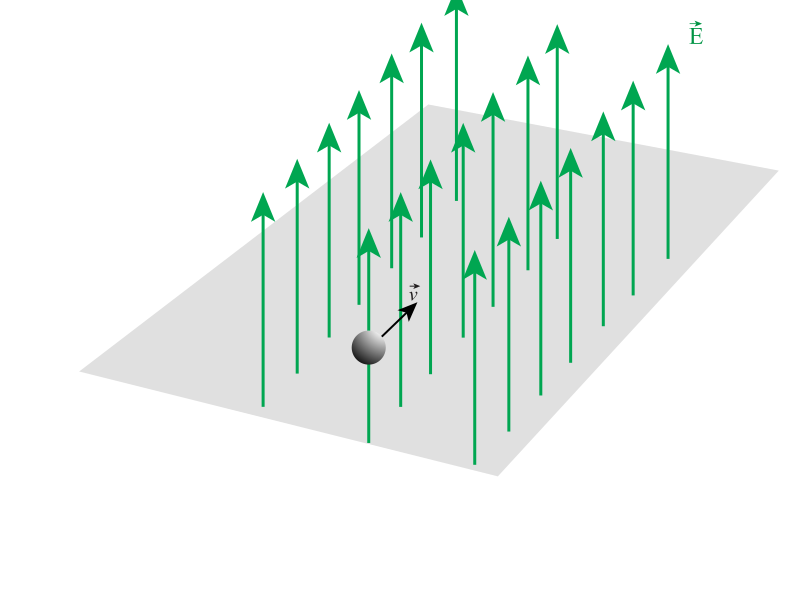
At some instant, a proton moves at a speed \(v\) perpendicular to an electric field of magnitude \(E\), as shown in the figure. If you want to use a uniform magnetic field to make the proton always move at constant speed along a straight line, in what direction should the field go and what should its magnitude be? Neglect the weight of the proton since it is too small compared to the other forces.
Use Newton’s Second Law to determine where the magnetic force is needed at equilibrium. The definition of magnetic force should give you the direction of the magnetic field.
Writing Newton’s Second Law at equilibrium, we get:
\begin{equation*}
\sum F = 0.
\end{equation*}
Then:
\begin{equation}
F_E – F_B = 0,
\end{equation}
so the forces must be the same, since \(F_E = qE\) and \(F_B = qvB\).
Solving for \(B\), we get:
\begin{equation}
B = \frac{E}{v}.
\end{equation}
If the velocity is in the \({y-}\)-direction and the electric field is in the \({z-}\)direction, the magnetic field must be pointing along the \({x-}\)axis according to the right-hand-rule.
For a more detailed explanation of any of these steps, click on “Detailed Solution”.
According to Newton’s second law, an object only moves in a straight line with constant speed if the net force over the object is zero (if the net force was not zero, then the proton would be either changing its speed or its direction of motion). Hence, for the proton to move in a straight line with a constant speed \({v}\), the net force exerted on the proton must be zero. We should use this condition, together with the expressions for the electric and magnetic forces, to find the magnetic field.
The only two forces acting on the proton are the electric force \(\vec{F}_E\), and the magnetic force \(\vec{F}_B\) (we neglect the weight, as they say in the prompt). Since the total force exerted on the proton must be zero in order for it to move in a straight line with constant speed, then we find
\begin{equation}
\label{EQ:1}
\vec{F}_E + \vec{F}_B = 0.
\end{equation}
Now, to continue, we should write these forces in terms of the variables we know, namely the electric field, the charge of the proton \(q = +e\), and the speed of the particle.
The electric force on a charge \(q\) due to an electric field \(\vec{E}\) is given by
\begin{equation}
\vec{F}_E = q\vec{E}.
\end{equation}
In our case, \(q=e\), yielding
\begin{equation}
\label{EQ:2}
\vec{F}_E = e\vec{E}.
\end{equation}
Let’s now choose a coordinate system according to which the electron is moving along the Y-axis, and the electric field points in the positive direction of Z (we are free to use whatever coordinate system we wish, and as we will see soon, this is a convenient one shown in figure 1).
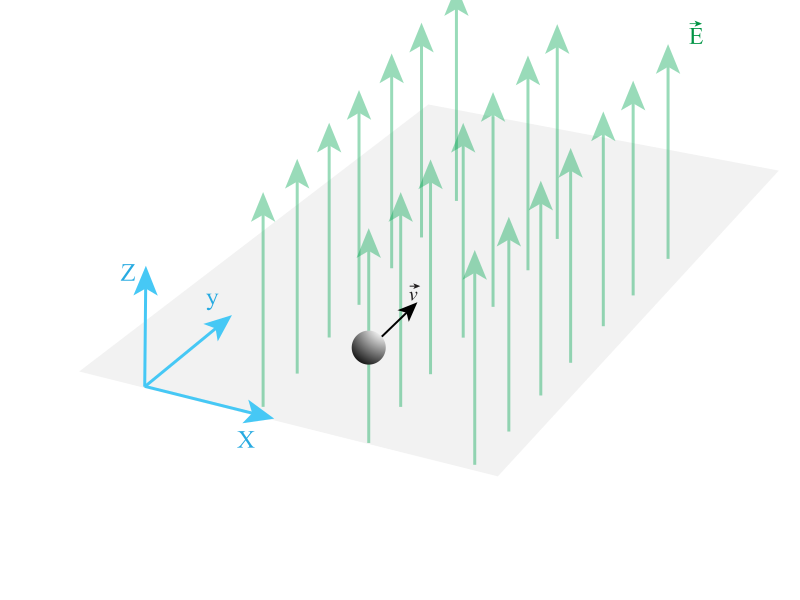
Figure 1: We choose the coordinate system such that the proton moves along the Y-axis and the electric field points in the positive Z-axis.
According to this system,
\begin{equation}
\vec{E} = E \, \hat{\textbf{k}}.
\end{equation}
After substituting this in \eqref{EQ:2}, we get
\begin{equation}
\vec{F}_E = eE \, \hat{\textbf{k}}.
\end{equation}
After inserting this in \eqref{EQ:1}, we obtain
\begin{equation}
eE \, \hat{\textbf{k}} + \vec{F}_B = 0.
\end{equation}
We can rewrite this equation as
\begin{equation}
\label{EQ:3}
\vec{F}_B = -eE \, \hat{\textbf{k}}.
\end{equation}
Hence, this equation shows that in order for the proton to keep a constant speed and move in a straight line, we must apply a magnetic force of magnitude \(eE\) that points in the \(-\hat{\textbf{k}}\) direction. So, to proceed, we must find what kind of magnetic field produces this particular kind of magnetic force.
In order to find the magnetic field \(B\) such that equation \eqref{EQ:3} is satisfied, we must write the magnetic force in terms of \(\vec{B}\). The magnetic force over a charge \(q\) that is moving with velocity \(\vec{v}\) in a region with a magnetic field \(\vec{B}\) is given by
\begin{equation}
\label{EQ:4}
\vec{F}_B = q \vec{v} \times \vec{B},
\end{equation}
where this expression comes from the magnetic part of Lorentz force.
Using the coordinate system shown in the first figure, we can write the velocity as \(\vec{v} = v \hat{\textbf{j}}\). After substituting this in equation \eqref{EQ:4}, we get
\begin{equation}
\vec{F}_B = qv \hat{\textbf{j}} \times \vec{B}.
\end{equation}
Now, if we replace this in equation \eqref{EQ:3}, we get
\begin{equation}
\label{EQ:5}
qv \hat{\textbf{j}} \times \vec{B} = -eE \, \hat{\textbf{k}}.
\end{equation}
In order to find \(\vec{B}\), we must determine its magnitude and direction such that eq. \eqref{EQ:5} is satisfied. We can write \(\vec{B} = B \hat{u}\), where \(B\) is the magnitude of \(\vec{B}\), and \(\hat{u}\) is a unit vector specifying its (still unknown) direction. After substituting this in equation \eqref{EQ:5}, we obtain
\begin{equation}
qv \hat{\textbf{j}} \times B\hat{u} = -eE \, \hat{\textbf{k}}.
\end{equation}
If we take \(B\) out of the cross product (which we can always do because it is a number), we get
\begin{equation}
qvB \hat{\textbf{j}} \times \hat{u} = -eE \, \hat{\textbf{k}}.
\end{equation}
This is an equality between vectors, and so both the magnitude and the direction on each side must be the same. In other words,
\begin{equation}
\label{EQ:6}
qvB = eE
\end{equation}
must hold for the magnitudes, and
\begin{equation}
\label{EQ:7}
\hat{\textbf{j}} \times \hat{u} = -\hat{\textbf{k}}
\end{equation}
must hold for the directions.
If we divide equation \eqref{EQ:6} by \(qv\), we obtain that the magnitude of \(\vec{B}\) must be
\begin{equation}
\label{EQ:8}
B = \frac{eE}{qv}
\end{equation}
Finally, the direction \(\hat{u}\) for \(\vec{B}\) must satisfy equation \eqref{EQ:7}. We can find this direction by using the right-hand rule as shown in figure 2.
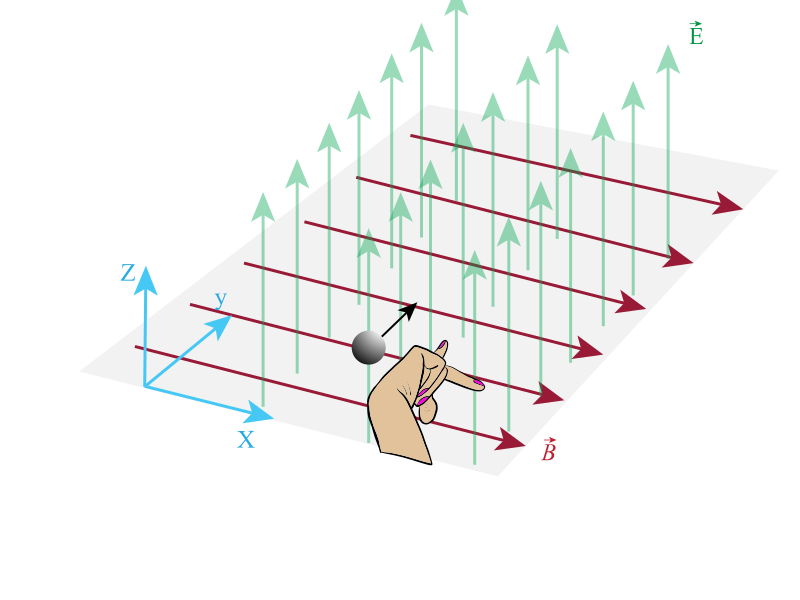
Figure 2: Diagram of the magnetic field \(\vec{B}\) using the right hand rule. If the velocity of the proton is along \(\hat{\textbf{j}}\) and the force needs to be along \(-\hat{\textbf{k}}\), then the magnetic field should be in the \(\hat{\textbf{i}}\) direction.
Hence, we find out that \(\hat{u} = \hat{\textbf{i}}\). Putting this together with the magnitude of \(\vec{B}\) in \eqref{EQ:8}, and since \(q = e\), we obtain that the magnetic field must be
\begin{equation}
\vec{B} = \frac{E}{v} \hat{\textbf{i}}.
\end{equation}


Leave A Comment