
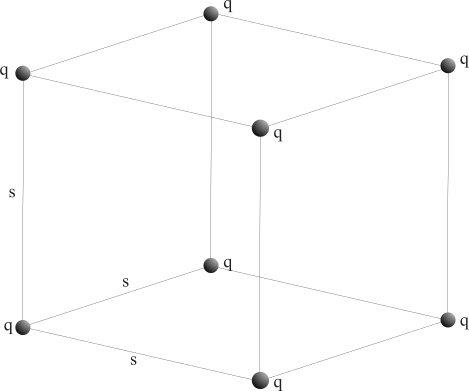
A cube with a side length of 25 cm has 8 charges of \(6 \, \mu \text{C}\), each located at each corner. Calculate the total electric field generated in the middle of each of the cube faces.
Write a vector originating at a particle and ending at the middle of any face of the cube. Then, use the principle of superposition for electric fields.
For a point charge, the electric field is given as:
\begin{equation*}
\vec{E}=\frac{1}{4\pi\epsilon_0}\frac{q}{r^2}\,\hat{\textbf{r}},
\end{equation*}
where \(\hat{\textbf{r}}=\frac{\vec{r}}{r} \). For the middle of any face of the cube, the vectors’ position for each particle is:
\begin{equation}
\vec{r}_i = \vec{a}_P – \vec{a}_i,
\end{equation}
where \( \vec{a}_P\) is the vector from the coordinate system, and \(a_i\) the vector from the coordinate system to the particle \(i\).
For particle 1:
\begin{equation*}
\vec{r}_1=-\frac{s}{2}\,\hat{\textbf{i}}+s\,\hat{\textbf{j}}-\frac{s}{2}\,\hat{\textbf{k}}.
\end{equation*}
For particle 2:
\begin{equation*}
\vec{r}_2=\frac{s}{2}\,\hat{\textbf{i}}+s\,\hat{\textbf{j}}-\frac{s}{2}\,\hat{\textbf{k}}.
\end{equation*}
For particle 3:
\begin{equation*}
\vec{r}_3=\frac{s}{2}\,\hat{\textbf{i}}-\frac{s}{2}\,\hat{\textbf{k}}.
\end{equation*}
For particle 4:
\begin{equation*}
\vec{r}_4=-\frac{s}{2}\,\hat{\textbf{i}}-\frac{s}{2}\,\hat{\textbf{k}}.
\end{equation*}
For particle 5:
\begin{equation*}
\vec{r}_5=-\frac{s}{2}\,\hat{\textbf{i}}+s\,\hat{\textbf{j}}+\frac{s}{2}\,\hat{\textbf{k}}.
\end{equation*}
For particle 6:
\begin{equation*}
\vec{r}_6=\frac{s}{2}\,\hat{\textbf{i}}+s\,\hat{\textbf{j}}+\frac{s}{2}\,\hat{\textbf{k}}.
\end{equation*}
For particle 7:
\begin{equation*}
\vec{r}_7=\frac{s}{2}\,\hat{\textbf{i}}+\frac{s}{2}\,\hat{\textbf{k}}.
\end{equation*}
For particle 8:
\begin{equation*}
\vec{r}_8=-\frac{s}{2}\,\hat{\textbf{i}}+\frac{s}{2}\,\hat{\textbf{k}}.
\end{equation*}
The electric field superposition is:
\begin{equation*}
\vec{E}=\frac{q}{4\pi\epsilon_0}\sum_{i=1}^{8}\frac{\vec{r}_i}{r_i^3},
\end{equation*}
which is:
\begin{equation*}
\vec{E}=\frac{q}{4\pi\epsilon_0}\frac{4}{s^2\left(\frac{3}{2}\right)^{3/2}}\,\hat{\textbf{j}},
\end{equation*}
or with numerical values:
\begin{equation*}
\vec{E}\approx 1.88\times 10^{6}\,\text{N/C}\,\hat{\textbf{j}}.
\end{equation*}
For a more detailed explanation of any of these steps, click on “Detailed Solution”.
We need to find the total electric field generated in the middle of each of the cube faces. To solve this problem, we must find the electric field produced by each point charge in the specified point in the cube array (the middle of one of its facets) and then make the vector sum. The point in which the electric field is being calculated will be denoted by P. The electric field \(\vec{E}\) produced by a point charge \(q\) is given by
\begin{equation}
\label{efield}
\vec{E}=\frac{1}{4\pi\epsilon_0}\frac{q}{r^2}\,\hat{\textbf{r}},
\end{equation}
where \(\vec{r}\) is the vector from the point charge to where the electric field is being calculated. The magnitude of this vector is \(r\), and the unitary vector \(\hat{\textbf{r}}\) is defined as
\begin{equation}
\label{rhat}
\hat{\textbf{r}}=\frac{\vec{r}}{r}.
\end{equation}
Using the expression for \(\hat{\textbf{r}}\) given in equation \eqref{rhat} into equation \eqref{efield}, we obtain
\begin{equation}
\vec{E}=\frac{1}{4\pi\epsilon_0}\frac{q}{r^3}\,\vec{r}.
\end{equation}
Since we know the coordinates of all point charges and point P, we only have to calculate the vector \(\vec{r}\) and its magnitude for every charge. Note that due to symmetry, the electric field would be the same at the middle of all the faces of the cube. Let’s choose the second face in the XZ plane, as seen in figure 1.

Figure 1: Eight charged particles placed on the vertices of a cube. We place the origin of our coordinate system on charge 6. The point P where the electric field must be calculated is also shown.
We label the charges using numbers, as shown in figure 2, and use the same label for the coordinates of each one and the associated vector \(\vec{r}\).
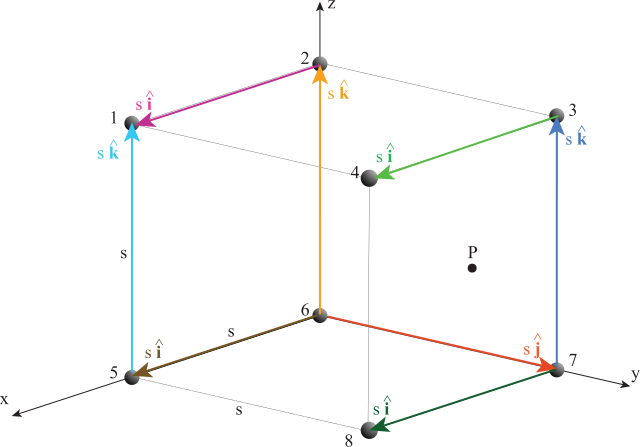
Figure 2: Unitary vectors along the X, Y, and Z axis multiplied by \(s\), the length of the edge of the cube. To find the position of each particle, we start at the origin and sum the vectors until we arrive to the desired charge. For example, for charge 1 we add up the brown and the cyan vector. Equivalently, we could also add the yellow and purple vectors to obtain the position of charge 1.
Using figure 2 as a guide, the coordinates \(\vec{a}\) of each charge can be given by linear combinations (different additions) of the the unitary vectors; namely,
\begin{equation}
\label{a1}
\vec{a}_1=s\,\hat{\textbf{i}}+s\,\hat{\textbf{k}},
\end{equation}
\begin{equation}
\vec{a}_2=s\,\hat{\textbf{k}},
\end{equation}
\begin{equation}
\vec{a}_3=s\,\hat{\textbf{j}}+s\,\hat{\textbf{k}},
\end{equation}
\begin{equation}
\vec{a}_4=s\,\hat{\textbf{i}}+s\,\hat{\textbf{j}}+s\,\hat{\textbf{k}},
\end{equation}
\begin{equation}
\vec{a}_5=s\,\hat{\textbf{i}},
\end{equation}
\begin{equation}
\vec{a}_6=\vec{0},
\end{equation}
\begin{equation}
\vec{a}_7=s\,\hat{\textbf{j}},
\end{equation}
\begin{equation}
\label{a8}
\vec{a}_8=s\,\hat{\textbf{i}}+s\,\hat{\textbf{j}}.
\end{equation}
The coordinates of point P are given by
\begin{equation}
\label{ap}
\vec{a}_P=\frac{s}{2}\,\hat{\textbf{i}}+s\,\hat{\textbf{j}}+\frac{s}{2}\,\hat{\textbf{k}},
\end{equation}
as we can see from figure 3:
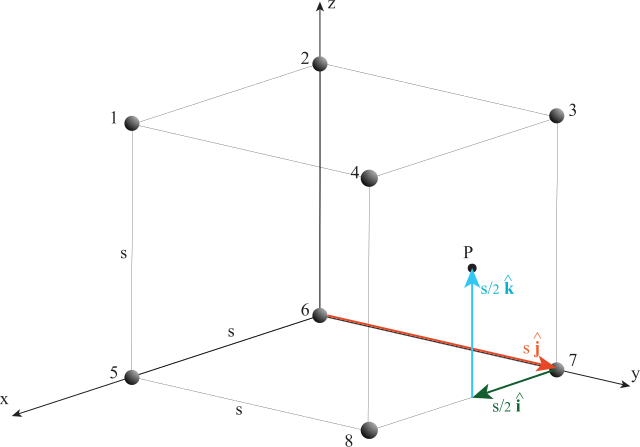
Figure 3: Coordinates of the point P in terms of the unitary vectors along the X, Y and Z axis.
The vectors \(\vec{r}_i\) are calculated as follows
\begin{equation}
\vec{r}_i=\vec{a}_P-\vec{a}_i,
\end{equation}
where \(i=\{1,2,3,4,5,6,7,8\}\). To illustrate this, consider the following three figures (figure 4, 5 and 6, respectively) for \( \vec{r}_1 \), \( \vec{r}_2 \) and \( \vec{r}_7 \), respectively.

Figure 4: The difference between \(\vec{a}_P\) (the position vector of point P) and the position vector for charge 1 \(\vec{a}_1\) gives the distance vector between point P and charge 1, \(\vec{r}_1\). In other words, \(\vec{r}_1=\vec{a}_P-\vec{a}_1\).
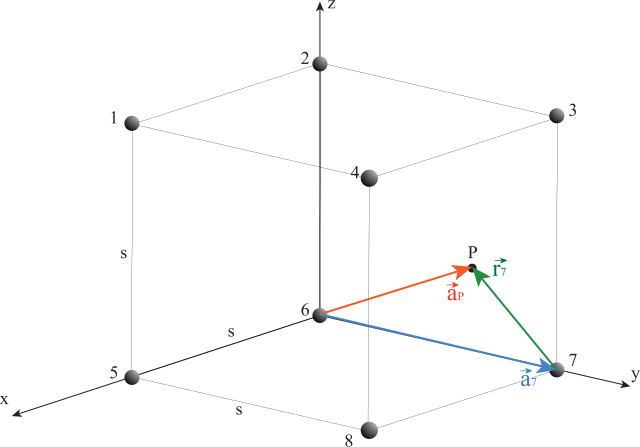
Figure 5: The difference between \(\vec{a}_P\) (the position vector of point P) and the position vector for charge 7 \(\vec{a}_7\) gives the distance vector between point P and charge 7, \(\vec{r}_7\). In other words, \(\vec{r}_7=\vec{a}_P-\vec{a}_7\).

Figure 6: The difference between \(\vec{a}_P\) (the position vector of point P) and the position vector for charge 2 \(\vec{a}_2\) gives the distance vector between point P and charge 2, \(\vec{r}_2\). In other words, \(\vec{r}_2=\vec{a}_P-\vec{a}_2\).
Therefore, using equations \eqref{a1}-\eqref{a8} and equation \eqref{ap}, we can write explicitly
\begin{equation}
\vec{r}_1=\frac{s}{2}\,\hat{\textbf{i}}+s\,\hat{\textbf{j}}+\frac{s}{2}\,\hat{\textbf{k}}-(s\,\hat{\textbf{i}}+s\,\hat{\textbf{k}}),
\end{equation}
\begin{equation}
\vec{r}_1=-\frac{s}{2}\,\hat{\textbf{i}}+s\,\hat{\textbf{j}}-\frac{s}{2}\,\hat{\textbf{k}},
\end{equation}
and its magnitude
\begin{equation}
r_1=\sqrt{\left(-\frac{s}{2}\right)^2+s^2+\left(-\frac{s}{2}\right)^2},
\end{equation}
\begin{equation}
\label{r1}
r_1=s\sqrt{\frac{3}{2}}
\end{equation}
For vector \(\vec{r}_2\):
\begin{equation}
\vec{r}_2=\frac{s}{2}\,\hat{\textbf{i}}+s\,\hat{\textbf{j}}+\frac{s}{2}\,\hat{\textbf{k}}-(s\,\hat{\textbf{k}}),
\end{equation}
\begin{equation}
\vec{r}_2=\frac{s}{2}\,\hat{\textbf{i}}+s\,\hat{\textbf{j}}-\frac{s}{2}\,\hat{\textbf{k}},
\end{equation}
and its magnitude
\begin{equation}
r_2=\sqrt{\left(\frac{s}{2}\right)^2+s^2+\left(\frac{s}{2}\right)^2},
\end{equation}
\begin{equation}
r_2=s\sqrt{\frac{3}{2}}
\end{equation}
For vector \(\vec{r}_3\):
\begin{equation}
\vec{r}_3=\frac{s}{2}\,\hat{\textbf{i}}+s\,\hat{\textbf{j}}+\frac{s}{2}\,\hat{\textbf{k}}-(s\,\hat{\textbf{j}}+s\,\hat{\textbf{k}}),
\end{equation}
\begin{equation}
\vec{r}_3=\frac{s}{2}\,\hat{\textbf{i}}-\frac{s}{2}\,\hat{\textbf{k}},
\end{equation}
and its magnitude
\begin{equation}
r_3=\sqrt{\left(\frac{s}{2}\right)^2+\left(\frac{s}{2}\right)^2},
\end{equation}
\begin{equation}
r_3=\frac{s}{\sqrt{2}}.
\end{equation}
For vector \(\vec{r}_4\):
\begin{equation}
\vec{r}_4=\frac{s}{2}\,\hat{\textbf{i}}+s\,\hat{\textbf{j}}+\frac{s}{2}\,\hat{\textbf{k}}-(s\,\hat{\textbf{i}}+s\,\hat{\textbf{j}}+\hat{\textbf{k}}),
\end{equation}
\begin{equation}
\vec{r}_4=-\frac{s}{2}\,\hat{\textbf{i}}-\frac{s}{2}\,\hat{\textbf{k}},
\end{equation}
and its magnitude
\begin{equation}
r_4=\sqrt{\left(-\frac{s}{2}\right)^2+\left(-\frac{s}{2}\right)^2},
\end{equation}
\begin{equation}
r_4=\frac{s}{\sqrt{2}}.
\end{equation}
For vector \(\vec{r}_5\):
\begin{equation}
\vec{r}_5=\frac{s}{2}\,\hat{\textbf{i}}+s\,\hat{\textbf{j}}+\frac{s}{2}\,\hat{\textbf{k}}-(s\,\hat{\textbf{i}}),
\end{equation}
\begin{equation}
\vec{r}_5=-\frac{s}{2}\,\hat{\textbf{i}}+s\,\hat{\textbf{j}}+\frac{s}{2}\,\hat{\textbf{k}},
\end{equation}
and its magnitude
\begin{equation}
r_5=\sqrt{\left(-\frac{s}{2}\right)^2+s^2+\left(\frac{s}{2}\right)^2},
\end{equation}
\begin{equation}
r_5=s\sqrt{\frac{3}{2}}.
\end{equation}
For vector \(\vec{r}_6\):
\begin{equation}
\vec{r}_6=\frac{s}{2}\,\hat{\textbf{i}}+s\,\hat{\textbf{j}}+\frac{s}{2}\,\hat{\textbf{k}}-(\vec{0}),
\end{equation}
\begin{equation}
\vec{r}_6=\frac{s}{2}\,\hat{\textbf{i}}+s\,\hat{\textbf{j}}+\frac{s}{2}\,\hat{\textbf{k}},
\end{equation}
and its magnitude
\begin{equation}
r_6=\sqrt{\left(\frac{s}{2}\right)^2+s^2+\left(\frac{s}{2}\right)^2},
\end{equation}
\begin{equation}
r_6=s\sqrt{\frac{3}{2}}.
\end{equation}
For vector \(\vec{r}_7\):
\begin{equation}
\vec{r}_7=\frac{s}{2}\,\hat{\textbf{i}}+s\,\hat{\textbf{j}}+\frac{s}{2}\,\hat{\textbf{k}}-(s\,\hat{\textbf{j}}),
\end{equation}
\begin{equation}
\vec{r}_7=\frac{s}{2}\,\hat{\textbf{i}}+\frac{s}{2}\,\hat{\textbf{k}},
\end{equation}
and its magnitude
\begin{equation}
r_7=\sqrt{\left(\frac{s}{2}\right)^2+\left(\frac{s}{2}\right)^2},
\end{equation}
\begin{equation}
r_7=\frac{s}{\sqrt{2}}.
\end{equation}
And, finally, for vector \(\vec{r}_8\), we have
\begin{equation}
\vec{r}_8=\frac{s}{2}\,\hat{\textbf{i}}+s\,\hat{\textbf{j}}+\frac{s}{2}\,\hat{\textbf{k}}-(s\,\hat{\textbf{i}}+s\,\hat{\textbf{j}}),
\end{equation}
\begin{equation}
\vec{r}_8=-\frac{s}{2}\,\hat{\textbf{i}}+\frac{s}{2}\,\hat{\textbf{k}},
\end{equation}
and its magnitude
\begin{equation}
r_8=\sqrt{\left(\frac{s}{2}\right)^2+\left(\frac{s}{2}\right)^2},
\end{equation}
\begin{equation}
r_8=\frac{s}{\sqrt{2}}.
\end{equation}
The total electric field will be given by the superposition principle as
\begin{equation}
\vec{E}=\sum_{i=1}^{8}\vec{E}_i,
\end{equation}
where \(\vec{E}_i\) is the electric field produced by the point charge \(i\). Using the explicit expression in equation \eqref{efield} in the equation above, we get
\begin{equation}
\vec{E}=\sum_{i=1}^{8}\frac{1}{4\pi\epsilon_0}\frac{q}{r_i^3}\vec{r}_i,
\end{equation}
where we can take the constant terms out of the sum to obtain
\begin{equation}
\label{efield2}
\vec{E}=\frac{q}{4\pi\epsilon_0}\sum_{i=1}^{8}\frac{\vec{r}_i}{r_i^3}.
\end{equation}
From the symmetry of the problem the electric field in the XZ plane is cancelled while the electric field in the Y plane always adds up. Take, for example, the point charges 3, 4, 7, and 8 which are at the same distance \(r\) from point P. Let’s sum the ratio found in equation \eqref{efield2}; namely,
\begin{equation}
\frac{\vec{r}_3}{r_3^3}+\frac{\vec{r}_4}{r_4^3}+\frac{\vec{r}_7}{r_7^3}+\frac{\vec{r}_8}{r_8^3}.
\end{equation}
Because \(r_3=r_4=r_7=r_8\), we can write
\begin{equation}
\label{3478}
\frac{\vec{r}_3}{r_3^3}+\frac{\vec{r}_4}{r_4^3}+\frac{\vec{r}_7}{r_7^3}+\frac{\vec{r}_8}{r_8^3}=\frac{\vec{r}_3+\vec{r}_4+\vec{r}_7+\vec{r}_8}{r_3^3}.
\end{equation}
Calculating the numerator in the left-hand side of the equation above, we obtain:
\begin{equation*}
\vec{r}_3+\vec{r}_4+\vec{r}_7+\vec{r}_8=\left(\frac{s}{2}\,\hat{\textbf{i}}-\frac{s}{2}\,\hat{\textbf{k}}\right)+\left(-\frac{s}{2}\,\hat{\textbf{i}}-\frac{s}{2}\,\hat{\textbf{k}}\right)
\end{equation*}
\begin{equation}
+\left(\frac{s}{2}\,\hat{\textbf{i}}+\frac{s}{2}\,\hat{\textbf{k}}\right)+\left(-\frac{s}{2}\,\hat{\textbf{i}}+\frac{s}{2}\,\hat{\textbf{k}}\right),
\end{equation}
\begin{equation}
\vec{r}_3+\vec{r}_4+\vec{r}_7+\vec{r}_8=\vec{0}.
\end{equation}
Thus, equation \eqref{3478} becomes
\begin{equation}
\label{def1}
\frac{\vec{r}_3}{r_3^3}+\frac{\vec{r}_4}{r_4^3}+\frac{\vec{r}_7}{r_7^3}+\frac{\vec{r}_8}{r_8^3}=\vec{0},
\end{equation}
meaning they do not contribute to the sum in \eqref{efield2}.
We are then left with the sum of point charges 1,2,5 and 6; explicitly,
\begin{equation}
\frac{\vec{r}_1}{r_1^3}+\frac{\vec{r}_2}{r_2^3}+\frac{\vec{r}_5}{r_5^3}+\frac{\vec{r}_6}{r_6^3}.
\end{equation}
Because \(r_1=r_2=r_5=r_6\), we can write
\begin{equation}
\label{1256}
\frac{\vec{r}_1}{r_1^3}+\frac{\vec{r}_2}{r_2^3}+\frac{\vec{r}_5}{r_5^3}+\frac{\vec{r}_6}{r_6^3}=\frac{\vec{r}_1+\vec{r}_2+\vec{r}_5+\vec{r}_6}{r_1^3}.
\end{equation}
Calculating the numerator in the left-hand side of the equation above, we obtain:
\begin{equation*}
\vec{r}_1+\vec{r}_2+\vec{r}_5+\vec{r}_6=\left(-\frac{s}{2}\,\hat{\textbf{i}}+s\,\hat{\textbf{j}}-\frac{s}{2}\,\hat{\textbf{k}}\right)+\left(\frac{s}{2}\,\hat{\textbf{i}}+s\,\hat{\textbf{j}}-\frac{s}{2}\,\hat{\textbf{k}}\right)
\end{equation*}
\begin{equation}
+\left(-\frac{s}{2}\,\hat{\textbf{i}}+s\,\hat{\textbf{j}}+\frac{s}{2}\,\hat{\textbf{k}}\right)+\left(\frac{s}{2}\,\hat{\textbf{i}}+s\,\hat{\textbf{j}}+\frac{s}{2}\,\hat{\textbf{k}}\right),
\end{equation}
\begin{equation}
\vec{r}_1+\vec{r}_2+\vec{r}_5+\vec{r}_6=4s\,\hat{\textbf{j}}.
\end{equation}
Thus, equation \eqref{1256} becomes
\begin{equation}
\frac{\vec{r}_1}{r_1^3}+\frac{\vec{r}_2}{r_2^3}+\frac{\vec{r}_5}{r_5^3}+\frac{\vec{r}_6}{r_6^3}=\frac{4s}{r_1^3}\,\hat{\textbf{j}},
\end{equation}
which, after using the explicit expression for \(r_1\) given in \eqref{r1}, becomes
\begin{equation}
\frac{\vec{r}_1}{r_1^3}+\frac{\vec{r}_2}{r_2^3}+\frac{\vec{r}_5}{r_5^3}+\frac{\vec{r}_6}{r_6^3}=\frac{4s}{\left(s\sqrt{\frac{3}{2}}\right)^3}\,\hat{\textbf{j}},
\end{equation}
\begin{equation}
\label{def2}
\frac{\vec{r}_1}{r_1^3}+\frac{\vec{r}_2}{r_2^3}+\frac{\vec{r}_5}{r_5^3}+\frac{\vec{r}_6}{r_6^3}=\frac{4}{s^2\left(\frac{3}{2}\right)^{3/2}}\,\hat{\textbf{j}}.
\end{equation}
The sum in equation \eqref{efield2} can be written explicitly as
\begin{equation}
\sum_{i=1}^{8}\frac{\vec{r}_i}{r_i^3}=\frac{\vec{r}_1}{r_1^3}+\frac{\vec{r}_2}{r_2^3}+\frac{\vec{r}_3}{r_3^3}+\frac{\vec{r}_4}{r_4^3}+\frac{\vec{r}_5}{r_5^3}+\frac{\vec{r}_6}{r_6^3}+\frac{\vec{r}_7}{r_7^3}+\frac{\vec{r}_8}{r_8^3},
\end{equation}
or regrouping
\begin{equation}
\sum_{i=1}^{8}\frac{\vec{r}_i}{r_i^3}=\left(\frac{\vec{r}_1}{r_1^3}+\frac{\vec{r}_2}{r_2^3}+\frac{\vec{r}_5}{r_5^3}+\frac{\vec{r}_6}{r_6^3}\right)+\left( \frac{\vec{r}_3}{r_3^3}+\frac{\vec{r}_4}{r_4^3}+\frac{\vec{r}_7}{r_7^3}+\frac{\vec{r}_8}{r_8^3}\right).
\end{equation}
We can now use the explicit expressions for the terms in each parenthesis given by equations \eqref{def1} and \eqref{def2} in the equation above to obtain
\begin{equation}
\label{suma}
\sum_{i=1}^{8}\frac{\vec{r}_i}{r_i^3}=\frac{4}{s^2\left(\frac{3}{2}\right)^{3/2}}\,\hat{\textbf{j}}.
\end{equation}
Finally, using the expression in equation \eqref{suma} into the equation for the electric field, equation \eqref{efield2}, we obtain
\begin{equation}
\vec{E}=\frac{q}{4\pi\epsilon_0}\frac{4}{s^2\left(\frac{3}{2}\right)^{3/2}}\,\hat{\textbf{j}}.
\end{equation}
Using the numerical values in SI units (\(q=6\times10^{-6}\,\text{C}\) and \(s=0.25\,\text{m}\)), we obtain
\begin{equation}
\vec{E}=\frac{6\times10^{-6}\,\text{C}}{4\pi(8.854\times10^{-12}\,\text{F/m})}\frac{4}{(0.25\,\text{m})^2\left(\frac{3}{2}\right)^{3/2}}\,\hat{\textbf{j}},
\end{equation}
\begin{equation}
\vec{E}\approx 1.88\times 10^{6}\,\text{N/C}\,\hat{\textbf{j}}.
\end{equation}


Leave A Comment