
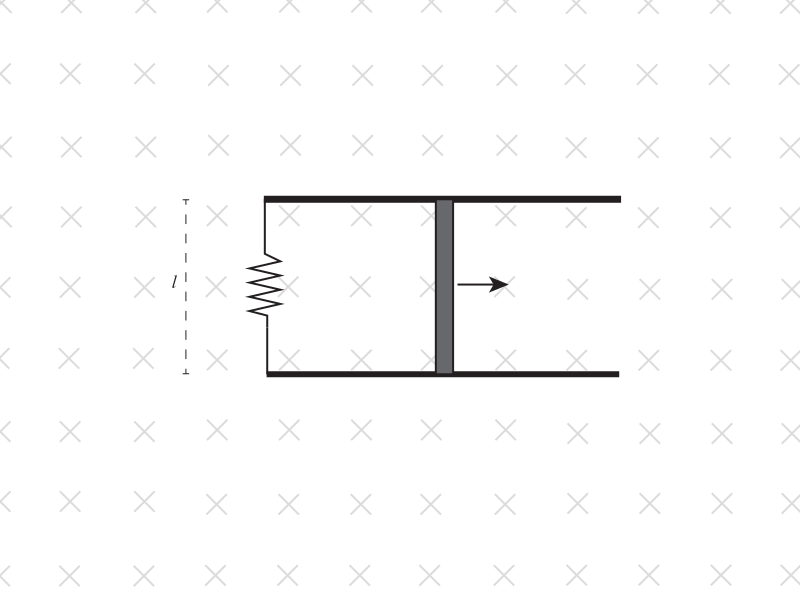
Consider a region where there is a 1.4 T magnetic field going into the screen. Perpendicular to it (over the screen), there is a circuit with a resistance of \(15 \Omega\). The bar that closes the circuit is 40 cm long and moves on frictionless rails to the right at a speed of 25 m/s, as shown in the figure. Assume the bar has negligible resistance.
a) Find the induced emf in the circuit.
b) Find the induced current in the circuit.
c) If we want the bar to move at a constant speed, how much force must be applied to the bar, and in which direction?
a) Use the definition of the induced emf from the magnetic flux. For the area, the dimensions can be related to the speed.
b) With the induced efm, use Ohm’s Law to get the current.
c) Find the magnetic force and use Newton’s Second Law.
a) Faraday’s Law states:
\begin{equation*}
\mathcal{E}=-\frac{d\Phi_B}{dt},
\end{equation*}
where the magnetic flux is:
\begin{equation*}
\Phi_B=-BA.
\end{equation*}
Since the area is \(A = \ell x\), then:
\begin{equation*}
\mathcal{E} = – \frac{d\Phi_B}{dt}= B\ell \frac{dx}{dt},
\end{equation*}
where \( \frac{dx}{dt} = v\). So:
\begin{equation*}
\mathcal{E}=B\ell v,
\end{equation*}
which numerically is
\begin{equation*}
\mathcal{E}=14\,\text{V}.
\end{equation*}
b) From Ohm’s Law, solving for \(I\) and replacing the value found for \( \mathcal{E}\) we get:
\begin{equation*}
I=\frac{B \ell v}{R},
\end{equation*}
or
\begin{equation*}
I \approx 0.93 \, \text{A}.
\end{equation*}
c) Since the magnetic force is \(\vec{F} = I \vec{L} \times \vec{B} \), then:
\begin{equation*}
\vec{F}_B=-ILB\,\hat{\textbf{i}},
\end{equation*}
which means the force is directed to the left. By Newton’s Second Law for motion with constant speed, we have:
\begin{equation*}
F – F_B = 0.
\end{equation*}
Then:
\begin{equation*}
F = ILB,
\end{equation*}
or:
\begin{equation*}
F \approx 0.52 \, \text{N}.
\end{equation*}
For a more detailed explanation of any of these steps, click on “Detailed Solution”.
a) We are required to find the induced electromotive force on the circuit. To solve this problem, we will use Faraday’s induction law to find the emf \(\mathcal{E}\) by calculating the change in the magnetic flux \(\Phi_B\). Faraday’s law states that
\begin{equation}
\label{fem}
\mathcal{E}=-\frac{d\Phi_B}{dt},
\end{equation}
where the magnetic flux \(\Phi_B\) over a given surface is defined as
\begin{equation}
\label{flujomag}
\Phi_B=\int_S \vec{B}\cdot \hat{\textbf{n}} dA,
\end{equation}
where \(\vec{B}\) is the magnetic field and \(\hat{\textbf{n}}\) is a unitary vector perpendicular to the surface \(S\) at each point, and \(dA\) is the area differential. For a flat surface such as that of the loop, and a constant magnetic field, the expression on \eqref{flujomag} simplifies to
\begin{equation}
\label{flujomag2}
\Phi_B=\int_S \vec{B}\cdot \hat{\textbf{n}} dA=\vec{B}\cdot \hat{\textbf{n}}\int_S dA,
\end{equation}
where we were able to take the unitary vector and the magnetic field outside the integration because they are constant (their magnitude and direction are the same over the whole surface). Hence, we get
\begin{equation}
\label{fluxB}
\Phi_B=\vec{B}\cdot\hat{\textbf{n}}\, A,
\end{equation}
where \(A\) is the area of the loop that is immersed in the magnetic field. We can express this area as
\begin{equation}
\label{arealoop}
A=\ell x,
\end{equation}
where \(x\) is the horizontal distance from the resistance to the moving bar as seen in figure 1.

Figure 1: Loop immersed in a constant magnetic field region that is pointing along the negative Z axis (going inside the screen). The moving bar has a velocity of \(\vec{v}\) and the dimensions of the loop are \(l\) and \(x\). The normal unitary vector \(\hat{\textbf{n}}\), pointing along the positive Z axis, is also shown. Notice the coordinate system that we have chosen.
From figure 1 we see that the magnetic field is directed towards the negative Z-axis, and so we can write
\begin{equation}
\label{bexplicit}
\vec{B}=-B\,\hat{\textbf{k}},
\end{equation}
where \(B\) is the magnitude of the magnetic field.
The unitary vector \(\hat{\textbf{n}}\) is perpendicular to the plane XY, and so we will take it to be directed along the positive Z-axis, as shown in figure 1 (it can also be directed towards the negative Z axis, but for simplicity we will choose the positive direction). Therefore, this unitary vector is just the same as \(\hat{\textbf{k}}\):
\begin{equation}
\label{normalvec}
\hat{\textbf{n}}=\hat{\textbf{k}}.
\end{equation}
Using this and the result from equation \eqref{bexplicit} into equation \eqref{fluxB}, we obtain
\begin{equation}
\label{flujoB2}
\Phi_B=(-B\,\hat{\textbf{k}})\cdot\hat{\textbf{k}}\,A=-BA,
\end{equation}
where we used the fact that \(\hat{\textbf{k}}\cdot\hat{\textbf{k}}=1\). Now, if we use the result from equation \eqref{arealoop} in this equation, we can write
\begin{equation}
\label{flujoB3}
\Phi_B=-B\ell x.
\end{equation}
To find the induced electromotive force (emf), we are interested in the temporal derivative of equation \eqref{flujoB3}:
\begin{equation}
\label{dtflujo}
\frac{d\Phi_B}{dt}=\frac{d(-B\ell x)}{dt}.
\end{equation}
Notice that \(B\) is constant, \(\ell\) is constant and only \(x\) varies (as the bar moves). Hence, we can calculate the temporal derivative as
\begin{equation}
\label{dtflujo2}
\frac{d\Phi_B}{dt}=-B\ell \frac{dx}{dt}.
\end{equation}
The rate at which \(x\) changes with time, \(dx/dt\), equals the bar’s speed \(v\) in the X axis. So, we can rewrite \eqref{dtflujo2} as
\begin{equation}
\label{dtflujo3}
\frac{d\Phi_B}{dt}=-B\ell v.
\end{equation}
Using this result back in equation \eqref{fem}, we obtain
\begin{equation}
\label{ecfem}
\mathcal{E}=-(-B\ell v)=B\ell v,
\end{equation}
which numerically is
\begin{equation}
\mathcal{E}=(1.4\,\text{T})(0.4\,\text{m})(25\,\text{m/s})=14\,\text{V}.
\end{equation}
Notice that the induced electromotive force is positive. Hence, according to the direction of the unitary vector \(\hat{\textbf{n}}\) and the right-hand rule, this means that the current in the circuit moves counter-clockwise. To see why, all we have to do is point our thumb of the right hand along the direction of the vector \(\hat{\textbf{n}}\); the direction at which the other fingers close define the positive direction of the current, as shown in figure 2.
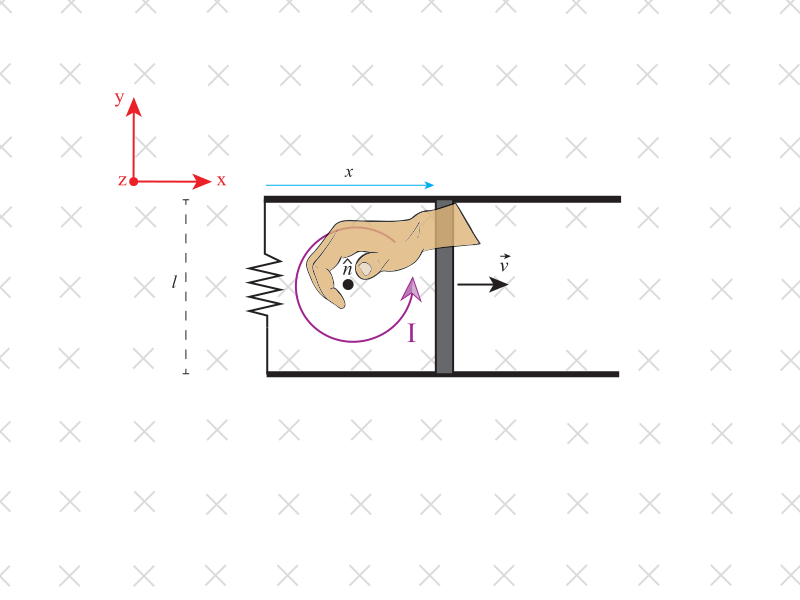
Figure 2: Because the induced emf is positive, the direction of the current is given by the right-hand rule. Pointing the thumb in the direction of \(\hat{\textbf{n}}\), the rest of the fingers indicate the direction at which the current flows. If emf was negative, then the current would have the opposite direction.
Since \(\mathcal{E}\) is positive, then the current flowing through the loops due to the electromotive force moves in a counter-clockwise direction.
b) To find the induced current on the circuit, we must use Ohm’s law
\begin{equation}
\label{ohm}
V=IR,
\end{equation}
where \(V\) is the voltage, \(I\) the current and \(R\) the resistance. In our case, emf is the same as the voltage. Then, solving for \(I\), we get
\begin{equation}
I=\frac{V}{R},
\end{equation}
or equivalently,
\begin{equation}
I=\frac{\mathcal{E}}{R}.
\end{equation}
Using here the result of equation \eqref{ecfem}, we finally get
\begin{equation}
I=\frac{B\ell v}{R},
\end{equation}
which numerically is
\begin{equation}
I=\frac{(1.4\,\text{T})(0.4\,\text{m})(25\,\text{m/s})}{15\,\Omega}\approx 0.93\,\text{A}.
\end{equation}
c) For the bar to move with a constant velocity, its acceleration must be zero. Thus, by Newton’s second law the sum of all forces exerted on the bar along the X direction must be zero:
\begin{equation}
\sum_X \vec{F}=m\vec{a},
\end{equation}
\begin{equation}
\label{f0}
\sum_X \vec{F}=\vec{0}.
\end{equation}
The two relevant forces exerted on the bar along the X direction are the magnetic force \(\vec{F}_B\), and the force we must apply to make sure the bar moves with constant velocity. The magnetic force is given by the Lorentz force, which in the absence of an electric field is
\begin{equation}
\label{lorentz}
\vec{F}_{B}=I\vec{L}\times\vec{B},
\end{equation}
where \(I\) is the current, \(L\) is a vector whose direction is the same as the current, and its magnitude is the length of the bar.
From the previous points, we know the magnitude of the induced current and its direction, which is counter-clockwise. This implies that for the moving bar, the current moves upwards, and so
\begin{equation}
\label{ele}
\vec{L}=L\,\hat{\textbf{j}},
\end{equation}
where \(L=0.4\,\text{m}\). Then, using the expressions given by \eqref{bexplicit} and \eqref{ele} into \eqref{lorentz}, we see that the magnetic force exerted on the bar is
\begin{equation}
\vec{F}_{B}=I(L\,\hat{\textbf{j}})\times(-B\,\hat{\textbf{k}}),
\end{equation}
\begin{equation}
\vec{F}_B=-ILB\,\hat{\textbf{j}}\times\hat{\textbf{k}},
\end{equation}
\begin{equation}
\label{fuerzamag}
\vec{F}_B=-ILB\,\hat{\textbf{i}},
\end{equation}
where in the last line we used the fact that \( \hat{\textbf{j}}\times\hat{\textbf{k}}=\hat{\textbf{i}}\) (which can be shown from the right-hand rule). From equation \eqref{fuerzamag}, we see that the magnetic force is directed towards the left, along the negative direction of the X axis. Its magnitude is \(ILB\). Therefore, if a force of the same magnitude but opposite direction is applied over the bar, the condition expressed in equation \eqref{f0} is satisfied. The force that must be applied is then
\begin{equation}
\vec{F}=ILB\,\hat{\textbf{i}},
\end{equation}
which numerically is
\begin{equation}
\vec{F}=(0.93\,\text{A})(0.4\,\text{m})(1.4\,\text{T})\hat{\textbf{i}},
\end{equation}
\begin{equation}
\vec{F}\approx 0.52\,\text{N}\,\hat{\textbf{i}}.
\end{equation}

Leave A Comment