
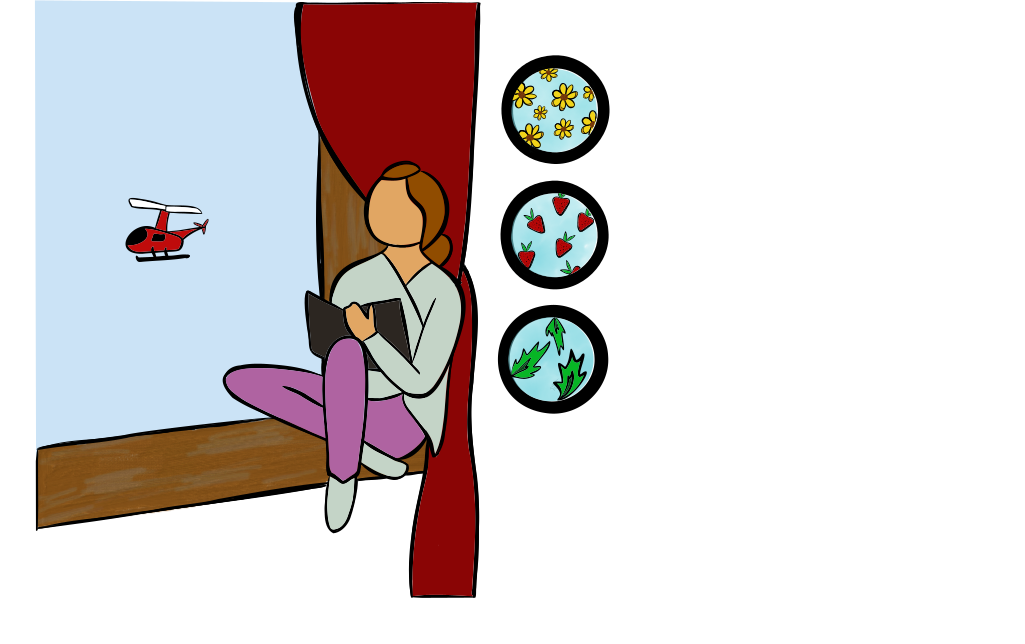
A toy helicopter flies upwards with an acceleration of \(0.5 \,\text{m}/\text{s}^2\), and passes by an apartment building. A curious neighbor notices the helicopter passing by her 2 m high window for a duration of 0.5 second. What floor is she on, assuming the average floor to ceiling height of each apartment unit is 3 meters? (Assume the helicopter started from rest on the ground and accelerates straight upward.)
Find the speed of the helicopter when it reaches the bottom of the window by taking into account the window’s height and the fact that the helicopter moves with constant acceleration. Then, find the height of the bottom of the window with respect to the floor. Finally, find a relation between this last height and the number of floors.
Consider the coordinate system to be on the base of the building. The height of the lowest part of the curious neighbor’s window is \(y_B\), and the height of the upper part of the window is \(y_A\). Let’s begin by writing the kinematic equation for \(y_A\), considering the situation at \(y_B\) as our starting point. Then, in the Y axis, we can write:
\begin{equation*}
\vec{y}_A=\vec{y}_B+\vec{v}_{B}\Delta t+\frac{1}{2}\vec{a}\Delta t^2.
\end{equation*}
Using the numerical values taking into account that \(y_A-y_B=2\,\text{m}\) is the height of the window and \(a=0.5\,\text{m/s}^2\), we get:
\begin{equation*}
v_B\approx 3.88\,\text{m/s}.
\end{equation*}
Now, we will use the following scalar kinematic equation for the Y axis that relates the variables at the floor and at point \(y_B\):
\begin{equation*}
v_B^2=v_0^2+2a(y_B-y_0).
\end{equation*}
Using the numerical values for \(a\) and the one for \(v_B\) calculated previously, we get:
\begin{equation*}
y_B \approx 15.02\,\text{m}.
\end{equation*}
If each floor has a height of approximately \(h=3\,\text{m}\), then the number of floors \(N\) below the curious neighbor is
\begin{equation}
N=\frac{y_B}{h} = \approx 5.01 \approx 5.
\end{equation}
Notice here that the “First floor” of a building would correspond to N close to zero. The second floor would correspond to N close to 1, and so on. Hence, the curious neighbor is on the 6th floor.
We need to calculate the floor number. To approach this problem we’ll first represent the situation using the drawing on figure 1.

Figure 1: We place the coordinate system at the bottom of the building. \(y_B\) is the height of the lower part of the window and \(y_A\) the height for the upper part.
As we see in the drawing, we consider the origin of our coordinate system to be on the base of the building. The height of the lowest part of the curious neighbor’s window is \(y_B\), and the height of the upper part of the window is \(y_A\). When the helicopter passes through \(y_B\) it has an unknown velocity \(v_B\). In order to solve for \(y_B\), we’ll first use the equations for a constant acceleration \(a\) motion to solve for \(v_B\). Once we find \(v_B\), we will be able to find, using another kinematic equation the height \(y_B\) (assuming the helicopter starts from the floor with zero speed).
Let’s begin by writing the kinematic equation for \(y_A\), considering the situation at \(y_B\) as our starting point. Then, in the Y axis we can write
\begin{equation}
\vec{y}_A=\vec{y}_B+\vec{v}_{B}\Delta t+\frac{1}{2}\vec{a}\Delta t^2,
\end{equation}
where \(\Delta t=0.5\,\text{s}\) is the time interval between point \(y_B\) and \(y_A\). Using unitary vectors based on the coordinate system, we get
\begin{equation}
y_A\,\hat{\textbf{j}}=y_B\,\hat{\textbf{j}}+v_B\Delta t\,\hat{\textbf{j}}+\frac{1}{2}a\Delta t^2\,\hat{\textbf{j}},
\end{equation}
which, after dropping the unitary vector notation (since everything happens in a straight line) and focusing on the magnitude of each vector, yields
\begin{equation}
y_A=y_B+v_B\Delta t+\frac{1}{2}a\Delta t^2.
\end{equation}
The only unknown variable in this equation is \(v_B\). To find it, we can move the other terms to the left:
\begin{equation}
y_A-y_B-\frac{1}{2}a\Delta t^2=v_B\Delta t.
\end{equation}
After dividing both sides by \(\Delta t\), we get
\begin{equation}
\frac{y_A-y_B}{\Delta t}-\frac{1}{2}a\Delta t=v_B.
\end{equation}
Using the numerical values taking into account that \(y_A-y_B=2\,\text{m}\) is the height of the window and \(a=0.5\,\text{m/s}^2\), we get:
\begin{equation}
v_B=\frac{2\,\text{m}}{0.5\,\text{s}}-\frac{1}{2}(0.5\,\text{m/s}^2)(0.5\,\text{s}),
\end{equation}
which is equivalent to
\begin{equation}
\label{vb}
v_B\approx 3.88\,\text{m/s}.
\end{equation}
Now, we will use the following scalar kinematic equation for the Y axis that relates the variables at the floor and at point \(y_B\):
\begin{equation}
\label{vb2}
v_B^2=v_0^2+2a(y_B-y_0),
\end{equation}
where \(v_0=0\) is the velocity of the helicopter on the floor and \(y_0=0\) is the position of the helicopter at the beginning of its journey upwards. Equation \eqref{vb2} can then be simplified to
\begin{equation}
v_B^2=2ay_B,
\end{equation}
which we can use to solve for \(y_B\) to arrive at the following expression:
\begin{equation}
y_B=\frac{v_B^2}{2a}.
\end{equation}
Using the numerical values for \(a\) and the one for \(v_B\) calculated in equation \eqref{vb}, we get
\begin{equation}
y_B=\frac{(3.88\,\text{m/s})^2}{2(0.5\,\text{m/s}^2)}
\end{equation}
This yields
\begin{equation}
y_B \approx 15.02\,\text{m}.
\end{equation}
If each floor has a height of approximately \(h=3\,\text{m}\), then the number of floors \(N\) below the curious neighbor is
\begin{equation}
N=\frac{y_B}{h},
\end{equation}
which numerically is
\begin{equation}
N=\frac{15.02\,\text{m}}{3\,\text{m}},
\end{equation}
\begin{equation}
N\approx 5.01\approx 5.
\end{equation}
Notice here that the “First floor” of a building would correspond to N close to zero. The second floor would correspond to N close to 1, and so on. Hence, the curious neighbor is on the 6th floor.




Leave A Comment