
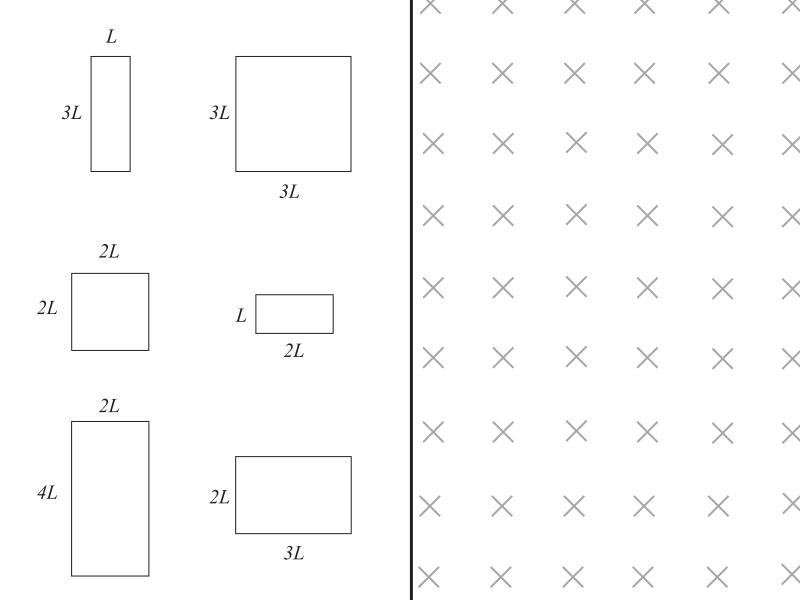
Consider six conducting loops with the dimensions shown in the figure. All of them enter a region with uniform magnetic field of magnitude \(B = 0.6 \, \text{T} \) that is perpendicular to the path of the loops, as shown in the figure. All the loops travel from left to right with a constant speed of \(v = 3.5 \ , \text{m/s}\). Take \(L = 1.4 \, \text{m}\).
a) Find the electromotive force that is generated on each of these loops when they are entering the magnetic field region.
b) Find the induced electromotive force on the loops when they are completely inside the magnetic field region.
a) Use the definition of the induced electromotive force (emf), where the dimensions for the loops can be written in terms of the horizontal length whose derivative can be related with the given velocity. The difference for each loop’s emf is in the dimensions of the loops.
b) Use the definition of induced-emf to see what happens this time.
a) The electromotive force is:
\begin{equation*}
\mathcal{E}=-\dfrac{d\Phi_B}{dt},
\end{equation*}
where the magnetic flux is just \(\Phi_B = BA\) in this case. The area is \(A=hx\). Then:
\begin{equation*}
\mathcal{E}= Bh \dfrac{dx}{dt},
\end{equation*}
where \( \dfrac{dx}{dt} = v_x\). So
\begin{equation*}
\mathcal{E} = Bhv_x.
\end{equation*}
Now for loops III and VI, we have the same \(h=2L\), and so
\begin{equation*}
\mathcal{E}_\text{III}=\mathcal{E}_{\text{VI}}=B2Lv_x =5.88\,\text{V}.
\end{equation*}
For loop IV, \(h=L\), and so we get
\begin{equation*}
\mathcal{E}_{\text{IV}}=BLv_x = 2.94\,\text{V}.
\end{equation*}
Finally, for loop V, \(h=4L\), and then we see that
\begin{equation*}
\mathcal{E}_\text{V}=B4Lv_x = 11.76\,\text{V}.
\end{equation*}
The current is counter-clockwise for all loops.
b) When the loops are totally immersed then:
\begin{equation*}
\frac{d\Phi_B}{dt}=\frac{d(-Bhw)}{dt}=0.
\end{equation*}
Then:
\begin{equation*}
\mathcal{E}=0,
\end{equation*}
For a more detailed explanation of any of these steps, click on “Detailed Solution”.
a) They ask us to find the induced electromotive force on each of the loops as they enter the magnetic field. To solve this problem, we will first derive a general expression for the induced electromotive force in a loop of height \(h\) and width \(w\), as shown in figure 1.
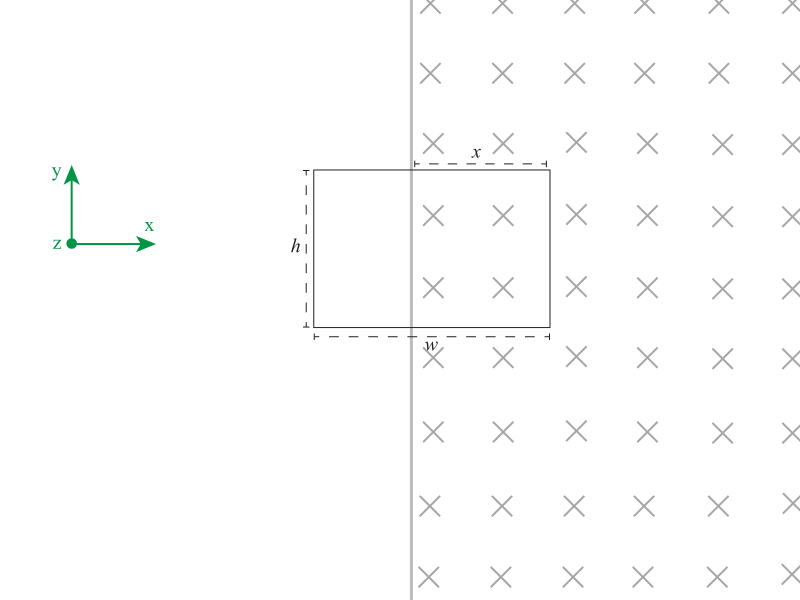
Figure 1: A loop wire entering a region of magnetic field \(\vec{B}\) (the field enters the screen). The coordinate axes are chosen such that the loop moves along the positive X-axis, and the magnetic field moves along the negative Z-axis.
In figure 1, \(x\) is the horizontal portion of loop that is inside the region with the magnetic field. As the loop moves towards the right, \(x\) increases from zero up to its maximum value \(w\). To find the electromotive force \(\mathcal{E}\), we must use Faraday’s induction law, which tells us that the rate of change in magnetic flux over a given area per some unit of time equals the negative of the electromotive force;
\begin{equation}
\label{fem}
\mathcal{E}=-\dfrac{d\Phi_B}{dt},
\end{equation}
where \(\Phi_B\) is the magnetic flux. This flux is defined over a surface \(S\) as
\begin{equation}
\label{flujomag}
\Phi_B=\int_S\vec{B}\cdot \hat{\textbf{n}}\, dA,
\end{equation}
where \(\vec{B}\) is the magnetic field, \(\hat{\textbf{n}}\) is a unitary vector perpendicular to the surface \(S\) at each point, and \(dA\) is an area differential. In this case, the relevant surface is the area of the loop that is inside the field, and so the unitary vector \(\hat{\textbf{n}}\) is perpendicular to the XY plane (the surface of the loop is on the XY plane). We are free to choose if \(\hat{\textbf{n}}\) is directed towards the positive Z-axis or towards the negative Z-axis, all that matters is that it is perpendicular to the XY plane. Let’s choose the positive direction of Z.
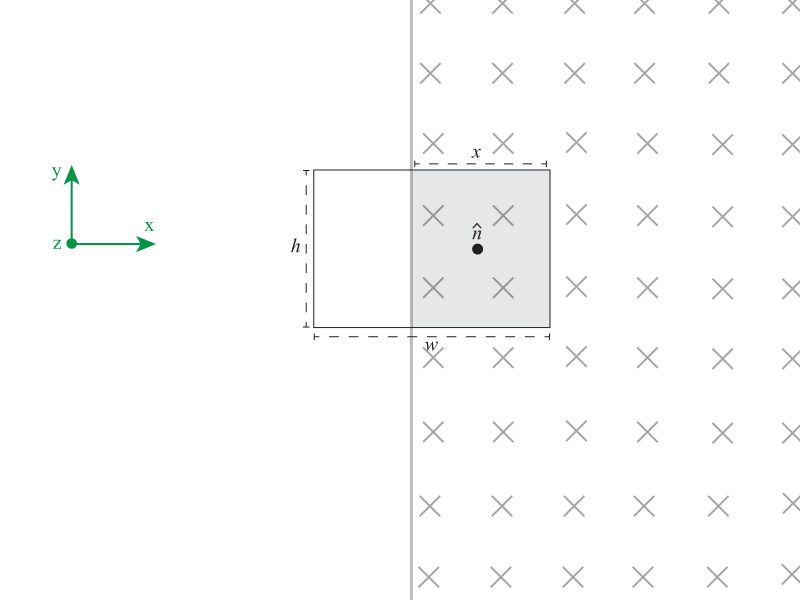
Figure 2: The shaded region of the loop is the one inside the region of non-zero magnetic field. The unitary vector \(\hat{\textbf{n}}\) is perpendicular to the shaded area, and points towards the positive Z-axis (it points outside the screen).
For a flat surface such as that of the loop, and a constant magnetic field, the expression on \eqref{flujomag} simplifies to
\begin{equation}
\label{flujomagb}
\Phi_B=\int_S\vec{B}\cdot \hat{\textbf{n}}\, dA=\vec{B}\cdot \hat{\textbf{n}}\int_S\, dA,
\end{equation}
where we moved the magnetic field and \(\hat{\textbf{n}}\) outside the integral because they are both constant (their directions and magnitudes do not change). Hence, all we must do now is integrate over the area differential, which is the same as finding the total area of the surface in question:
\begin{equation}
\label{fluxB}
\Phi_B=\vec{B}\cdot\hat{\textbf{n}}\, A.
\end{equation}
Here \(A\) is the area of the loop that is immersed in the magnetic field, which we can write as
\begin{equation}
\label{arealoop}
A=hx.
\end{equation}
From the figure 2, we see that the magnetic field is directed towards the negative Z axis. Then, we can write
\begin{equation}
\label{bexplicit}
\vec{B}=-B\,\hat{\textbf{k}},
\end{equation}
where \(B\) is the magnitude of the magnetic field. On the other hand, we know that \(\hat{\textbf{n}}\) goes in the positive Z direction (we chose it that way), and its magnitude is one (it is a unitary vector). This means that this vector must be the same as \(\hat{\textbf{k}}\):
\begin{equation}
\label{normalvec}
\hat{\textbf{n}}=\hat{\textbf{k}}.
\end{equation}
Using the result from equations \eqref{bexplicit} and \eqref{normalvec} into equation \eqref{fluxB}, we obtain
\begin{equation}
\label{flujoB2}
\Phi_B=(-B\,\hat{\textbf{k}})\cdot\hat{\textbf{k}}\,A=-BA,
\end{equation}
where we used the fact that \(\hat{\textbf{k}}\cdot\hat{\textbf{k}}=1\). If we use the result from equation \eqref{arealoop} into \eqref{flujoB2}, we can write
\begin{equation}
\label{flujoB3}
\Phi_B=-Bhx.
\end{equation}
Now, to find the induced electromotive force, we are interested in the temporal derivative of this result:
\begin{equation}
\label{dtflujo}
\frac{d\Phi_B}{dt}=\frac{d(-Bhx)}{dt}.
\end{equation}
Notice that \(B\) is constant, \(h\) is constant and so only \(x\) varies (as the loop enters the region). Hence, we can calculate the temporal derivative as
\begin{equation}
\label{dtflujo2}
\frac{d\Phi_B}{dt}=-Bh\frac{dx}{dt}.
\end{equation}
But notice now that the rate at which \(x\) changes with time \(dx/dt\) is equal to the speed along the X axis of the loop, \(v_x\). Then, we can rewrite \eqref{dtflujo2} as
\begin{equation}
\label{dtflujo3}
\frac{d\Phi_B}{dt}=-Bhv_x.
\end{equation}
Use now this result back in equation \eqref{fem}, to obtain
\begin{equation}
\label{ecfem}
\mathcal{E}=-(-Bhv_x)=Bhv_x.
\end{equation}
We can see that for the situation of the prompt, the electromotive force only depends on the magnetic field, the speed at which the loop enters the region with the magnetic field, and the vertical dimension of the loop.
We will now use equation \eqref{ecfem} to explicitly calculate the electromotive force for each loop. We will enumerate the loops by row, as shown in figure 3.
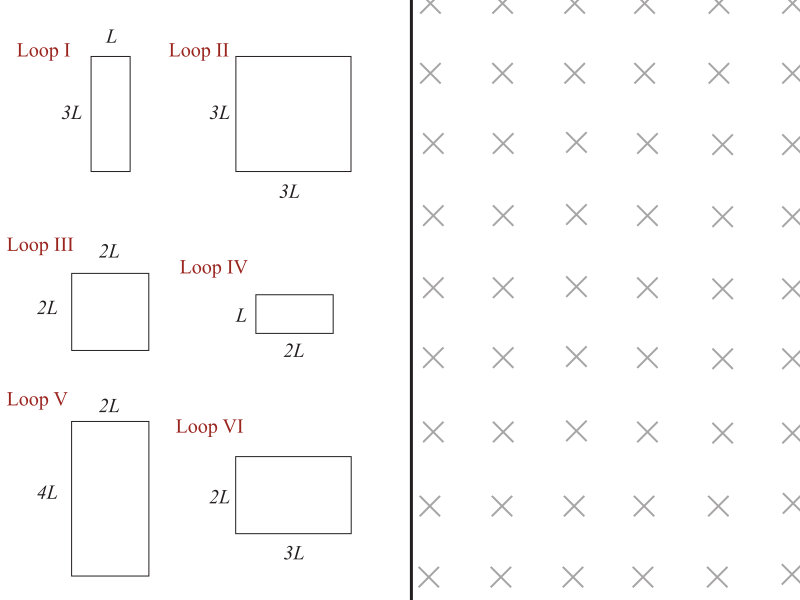
Figure 3: We enumerate the different loops to be able to reference them in what follows.
Loops I and II have the same \(h=3L\), and so we have
\begin{equation}
\mathcal{E}_\text{I}=\mathcal{E}_{\text{II}}=B3Lv_x.
\end{equation}
Using the numerical values, we get
\begin{equation}
\mathcal{E}_\text{I}=\mathcal{E}_{\text{II}}=(0.6\,\text{T})3(1.4\,\text{m})(3.5\,\text{m/s})=8.82\,\text{V},
\end{equation}
where the units are volts (V).
Now for loops III and VI, we have the same \(h=2L\), and so
\begin{equation}
\mathcal{E}_\text{III}=\mathcal{E}_{\text{VI}}=B2Lv_x.
\end{equation}
After using the numerical values, we get
\begin{equation}
\mathcal{E}_\text{I}=\mathcal{E}_{\text{II}}=(0.6\,\text{T})2(1.4\,\text{m})(3.5\,\text{m/s})=5.88\,\text{V}.
\end{equation}
For loop IV, \(h=L\), and so we get
\begin{equation}
\mathcal{E}_{\text{IV}}=BLv_x.
\end{equation}
Or, after using the numerical values, we find
\begin{equation}
\mathcal{E}_\text{I}=\mathcal{E}_{\text{II}}=(0.6\,\text{T})(1.4\,\text{m})(3.5\,\text{m/s})=2.94\,\text{V}.
\end{equation}
Finally, for loop V, \(h=4L\), and then we see that
\begin{equation}
\mathcal{E}_\text{V}=B4Lv_x.
\end{equation}
Or after using the numerical values, we get
\begin{equation}
\mathcal{E}_\text{I}=\mathcal{E}_{\text{II}}=(0.6\,\text{T})4(1.4\,\text{m})(3.5\,\text{m/s})=11.76\,\text{V}.
\end{equation}
Notice that in every case, the induced electromotive force is positive. According to the direction of the unitary vector \(\hat{\textbf{n}}\) and the right-hand rule, this means that the current in each loop move counter-clockwise. To see why, all we have to do is point our thumb in the right hand in the direction of the vector \(\hat{\textbf{n}}\). The direction at which the other fingers close defines the positive direction of the current. Since \(\mathcal{E}\) is positive in each case, then the current flowing through the loops due to the electromotive force moves in a counter-clockwise direction, as illustrated in figure 4.
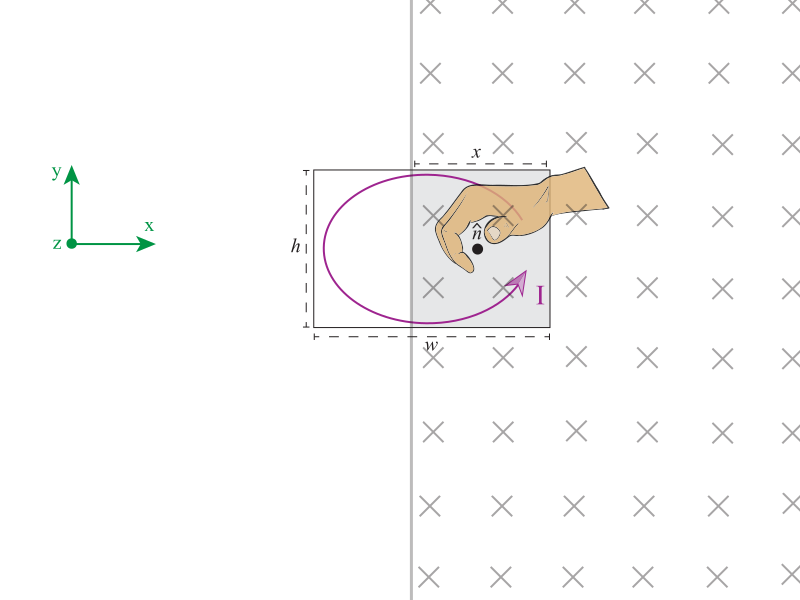
Figure 4: Because the induced emf is positive, we point the thumb in the direction of \(\hat{\textbf{n}}\) and the direction of the rest of the fingers indicate the direction at which the induced current \(I\) flows.
b) In the case when the loops are totally immersed in the region with the magnetic field, we can still calculate the magnetic flux using equation \eqref{flujoB2}. The only thing that changes is the area \(A\) of the loop that is immersed in the region with the magnetic field. Now the area is just the area of the whole loop, namely
\begin{equation}
\label{areatotal}
A=hw.
\end{equation}
Then, putting this result into equation \eqref{flujoB2}, we obtain
\begin{equation}
\Phi_B=-Bhw.
\end{equation}
Notice that each one of these factors is constant. Then, if we take the temporal derivative the result will be zero. Explicitly,
\begin{equation}
\label{fluxb2}
\frac{d\Phi_B}{dt}=\frac{d(-Bhw)}{dt}=0.
\end{equation}
Thus, if we go back to equation \eqref{fem}, we see that in this case
\begin{equation}
\mathcal{E}=0,
\end{equation}
for all loops. This makes sense; the emf is always associated with changes in the magnetic flux, but if the whole loop is already inside the region with the magnetic field, then the flux will be constant because the area of the loop is constant (and the field does not change).

Leave A Comment