

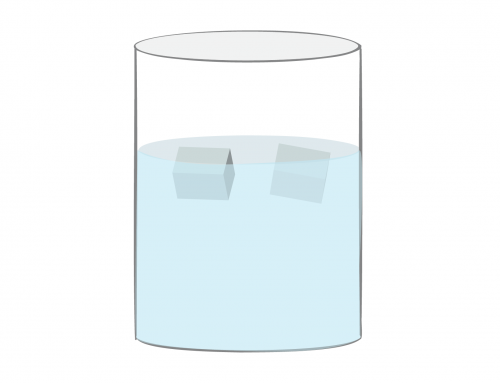
A jacuzzi with \(3,000 \, \text{L}\) of water at a temperature of \(40\, ^{\circ}\text{C}\) is switched off overnight and allowed to cool down until it reaches the same temperature as the air \((5\, ^{\circ}\text{C})\).
a) How much does the entropy of the water change?
b) How much does the entropy of the surrounding air change?
c) How much does the total entropy change?
a) Use the definition of entropy as an integral of the differential heat, and perform the integral with the given temperatures.
b) Consider the air as an isothermal system. The definition of entropy will then be given in terms of the heat and the constant temperature of the air.
c) You already found both entropies needed to find the sum.
a) The change of entropy as a general expression is:
\begin{equation*}
\Delta S=\int\frac{dQ}{T},
\end{equation*}
where \(dQ = mc dT\) as the change of heat for the water.
The integral becomes:
\begin{equation*}
\Delta S_{\text{water}}=\int \frac{mc\,dT}{T}.
\end{equation*}
After performing the integral we get:
\begin{equation*}
\Delta S_{\text{water}}= mc\ln\left(\frac{T_f}{T_i}\right),
\end{equation*}
or with numerical values:
\begin{equation*}
\Delta S_{\text{water}} \approx – 1.49 \times 10^6 \, \text{J/K}.
\end{equation*}
b) For the air as an isothermal system, the temperature can be took out from the integral to get:
\begin{equation*}
\Delta S_{\text{air}}=\frac{Q_{\text{air}}}{T_{\text{air}}},
\end{equation*}
where \( Q_{\text{air}} = -Q_{\text{water}} \) which is easily found with the given values of the problem since \(Q_{\text{water}} = mc \Delta T\). Then:
\begin{equation*}
\Delta S_{\text{air}}\approx 1.579 \times 10^6 \,\text{J/K}.
\end{equation*}
c) The total entropy can be calculated as:
\begin{equation*}
\Delta S_{\text{system}}=\Delta S_{\text{water}}+\Delta S_{\text{air}}.
\end{equation*}
And numerically:
\begin{equation*}
\Delta S_{\text{system}}\approx 8.9 \times 10^4 \,\text{J/K}.
\end{equation*}
For a more detailed explanation of any of these steps, click on “Detailed Solution”.
We can use the definition of entropy change to find how much the entropy of the water and of the surrounding air changes. In order to do this, we must first write expressions for the heat transferred in terms of the temperatures of both the water and the air at their initial and final states.
An infinitesimal entropy change \(dS\) of a system during a thermodynamic process is defined as
\begin{equation}
\label{EQ:ds}
dS = \frac{dQ_{\text{rev}}}{T},
\end{equation}
where \(T\) is the temperature of the system and \(dQ_{\text{rev}}\) is a very small amount of heat absorbed by the system during a reversible process. We should keep in mind that this does not mean that the actual process we are considering has to be reversible in order for us to be able to calculate the entropy change. Since entropy is a state variable, the change in entropy between an initial and a final state will be the same regardless of the process by which the change occurs. Hence, we can define a process that facilitates the calculations as long as it has the same initial and final states compared to the actual process we are considering.
The total change in entropy \(\Delta S\) of a process can be found by integrating eq. \eqref{EQ:ds} between the initial and final states. In order to perform the integration, we must first write an expression for \(dQ_{rev}\) in terms of the state variables of the system.
a) Since the water remains in the same container, the atmospheric and hydrostatic pressure will be the same throughout the process. In other words, this process occurs under constant pressure. For this type of process, the relation between a small amount of heat absorbed by the system \(dQ\) and the temperature change it produces is given by
\begin{equation}
\label{EQ:dq_1}
dQ = C_p dT,
\end{equation}
where \(C_p\) is the heat capacity of the material at constant pressure. By definition, we can write the heat capacity as
\begin{equation}
C_p = m c_p,
\end{equation}
where \(m\) is the mass of the substance and \(c_p\) is its specific heat capacity at a constant pressure of the material. Substituting this in eq. \eqref{EQ:dq_1} gives
\begin{equation}
dQ = m c_p dT.
\end{equation}
In this particular case, the heat absorbed by the water \(dQ_w\) in the jacuzzi is related to its change in temperature by
\begin{equation}
\label{EQ:dq_2}
dQ_w = m_w c_{p,w} dT,
\end{equation}
where \(m_w\) is the mass of the water in the jacuzzi, and \(c_{p,w}\) is its specific heat capacity at constant pressure.
Since we are given the volume of water, we can write the mass in terms of the volume by using the density of water \(\rho_w\), which is given by
\begin{equation}
\rho_w = \frac{m_w}{V_w},
\end{equation}
where \(V_w\) is the volume of water in consideration. Multiplying by \(V_w\) yields
\begin{equation}
m_w = \rho_w V_w.
\end{equation}
Hence, if we insert this equation in eq. \eqref{EQ:dq_2}, we get
\begin{equation}
\label{EQ:dq_3}
dQ_w = \rho_w V_w c_{p,w} dT.
\end{equation}
In order to calculate the entropy, let’s consider an alternative process in which water undergoes the same temperature change occuring at a constant pressure, but it does so very slowly so that the process is reversible. In this case, the expression relating the heat absorbed by the water and the temperature is the same as eq. \eqref{EQ:dq_3}, but since this process is reversible, we can use it to calculate the change in entropy. Therefore, by setting \(dQ_{\text{rev}} = dQ_w\) in eq. \eqref{EQ:ds}, we find that the infinitesimal change in entropy of water \(dS_w\) is given by
\begin{equation}
dS_w = \frac{dQ_w}{T},
\end{equation}
and substituting in eq. \eqref{EQ:dq_3} yields
\begin{equation}
dS_w = \rho_w V_w c_{p,w} \frac{dT}{T}.
\end{equation}
We must integrate this expression between the initial and final temperatures of the water \(T_i\), and \(T_f\) in order to find its total change in entropy \(\Delta S_w\). This can be written as
\begin{equation}
\Delta S_w = \int_{T_i}^{T_f} dS_w = \int_{T_i}^{T_f} \rho_w V_w c_{p,w} \frac{dT}{T} .
\end{equation}
If we take the constant terms out of the integral, we obtain
\begin{equation}
\Delta S_w = \rho_w V_w c_{p,w} \int_{T_i}^{T_f} \frac{dT}{T},
\end{equation}
and solving the integral yields
\begin{equation}
\Delta S_w = \rho_w V_w c_{p,w} \ \ln \left(T\right)\Big|_{T_i}^{T_f} = \rho_w V_w c_{p,w} \left(\ln \left(T_f\right) – \ \ln \left(T_i\right)\right).
= \rho_w V_w c_{p,w} \ \ln \left(\frac{T_f}{T_i}\right).
\end{equation}
After inserting numerical values, we get
\begin{equation}
\label{EQ:a}
\Delta S_w = \left(1 \ \frac{\text{kg}}{L}\right) \left(3000 \ L\right) \left(4182\frac{L}{\text{kg}\ \text{K}}\right) \ \ln \left(\frac{ \left(5 + 273.15\right)\ \text{K} }{ \left(40 + 273.15\right)\text{K} }\right)
= -1.49 \times 10^6 \ \frac{\text{J}}{\text{K}}.
\end{equation}
b) Now, we have to find the change in entropy of the air. The mass of surrounding air is so large that the temperature change produced by the heat it absorbs from the jacuzzi is negligible. Hence, if we let \(T = T_{\text{air}}\) in eq. \eqref{EQ:ds}, we get
\begin{equation}
dS_{\text{air}} = \frac{dQ_{\text{rev}}}{T_{\text{air}}},
\end{equation}
and thus,
\begin{equation}
\Delta S_{\text{air}} = \int dS = \int \frac{dQ_{\text{rev}}}{T_{\text{air}}} = \frac{1}{T_{\text{air}}} \int dQ_{\text{rev}}.
\end{equation}
Here we used the fact that the temperature of the air remains essentially constant as it absorbs heat from the jacuzzi to pull \(T_{\text{air}}\) out of the integral. Now, the integral of \(dQ_{\text{rev}}\) is simply the total heat absorbed by the air \( Q_{\text{rev}}\) during a reversible process, i.e.
\begin{equation}
\label{EQ:DS_air}
\Delta S_{\text{air}} = \frac{1}{T_{\text{air}}} Q_{\text{rev}}.
\end{equation}
The heat absorbed by the air is the same as the heat released by the water. We can write this as
\begin{equation}
\label{EQ:Qair}
Q_{\text{air}} = – Q_w,
\end{equation}
and we can calculate \(Q_w\) from eq. \eqref{EQ:dq_3} as
\begin{equation}
Q_w = \int_{T_i}^{T_f} dQ_w = \int_{T_i}^{T_f} \rho_w V_w c_{p,w} dT = \rho_w V_w c_{p,w} \int_{T_i}^{T_f} dT = \rho_w V_w c_{p,w} T\Big|_{T_i}^{T_f} ,
\end{equation}
which is equivalent to
\begin{equation}
Q_w = \rho_w V_w c_{p,w}(T_f – T_i).
\end{equation}
where \(T_i\) and \(T_f\) are the initial and final temperatures of the water. The final temperature of the water is the same as the temperature of the air. Hence,
\begin{equation}
Q_w = \rho_w V_w c_{p,w}(T_{\text{air}} – T_i),
\end{equation}
and inserting this equation in eq. \eqref{EQ:Qair}, we get
\begin{equation}
\label{EQ:Qair2}
Q_{\text{air}} = – \rho_w V_w c_{p,w}(T_{\text{air}} – T_i).
\end{equation}
Now, in order to calculate the entropy. Let’s consider a reversible process in which the air absorbs an amount of heat \(Q_{\text{air}}\) without changing its temperature but does it very slowly so that the process is reversible. This hypothetical process has the same initial and final states as the actual process, and so we can use it to calculate the entropy of the actual process. The amount of heat absorbed by the air during this process is \(Q_{\text{rev}} = Q_{\text{air}}\). Hence, substituting this in eq. \eqref{EQ:DS_air} gives
\begin{equation}
\Delta S_{\text{air}} = \frac{1}{T_{\text{air}}} Q_{\text{air}},
\end{equation}
and if we insert eq. \eqref{EQ:Qair2} in this eq., we obtain
\begin{equation}
\label{EQ:b}
\Delta S_{\text{air}} = \frac{1}{T_{\text{air}}} ( – \rho_w V_w c_{p,w}(T_{\text{air}} – T_i) )
= \rho_w V_w c_{p,w} \frac{T_i – T_{\text{air}}}{T_{\text{air}}}.
\end{equation}
Finally, after inserting numerical values, we obtain
\begin{equation}
\Delta S_{\text{air}} = \left(1 \ \frac{\text{K}g}{L}\right) \left(3000 \ L\right) \left(4182 \ \frac{L}{\text{kg}\ \text{K}}\right) \left( \frac{\left(40 – 5\right)\ \text{K}} { \left(5 + 273.15\right) \ \text{K} } \right),
\end{equation}
which is the same as
\begin{equation}
\Delta S_{\text{air}} = 1.579 \ \times 10^6 \ \frac{\text{J}}{\text{K}}.
\end{equation}
c) The total entropy change \(\Delta S_T\) is simply the entropy change of the water plus the entropy change of the air i.e.
\begin{equation}
\Delta S_T = \Delta S_{w} + \Delta S_{\text{air}},
\end{equation}
and substituting eqs. \eqref{EQ:a} and \eqref{EQ:b}, we obtain
\begin{equation}
\Delta S_T = -1.49 \times 10^6 \ \frac{\text{J}}{\text{K}} + 1.579 \times 10^6 \ \frac{\text{J}}{\text{K}}
= 8.9 \times 10^4 \ \frac{\text{J}}{\text{K}}.
\end{equation}
The total entropy is positive, as we can expect from the Second Law of thermodynamics, which states that the total entropy never decreases during a process.


Leave A Comment