

A large ice block, at temperature of \(0\, ^{\circ}\text{C}\), slides down a 15 m-high hill that has a \(30 ^{\circ}\) incline. If the coefficient of kinetic friction between the ice cube and the surface of the hill is 0.3, and all the work done by friction is dissipated as thermal energy, calculate the fraction of ice that melts.
Find the work done by the force due to friction with the given values, and relate the work to the thermal energy required to melt the ice. This will help you to find the fraction of melted ice.
The thermal energy required to melt the ice is:
\begin{equation*}
Q = m_m L_f,
\end{equation*}
and the work done by the force due to friction is:
\begin{equation*}
W_f = -f x.
\end{equation*}
The distance and the angle can be related as:
\begin{equation*}
\sin \alpha = \frac{h}{x}.
\end{equation*}
Based on Newton’s Second Law, we get:
\begin{equation*}
N – mg \cos\alpha = 0,
\end{equation*}
and since the friction is \(f = \mu N\), the work can be written by substituting all the found variables. Then:
\begin{equation*}
W_f = – \mu mg h \cot\alpha.
\end{equation*}
The dissipated thermal energy is written as \(|W_f| = Q \). Then, dividing by the mass \(m\) we get:
\begin{equation*}
\frac{m_m}{m}= \frac{\mu g h \cot\alpha}{L_f},
\end{equation*}
or:
\begin{equation*}
\frac{m_m}{m} = 2.3 \times 10^{-4}.
\end{equation*}
For a more detailed explanation of any of these steps, click on “Detailed Solution”.
We can get an expression for the mass of ice that melts by relating the heat absorbed by the ice block with its latent heat of fusion. The heat absorbed by the ice equals the work done by the friction force. In order to find the friction force, we must apply Newton’s second law on the ice block.
The ice block is at \(0\, ^{\circ}\text{C}\), which is the fusion point of water. At this temperature, any heat absorbed by the water will be used to transition to the liquid phase. The temperature will not increase until all the ice has melted. The mass of ice that melts \(m_m\) can be related to the heat absorbed by the ice \(Q\) by using the following equation:
\begin{equation}
\label{EQ:latent}
Q = m_m L_f,
\end{equation}
where \(L_f\) is the latent heat of fusion for water, which represents how much heat is required to turn a certain mass of ice into liquid water.
Now, we are told that all the work performed by the friction force, \(W_f\), is dissipated as heat, which is absorbed by the ice cube. We can write this as
\begin{equation}
|W_f| = Q,
\end{equation}
and substituting in eq. \eqref{EQ:latent}, we get
\begin{equation}
\label{EQ:latent2}
|W_f| = m_m L_f.
\end{equation}
We should now find an expression for \(W_f\). Recall that the work \(W_F\) performed by a force \(\vec{F}\) on an object as it moves a distance \(x\) in straight line is given by
\begin{equation}
W_F = F x \cos \theta,
\end{equation}
where theta is the angle between \(\vec{F}\) and the displacement vector \(\vec{x}\) (i.e. the vector pointing from the initial point towards the final point of the displacement whose magnitude equals the distance traveled by the object). In our particular case, we can write this equation as
\begin{equation}
W_f = f x \cos \theta,
\end{equation}
where \(f\) is the magnitude of the friction force. Figure 1 shows the directions of \(\vec{f}\) and \(\vec{x}\). We can notice that they are antiparallel. Hence, \( \theta = 180 ^{\circ}\), and \(\cos \theta = -1\). Therefore,
\begin{equation}
\label{EQ:wf}
W_f = f x (-1) = -f x.
\end{equation}
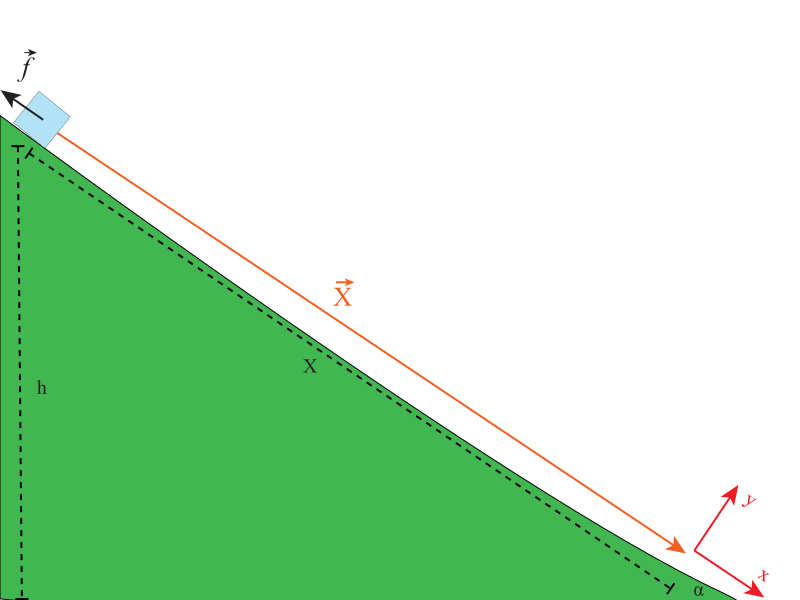
Figure 1: We place our coordinate system at the bottom of the hill with the X axis parallel to the inclination of the hill. The height \(h\) of the block and the distance travelled along the hill \(\vec{x}\) are also shown. The friction force \(\vec{f}\) is parallel to the X axis along its negative direction.
Also, notice that in figure 1 we can write the distance \(x\) (which we do not know) in terms of \(h\) and the slope \(\alpha\) as
\begin{equation}
\sin \alpha = \frac{h}{x}.
\end{equation}
If we multiply by \(x\), we get
\begin{equation}
x \sin \alpha = h,
\end{equation}
and if we divide by \(\sin \alpha\), we get
\begin{equation}
x = \frac{h}{\sin \alpha}.
\end{equation}
Substituting this in eq. \eqref{EQ:wf}, we get
\begin{equation}
\label{EQ:wf2}
W_f = \frac{f h }{\sin \alpha}.
\end{equation}
Now, in order to find the magnitude of the friction force \(f\), we need to use Newton’s second law. The force diagram for the ice cube is depicted in figure 2.
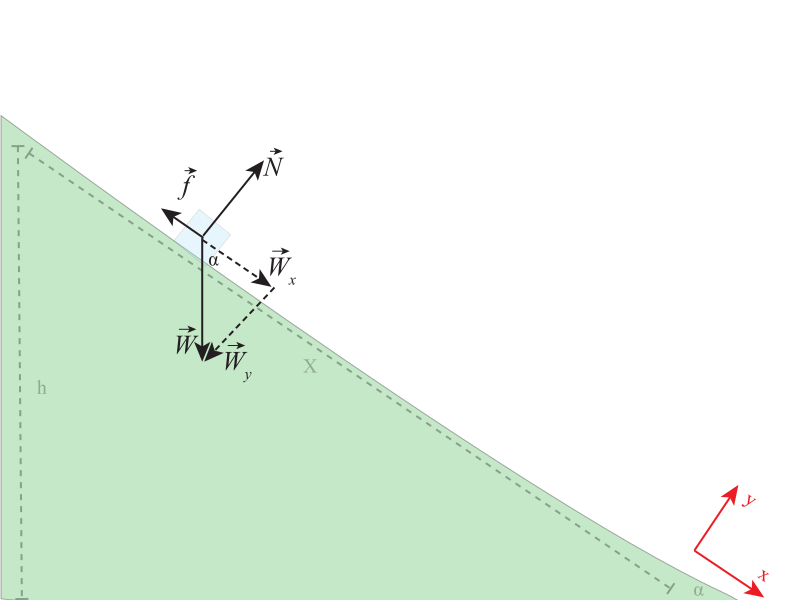
Figure 2: Free-body diagram for the ice block. The three forces exerted on the block: the normal force \(\vec{N}\) , the friction \(\vec{f}\), and the weight \(\vec{W}\).
In figure 2, \(\vec{f}\) is the friction, \(\vec{N}\) is the normal force exerted by the surface on the block, and \(\vec{W}=m\vec{g}\) is the weight of the ice block. The friction force is related to the normal force as
\begin{equation}
\vec{f} = \mu \vec{N},
\end{equation}
where \(\mu\) is the kinetic coefficient of friction. Focusing only on the magnitudes, we get
\begin{equation}
\label{EQ:f}
f = \mu N.
\end{equation}
We are given \(\mu\), so we should find \(N\). According to figure 2, \(N\) is in the \(y\)-axis. We can write Newton’s second law along this axis as
\begin{equation}
\label{EQ:n2l}
N – mg_y = ma_y,
\end{equation}
where \(m\) is the mass of the ice cube, \(mg_y\) represents the component of the weight along the \(y\)-axis, and \(a_y\) represents the acceleration in the \(y\) direction. The block only moves downhill along the \(x\)-axis. Therefore,
\begin{equation}
a_y = 0.
\end{equation}
Substituting this in eq. \eqref{EQ:n2l}, we get
\begin{equation}
N – mg_y = 0.
\end{equation}
Now, notice from figure 2 that we can write \(mg_y\) as
\begin{equation}
mg_y = mg \cos\alpha.
\end{equation}
Hence,
\begin{equation}
N – mg \cos\alpha = 0,
\end{equation}
or equivalently
\begin{equation}
N = mg\cos\alpha.
\end{equation}
Substituting this in eq. \eqref{EQ:f} gives
\begin{equation}
f = \mu mg \cos\alpha.
\end{equation}
We now have an expression for the friction force in terms of known variables. If we substitute it in eq. \eqref{EQ:wf2}, we find that the work done by the friction force is given by
\begin{equation}
W_f =\frac{- (\mu mg \cos\alpha) h}{\sin\alpha}
= – \mu mg h \cot\alpha.
\end{equation}
Substituting this expression in eq. \eqref{EQ:latent2} yields
\begin{equation}
|-\mu m g h \cot\alpha| = m_m L_f,
\end{equation}
or equivalently
\begin{equation}
m \mu g h \cot\alpha = m_m L_f.
\end{equation}
If we divide by \(m L_f\), we get
\begin{equation}
\frac{m_m}{m}= \frac{\mu g h \cot\alpha}{L_f},
\end{equation}
which is the fraction of mass of ice that melted as it moved downhill. Inserting numerical values, we obtain
\begin{equation}
\frac{m_m}{m} = \frac{(0.3)( 9.8 \frac{\text{m}}{\text{s}^2}) (15 \ \text{m}) \cot(30 ^{\circ})}{333500\ \frac{\text{J}}{\text{kg}}}
= 2.3 \times 10^{-4}.
\end{equation}
Only \(0.023\%\) of the ice melts under these conditions.


Leave A Comment