
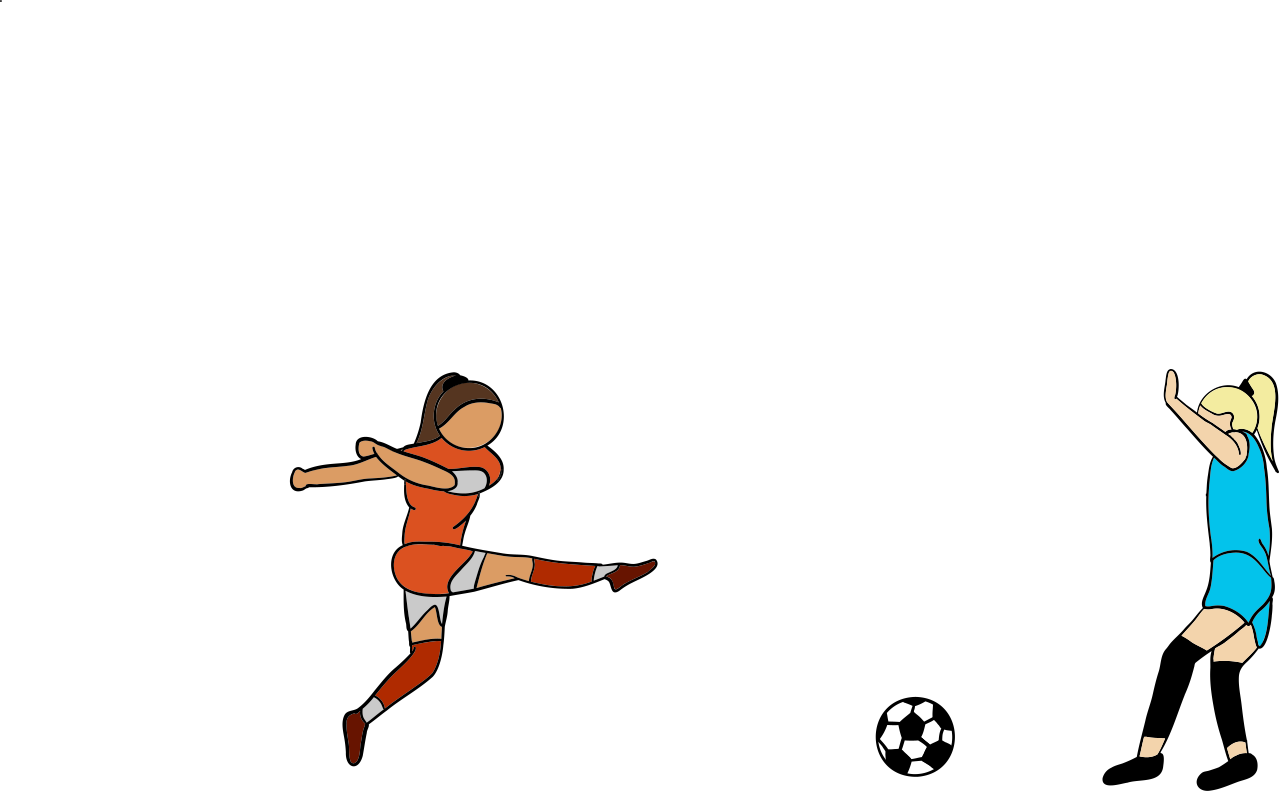
If a soccer team member commits a foul, the opposing team is awarded a \({free kick}\) to score a goal. Tammy and Sam are on opposite teams, and Sam is chosen to kick the soccer ball. She stands 20 meters away while Tammy guards the net. Sam kicks the ball, giving it an initial speed of 22 m/s, and the ball flies just barely above the ground, passing in between the legs of the unlucky goalie. After 1.2 seconds, the ball reaches the net at 14 m/s. Air resistance acts as an opposing force that can be modeled to be \(\frac{1}{2}bAv^2\), where \(A\) is the cross-section area of the object, \(v\) the speed of the ball, and \(b\) the friction coefficient (which depends on the air density and shape of the ball).
a) What would be the units of \(b\), the friction coefficient? (Make sure your answer is given in SI units.)
b) Calculate the friction coefficient \(b\). To do that, assume the soccer ball to be a perfect sphere of mass 0.4 kg with a diameter of 0.22 meters. Also, assume that the ball flies at roughly the same height until reaching the net. Hint: Use the average speed of the ball to calculate the net friction force.
c) In fluid dynamics, the friction coefficient is typically defined as \(b=\rho C\), where \(\rho\) is the air density and \(C\) is the drag coefficient. Consider \(C=0.47\) for a sphere. Calculate the air density \(\rho\).
a) If you already know the SI units of \(f_r\), \(A\) and \(v\), solve for \(b\). The constant, \(1/2\), does not matter in terms of dimensional analysis. b) Apply the Work-Energy Theorem. Consider that the only force doing work is the force due to friction which is given by the function. Remember that the net force can be calculated from the average velocity. c) This can be directly solved. a) Since \([f_r] = \text{kg} \cdot \text{m/s}^2\), \([A] = \text{m}^2\) and \([v] = \text{m/s}\), you may write: \begin{equation*} where we need to solve for \(b\) and replace the corresponding SI units. Using some algebra, we get: \begin{equation*} b) Since the velocity is \((v_{aver}=\frac{v_f+v_i}{2}\)), the force due to friction will be: \begin{equation*} Based on the Work-Energy Theorem, (\(W = \Delta K \)), the only force doing work is the force due to friction, so we can write: \begin{equation*} where the force due to friction is given by the previous equation. Considering that the cross-sectional area of the ball can be solved using the formula for the area of a circle, (\(\pi r^2\)), we can then solve for \(b\). After doing a lot of algebra, we get: \begin{equation*} which, with numerical values, gives us: \begin{equation} c) Using the equation (\(b = \rho C\)), we can solve for \(\rho\) to get: \begin{equation*}
which, with numerical values, gives us:
\begin{equation*} For a more detailed explanation of any of these steps, click on “Detailed Solution”. a) First we need to find the SI units (the International System of units) for \(b\), which is the friction coefficient. We can do that by analyzing the units of the friction force, given by
\begin{equation}
We know that the units of force is Newtons, which in SI units correspond to N=kg\(\cdot\)m/s\(^2\). Hence, the units of \(f_r\) are
\begin{equation}
where \([f_r]\) means units of \(f_r\) (the brackets ‘\([\;]\)’ are used to refer to the units of the term inside them). Hence, the units of the right hand side of equation \eqref{Soccer_friccion} must also be kg\(\cdot\)m/s\(^2\): \begin{equation}
where we have ignored the 1/2 term because numbers do not have a unit. We want to find the units of \(b\), so we can divide by the units of \(A\) and \(v^2\):
\begin{equation}
So to find [b] we only need to find the units of \(A\) and \(v^2\). \(A\) is the cross-sectional area of the object, and like any area, it has SI units of square meter:
\begin{equation}
If we use this result in equation \eqref{Soccer_bConAyV}, we get
\begin{equation}
If we divide m by m\(^2\), we get m\(^{-1}\):
\begin{equation}
On the other hand, \(v\) is the speed of the object, and so it has SI units of meters per second:
\begin{equation}
Hence, \(v^2\) has units of
\begin{equation}
Finally, use this in \eqref{Soccer_bConV} to get
\begin{equation}
Notice that the seconds cancel out and that m\(^{-1}\) over m\(^{2}\) is m\(^{-3}\). So we get
\begin{equation}
b) To find \(b\) from equation \eqref{Soccer_friccion}, we need to find \(f_r, A\) and \(v\). In the hint they suggest that we use the average speed of the ball to compute \(f_r\). That is, we need to use
\begin{equation}
where \(v_{aver}\) is the average speed. It is given by
\begin{equation}
where \(v_f\) is the final speed and \(v_i\) the initial speed. We know all these variables, but let’s not use the numerical values just yet. So if we use this result in equation \eqref{Soccer_friccionConVaverage}, we get
\begin{equation}
Now, this is not enough for finding \(b\), because we do not know \(f_r\). So we need to use more equations.
Since we know the final and initial speeds, and the mass, we can compute the change in kinetic energy. By the work-energy theorem, the change of kinetic energy equals the total work on the object. In particular, the theorem states that
\begin{equation}
where \(\Delta K\) is the change in kinetic energy (\(\Delta K = K_f-K_i\) ), and \(W_{tot}\) is the total work on the object. To find the total work, let’s start by identifying the forces on the ball.
Once it is moving through the air, there are two forces on the ball, namely, the weight and the air friction, as illustrated in figure 1.
Figure 1: Free-body diagram for the ball.
Notice that we use a coordinate system with X pointing in the direction of the motion of the ball. Also, in the diagram, we included the displacement of the ball, since we will need it in order to find the work.
Now, to find the total work, we need to find the work produced by each one of these two forces. In general, the work produced by a force is given by
\begin{equation}
where \(\vec{F}\) is the force and \(\vec{d}\) the displacement vector. The dot product is given by
\begin{equation}
where \(\theta\) is the angle between the two vectors, and \(F\) and \(d\) their magnitudes (we know \(d\), it is 20 meters). So, with this equation, we can find the force performed by each force. Clearly, from the diagram, we see that the weight is perpendicular to the displacement, and so \(\theta\) is \(\pi/2\). Since \( \cos \pi/2 = 0\), we can see that this force does not do any work on the ball (forces perpendicular to the displacement of the body do not exert any work). Hence, the only other force that can do work is the friction.
From the diagram, we see that the friction is anti-parallel to the displacement (they point in opposite directions), meaning that the angle between them is \(\pi\). Since \( \cos \pi = -1\), we get
\begin{equation}
(The fact that the work of friction is negative means that the ball is losing energy due to the action of the force.)
So, since the only force that makes work is the friction, we have
\begin{equation}
And so from equation \eqref{Soccer_trabajoFriccion} we have
\begin{equation}
Let’s use this result in equation \eqref{Soccer_teoremaTrabajoEnergia} to obtain
\begin{equation}
If we write the change in kinetic energy more explicitly, we get
\begin{equation}
where \(v_f\) is the speed when the ball touches the net, and \(v_i\) is the initial speed. Now we can use equation \eqref{Soccer_friccionVAvReemplazada} here to get
\begin{equation}
If we multiply by 8 and get the common factor of \(m\) at the left side we get
Then if we divide by \( -A(v_f + v_i)^2 d \), we get
\begin{equation}
Notice that the factor \( (v_f^2 – v_i^2) \) can be written as \( (v_f – v_i)(v_f + v_i) \) by applying the formula of difference of two squares. So we get
\begin{equation}
where one parenthesis can be cancel out to get
\begin{equation}
So this expression allows us to find the friction coefficient due to the air. Before inserting the numerical values, however, we need to note that \(A\) is the cross-section area of the ball, which is a sphere. The cross-section area of a sphere is just the area of a circle that has the diameter of the sphere, and so
\begin{equation}
where \(r\) is the radius. If we use this in \eqref{Soccer_bCasiTerminada}, we get
\begin{equation}
Now we can insert the numerical values:
\begin{equation}
We get
\begin{equation}
c) They tell us that the friction coefficient is typically defined as
\begin{equation}
where \(\rho\) is the air density and \(C\) is the drag coefficient. They also say that \(C=0.47\) for a sphere. So to find the air density we just need to divide equation \eqref{Soccer_bConCyRho} by \(C\):
\begin{equation}
We know \(b\) from point (b) and we know \(C\), so let’s insert these values here to get
\begin{equation}
f_r = \frac{1}{2}bAv^2,
\end{equation*}
[b] = \frac{\text{kg}}{\text{m}^3}.
\end{equation*}
f_r = \frac{1}{2}bA\left( \frac{v_f+v_i}{2} \right)^2.
\end{equation*}
– f_r d =\frac{1}{2} mv_f^2 – \frac{1}{2} mv_i^2,
\end{equation*}
b = – \frac{8 m (v_f – v_i)}{\pi r^2 d(v_f + v_i)}.
\end{equation*}
b = 0.935 \, \text{kg}\cdot\text{m}^{-3}
\end{equation}
\rho = \frac{b}{C},
\end{equation*}
\rho = 1.99 \, \text{kg}\cdot\text{m}^{-3}.
\end{equation*}
\label{Soccer_friccion}
fr = \frac{1}{2}bAv^2.
\end{equation}
[f_r] = \text{kg}\cdot\text{m/s}^2,
\end{equation}
[b] \cdot [A] \cdot [v^2] = \text{kg}\cdot\text{m/s}^2,
\end{equation}
\label{Soccer_bConAyV}
[b] = \frac{\text{kg}\cdot\text{m/s}^2}{[A] \cdot [v^2]}.
\end{equation}
[A] = m^2.
\end{equation}
[b] = \frac{\text{kg}\cdot\text{m/s}^2}{ \text{m}^2 \cdot [v^2]}.
\end{equation}
\label{Soccer_bConV}
[b] = \frac{\text{kg}\cdot\text{m}^{-1}/\text{s}^2}{ [v^2]}
\end{equation}
[v] = \text{m/s}.
\end{equation}
[v^2] = \text{m}^2/\text{s}^2.
\end{equation}
[b] = \frac{\text{kg}\cdot\text{m}^{-1}/\text{s}^2}{ \text{m}^2/\text{s}^2}.
\end{equation}
[b] = \text{kg}\cdot\text{m}^{-3}.
\end{equation}
\label{Soccer_friccionConVaverage}
fr = \frac{1}{2}bA(v_{aver})^2,
\end{equation}
\frac{v_f + v_i}{2} = v_{aver},
\end{equation}
\label{Soccer_friccionVAvReemplazada}
fr = \frac{1}{2}bA\left(\frac{v_f + v_i}{2}\right)^2,
\end{equation}
\label{Soccer_teoremaTrabajoEnergia}
\Delta K = W_{tot},
\end{equation}
W = \vec{F} \cdot \vec{d},
\end{equation}
W = F d \cos \theta,
\end{equation}
\label{Soccer_trabajoFriccion}
W_{f_r} = – f_r d.
\end{equation}
W_{tot} = W_{f_r}.
\end{equation}
W_{total} = – f_r d.
\end{equation}
\label{Soccer_cineticaFriccion}
\Delta K = – f_r d.
\end{equation}
\frac{1}{2}m v_f^2 – \frac{1}{2} m v_i^2 = – f_r d,
\end{equation}
\frac{1}{2}m v_f^2 – \frac{1}{2} m v_i^2 = – \frac{1}{2}bA\left(\frac{v_f + v_i}{2}\right)^2 d
\end{equation}
\begin{equation}
8 m (v_f^2 – v_i^2) = – bA(v_f + v_i)^2 d
\end{equation}
– \frac{8 m (v_f^2 – v_i^2)}{Ad(v_f + v_i)^2} = b.
\end{equation}
– \frac{8 m (v_f – v_i)(v_f + v_i)}{Ad(v_f + v_i)^2} = b,
\end{equation}
\label{Soccer_bCasiTerminada}
– \frac{8 m (v_f – v_i)}{Ad(v_f + v_i)} = b.
\end{equation}
A = \pi r^2,
\end{equation}
– \frac{8 m (v_f – v_i)}{\pi r^2 d(v_f + v_i)} = b.
\end{equation}
– \frac{8 (0.4 \, \text{kg}) [(14 \, \text{m/s}) – (22 \, \text{m/s})]}{\pi (0.11 \, \text{m})^2 (20 \, \text{m})[(14 \, \text{m/s}) + (22 \, \text{m/s})] } = b.
\end{equation}
b = 0.935 \, \text{kg}\cdot\text{m}^{-3}
\end{equation}
\label{Soccer_bConCyRho}
b = \rho C,
\end{equation}
\frac{b}{C} = \rho.
\end{equation}
\rho = 1.99 \, \text{kg}\cdot\text{m}^{-3}.
\end{equation}


Leave A Comment