

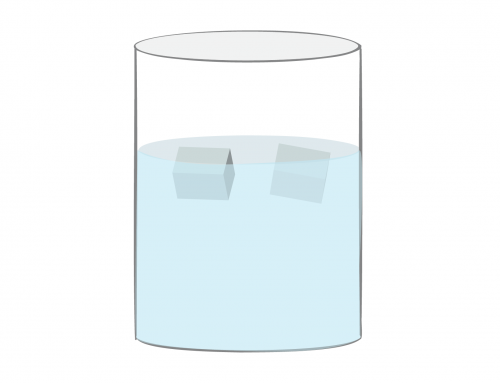
Luis makes a cup of coffee using 0.4 kg of water at 92\(^\circ\)C. Before drinking it, he lets it cool down to the temperature of the kitchen, which is usually 25\(^\circ\)C.
a) Calculate the entropy change of the water while it cools down.
b) Calculate the change in the entropy of the kitchen while the coffee cools down, assuming that there is no other exchange of energy.
c) Calculate the total entropy change of the system.
The specific heat of water is 4186 J/kg \(^\circ\)C.
a) Use the definition of entropy as an integral of the differential heat, and perform the integral with the given temperatures.
b) Consider the kitchen as an isothermal system; the definition of entropy will then be in terms of the heat and the temperature of the kitchen.
c) Use the previously calculated entropies to find the answer.
a) The change of entropy as a general expression is:
\begin{equation*}
\Delta S=\int\frac{dQ}{T},
\end{equation*}
where \(dQ = mc dT\) represents the infinitesimally small change in the coffee’s thermal energy.
The integral becomes:
\begin{equation*}
\Delta S_{\text{coffee}}=\int \frac{mc\,dT}{T}.
\end{equation*}
After performing the integral, we get:
\begin{equation*}
\Delta S_{\text{coffee}}= mc\ln\left(\frac{T_f}{T_i}\right),
\end{equation*}
which, with numerical values, becomes:
\begin{equation*}
\Delta S_{\text{coffee}} \approx – 339.4 \, \text{J/K}.
\end{equation*}
b) For the kitchen as an isothermal system, the temperature can be removed from the integral, and rewritten as:
\begin{equation*}
\Delta S_{\text{kitchen}}=\frac{Q_{\text{kitchen}}}{T_{\text{kitchen}}},
\end{equation*}
where \( Q_{\text{kitchen}} = -Q_{\text{coffee}} \). (This relationship can be easily found with the given values of the problem since \(Q_{\text{coffee}} = mc \Delta T\).) This gives us:
\begin{equation*}
\Delta S_{\text{kitchen}}\approx376.3\,\text{J/K}.
\end{equation*}
c) The total entropy can be calculated as:
\begin{equation*}
\Delta S_{\text{system}}=\Delta S_{\text{coffee}}+\Delta S_{\text{kitchen}}.
\end{equation*}
which, numerically, is:
\begin{equation*}
\Delta S_{\text{system}}\approx 36.9\,\text{J/K}.
\end{equation*}
For a more detailed explanation of any of these steps, click on “Detailed Solution”.
a) We’ve been asked to calculate the entropy change of the water while it cools down. Let’s begin our solution by identifying the parts of our closed system. The whole system consists of a cup of coffee and the kitchen. To calculate the change of entropy \(\Delta S\), we must use the general expression
\begin{equation}
\label{dS}
\Delta S=\int\frac{dQ}{T},
\end{equation}
where \(dQ\) is the differential amount of heat that enters or leaves the object we are analyzing, and \(T\) is the absolute temperature of such object. In the case of the cup of coffee, we are given information about the mass of water \(m\) and the change in temperature. We can then calculate the total amount of heat \(Q\) that leaves the cup of coffee as
\begin{equation}
\label{mcdt}
Q_{\text{coffee}}=mc\Delta T,
\end{equation}
where \(c\) is the specific heat, in this case of water, and \(\Delta T\) is the total change in temperature. Because we must use the differential \(dQ\) in expression \eqref{dS}, we’ll use equation \eqref{mcdt} to deduce that
\begin{equation}
\label{dQ}
dQ=mc\,dT,
\end{equation}
where we have replaced the change in temperature with an infinitesimal change in temperature \(dT\). To justify the expression in \eqref{dQ}, we must notice that neither the mass nor the specific heat changes during the process, only the temperature. Thus, an infinitesimal change in temperature \(dT\) will be proportional to an infinitesimal amount of heat \(dQ\).
Using equation \eqref{dQ} into equation \eqref{dS}, we find that
\begin{equation}
\label{ds2}
\Delta S_{\text{coffee}}=\int \frac{mc\,dT}{T}.
\end{equation}
We can now take the constants out from the integral in equation \eqref{ds2} and put the limits in absolute temperature: the initial temperature is
\begin{equation}
T_i=92\,{}^{\circ}\text{C}=(92+273.15)\,\text{K}=365.15\,\text{K},
\end{equation}
while the final temperature is
\begin{equation}
T_f=25\,{}^{\circ}\text{C}=(25+273.15)\,\text{K}=298.15\,\text{K};
\end{equation}
therefore, equation \eqref{ds2} is transformed into
\begin{equation}
\label{ds3}
\Delta S_{\text{coffee}}=mc\int_{T_i}^{T_f}\frac{dT}{T}.
\end{equation}
Performing the integral in equation \eqref{ds3}, we obtain
\begin{equation}
\label{ds4}
\Delta S_{\text{coffee}}= mc\left[\ln(T_f)-\ln(T_i)\right]=mc\ln\left(\frac{T_f}{T_i}\right),
\end{equation}
where we have used some properties of the logarithmic function. Using the numerical values, we find that
\begin{equation}
\label{ds5}
\Delta S_{\text{coffee}}=(0.4\,\text{kg})(4186\,\text{J/kg K})\ln\left(\frac{298.15\,\text{K}}{365.15\,\text{K}}\right),
\end{equation}
\begin{equation}
\label{ds6}
\Delta S_{\text{coffee}}\approx -339.4\,\text{J/K}.
\end{equation}
b) Now we must calculate the change of entropy of the kitchen. In this problem, the kitchen acts as a thermal reservoir, that is, its change in temperature is negligible when an amount of heat enters or leaves the kitchen. In our case, heat is transferred from the cup of coffee to the kitchen.
Because the kitchen does not change its temperature, we can write expression in equation \eqref{dS} for the kitchen as
\begin{equation}
\Delta S_{\text{kitchen}}=\int\frac{dQ}{T_{\text{kitchen}}},
\end{equation}
and take out from the integral the temperature to get
\begin{equation}
\Delta S_{\text{kitchen}}=\frac{1}{T_{\text{kitchen}}}\int dQ,
\end{equation}
which after performing the integral becomes
\begin{equation}
\label{dsk}
\Delta S_{\text{kitchen}}=\frac{Q_{\text{kitchen}}}{T_{\text{kitchen}}},
\end{equation}
where \(Q\) is the heat transferred from the cup of coffee and \(T_{\text{kitchen}}\) is the absolute temperature of the kitchen.
From conservation of energy, and because no other energy enters or leaves the whole system, we can write
\begin{equation}
\label{sumq}
Q_{\text{coffee}}+Q_{\text{kitchen}}=0,
\end{equation}
then
\begin{equation}
\label{sumq2}
Q_{\text{kitchen}}=-Q_{\text{coffee}}.
\end{equation}
Using the expression for \(Q_{\text{coffee}}\) given in equation \eqref{mcdt}, we get
\begin{equation}
\label{sumq3}
Q_{\text{kitchen}}=-mc\Delta T.
\end{equation}
Putting the expression of equation \eqref{sumq3} into equation \eqref{dsk}, we finally get
\begin{equation}
\Delta S_{\text{kitchen}}=-\frac{mc\Delta T}{T_{\text{kitchen}}}.
\end{equation}
Using the fact that \(\Delta T=T_f-T_i\), we can write explicitly
\begin{equation}
\Delta S_{\text{kitchen}}=-\frac{mc(T_f-T_i)}{T_{\text{kitchen}}}.
\end{equation}
Using the numerical values given by the problem, and noting that \(T_{\text{kitchen}}=T_f=298.15\,\text{K}\), we get
\begin{equation}
\label{dsk2}
\Delta S_{\text{kitchen}}=-\frac{(0.4\,\text{kg})(4186\,\text{J/kg K})(298.15,\text{K}-365.15\,\text{K})}{298.15\,\text{K}},
\end{equation}
\begin{equation}
\label{dsk3}
\Delta S_{\text{kitchen}}\approx376.3\,\text{J/K}.
\end{equation}
c) The total entropy change of the system can be calculated as the sum of the entropy changes of its parts: coffee and kitchen, so
\begin{equation}
\Delta S_{\text{system}}=\Delta S_{\text{coffee}}+\Delta S_{\text{kitchen}}.
\end{equation}
Using the values given in equations \eqref{ds6} and \eqref{dsk3}, we obtain numerically
\begin{equation}
\Delta S_{\text{system}}\approx -339.4\,\text{J/K}+376.3\,\text{J/K}=36.9\,\text{J/K}.
\end{equation}
Notice that the result is greater than zero, which is correct according to the second law of thermodynamics: the change in entropy \(\Delta S\) for an isolated system is always positive or zero.


Leave A Comment