

Consider \(n\) particles with an equal positive charge, each with magnitude \(\frac{Q}{n}\) and placed symmetrically around a circle of radius R.
a) Calculate the magnitude of the electric field at a distance \(x \) from the center of the circle, on the line that passes through the center and is perpendicular to the plane of the circle.
b) Explain why this result is identical to the electric field generated by a ring of uniform charge.
a) Use the definition of electric field for a punctual charge, and then sum over all the charges.
b) Starting the same as in a), the sum is not discrete but continuous, so integrating will be enough.
a) The electric field for a puntual charge is:
\begin{equation*}
\vec{E}=\frac{1}{4\pi\epsilon_0}\frac{q}{r^2}\hat{\textbf{r}},
\end{equation*}
where taking a top charge, \(\hat{\textbf{r}}=\cos\theta\,\hat{\textbf{i}}-\sin\theta\,\hat{\textbf{j}}\). By symmetry, the Y and Z component cancels out, and the X component has a cosine, where \( \cos \theta = \frac{x}{r} \). Considering the dimensions and that \(q = \frac{Q}{n} \), we can write:
\begin{equation*}
E_x=\frac{1}{4\pi \epsilon_0}\frac{Qx}{n(R^2+x^2)^{3/2}}.
\end{equation*}
To get the total electric field we have to sum \( E_x^{\text{Total}} = \sum E_x\). Then:
\begin{equation*}
E_x^{\text{Total}}=\frac{1}{4\pi\epsilon_0}\frac{Qx}{(R^2+x^2)^{3/2}}.
\end{equation*}
b) A uniformly charged ring is the limit of the problem presented in (a) as \(n\) goes to infinity, while keeping the total charge of the array \(Q\) constant. For the electric field, there is a differential \(dE_x\). Thus, the last equation from a) is:
\begin{equation*}
dE_x=\frac{1}{4\pi\epsilon_0}\frac{xdq}{(R^2+x^2)^{3/2}}.
\end{equation*}
By integration \(Q = \int dq \). Then:
\begin{equation*}
E_x^{\text{Total}}=\frac{1}{4\pi\epsilon_0}\frac{Qx}{(R^2+x^2)^{3/2}}.
\end{equation*}
For a more detailed explanation of any of these steps, click on “Detailed Solution”.
First, let’s draw the situation with the \(n\) charges placed on the circle and with the origin of our coordinate system at the center of the circle (see figure 1).
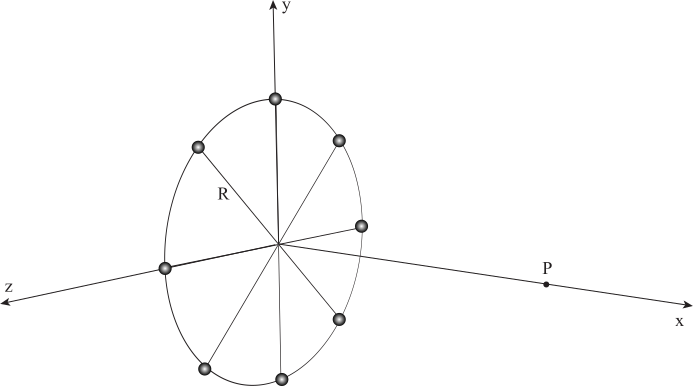
Figure 1: We place the origin of our cartesian coordinate system at the center of the circle defined by the array of charges. All the charges are in the YZ plane, while point P is placed on the X-axis.
From the previous figure, we see a point P along the X-axis, where we need to find the magnitude of the electric field. We must first calculate the electric field components along the X, Y, and Z-axis.
Instead of jumping to the equation that lets us calculate each component of the electric field, let’s first examine the symmetry of the problem. There is clearly symmetry along the X-axis since all the charges are placed in the YZ plane. Taking the charges by diametrically opposed pairs and drawing the electric field vector for each one (as in figure 2 and 3), it is evident that when we add them, some components of the Electric field will cancel out and others will add up.

Figure 2: Electric fields at point P produced by two diametrically opposed charges. Notice that the components along the X-axis add up while the components along the other axes cancel.
For another example, consider these two charges

Figure 3: Electric fields at point P produced by two diametrically opposed charges. Notice that the components along the X-axis add up while the components along the other axes cancel.
If we repeat this same analysis for any diametrically opposed charges, the components along the Y and Z axis cancel out, while the components along the X-axis add up; therefore, when calculating the magnitude of the electric field, we’ll concentrate solely on the component along the X-axis.
As can also be seen from the previous figures, the distance from each charge to the point P is equal. If we call this distance \(r\), then by using the Pythagorean theorem
\begin{equation}
\label{distancer}
r=\sqrt{R^2+x^2},
\end{equation}
where \(R\) is the radius of the circle and \(x\) is the distance along the X-axis from the center of the circle to the point P.
Now, we can write the expression for the electric field of a point particle of charge \(q\)
\begin{equation}
\label{efieldpc}
\vec{E}=\frac{1}{4\pi\epsilon_0}\frac{q}{r^2}\hat{\textbf{r}},
\end{equation}
where \(r\) is the distance from the charge to the point where the electric field \(\vec{E}\) is being calculated and \(\hat{\textbf{r}}\) is the unitary vector along the direction joining the charge and the point P. To illustrate the concept of the unitary vector, let’s see figure 4, where the unitary vector is shown in pink.

Figure 4: Lateral view from the charge array and point P. The unitary vector \(\hat{\textbf{r}}\) is shown and is parallel to the electric field \(\vec{E}\). The angle \(\theta\) between the electric field and the X-axis is also shown. The angle is related to the distances \(R\) and \(X\) through the triangle formed by the dashed green line and the axes.
We can then write the unitary vector and the electric field in terms of the angle \(\theta\), as illustrated in figure 5.
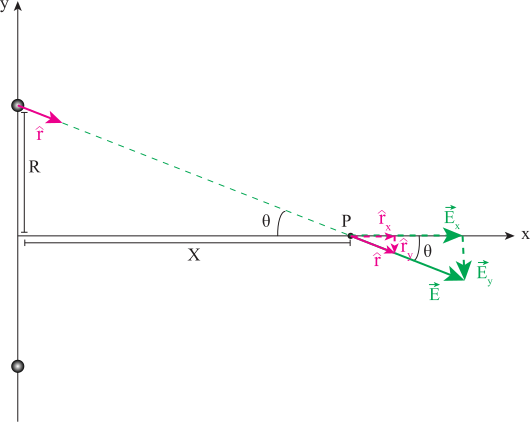
Figure 5: Decomposition of the electric field \(\vec{E}\) and the unitary vector \(\hat{ \textbf{r}}\) along the X and Y-axis. The components will be given by trigonometric relations in terms of the angle \(\theta\).
From figure 5, we see that
\begin{equation}
\label{rhat}
\hat{\textbf{r}}=\cos\theta\,\hat{\textbf{i}}-\sin\theta\,\hat{\textbf{j}}.
\end{equation}
Recall at this point that we’ll only focus on the component along the X axis, so we’ll only keep the first term in equation \eqref{rhat}. Putting together equations \eqref{efieldpc} and \eqref{rhat}, we can find an expression for the electric field along the X axis \(E_x\) for a point charge; namely,
\begin{equation}
\label{efieldx}
E_x=\frac{1}{4\pi\epsilon_0}\frac{q}{r^2}\cos\theta,
\end{equation}
where we omit the unitary vector \(\hat{\textbf{i}}\) because we are only dealing with the magnitude. Notice that the \(\cos\theta\) can be given in terms of previously known variables, that is
\begin{equation}
\label{costheta}
\cos\theta=\frac{x}{r}.
\end{equation}
Using the result from \eqref{costheta} in equation \eqref{efieldx}, we obtain
\begin{equation}
\label{efieldxr}
E_x=\frac{1}{4\pi\epsilon_0}\frac{qx}{r^3}.
\end{equation}
Remember that this result is valid for 1 charge. Since each charge has a value of \(q=Q/n\), we can write
\begin{equation}
\label{efieldx2}
E_x=\frac{1}{4\pi\epsilon_0}\frac{Qx}{nr^3}.
\end{equation}
Now, we put the result of equation \eqref{distancer} into equation \eqref{efieldx2} to get
\begin{equation}
\label{efieldx3}
E_x=\frac{1}{4\pi \epsilon_0}\frac{Qx}{n(R^2+x^2)^{3/2}},
\end{equation}
which is the field produced by any charge of the circle along the X axis. Since we want the total electric field produced by the \(n\) charges \( E_x^{\text{Total}}\), we use the superposition principle to write
\begin{equation}
E_x^{\text{Total}}=\sum_{i=1}^{n}E_x=nE_x,
\end{equation}
where \(E_x\) is given by equation \eqref{efieldx3}. Then the magnitude of the electric field produced by the charge array is
\begin{equation}
\label{resultado}
E_x^{\text{Total}}=n\frac{1}{4\pi\epsilon_0}\frac{Qx}{n(R^2+x^2)^{3/2}}=\frac{1}{4\pi\epsilon_0}\frac{Qx}{(R^2+x^2)^{3/2}}.
\end{equation}
(b) A uniformly charged ring is the limit of the problem presented in (a) as \(n\) goes to infinity, while keeping the total charge of the array \(Q\) constant. Then, we can use the same symmetry argument to discard all components in the Y and Z axis and calculate the electric field as in equation \eqref{efieldxr}, only this time the charge \(q\) will be infinitely small (since \(n\to\infty\)). This small charge is a differential charge that we shall call \(dq\). As a consequence, the electric field will be infinitely small, a differential that we shall call \(dE_x\). Thus, we can rewrite the expression in equation \eqref{efieldxr} in terms of the differentials as
\begin{equation}
dE_x=\frac{1}{4\pi\epsilon_0}\frac{xdq}{r^3}.
\end{equation}
We can still use the value for \(r\) given in equation \eqref{distancer} to get
\begin{equation}
dE_x=\frac{1}{4\pi\epsilon_0}\frac{xdq}{(R^2+x^2)^{3/2}}.
\end{equation}
The superposition principle then tells us that in order to get the total electric field, we must sum the contribution of all the infinitesimal charges \(dq\), that is, to make the following integral
\begin{equation}
E_x^{\text{Total}}=\int dE_x=\int\frac{1}{4\pi\epsilon_0}\frac{xdq}{(R^2+x^2)^{3/2}}.
\end{equation}
If we take out everything that is constant \((R,\,x,\,\epsilon_0)\), the integral becomes
\begin{equation}
E_x^{\text{Total}}=\frac{1}{4\pi\epsilon_0}\frac{x}{(R^2+x^2)^{3/2}}\int dq,
\end{equation}
which leaves us with the integral of \(dq\), which is the total charge of the ring \(Q\); explicitly,
\begin{equation}
E_x^{\text{Total}}=\frac{1}{4\pi\epsilon_0}\frac{xQ}{(R^2+x^2)^{3/2}}
\end{equation}
which is exactly the same result we have obtained in equation \eqref{resultado}.


Leave A Comment