
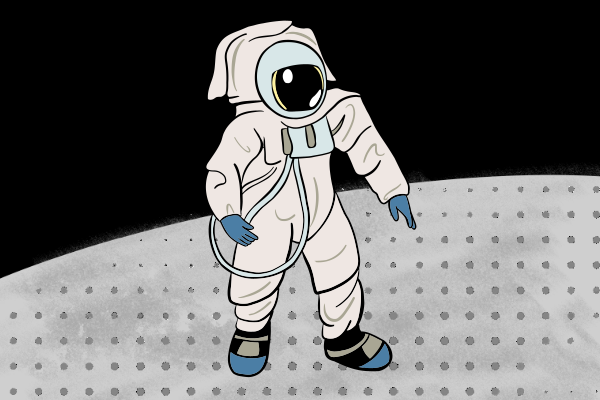
Michelle, an astronaut on the moon, jumps with an initial velocity of \(2\,\text{m/s}\).
a) Calculate the maximum height that Michelle will reach and the time that it will take for her to reach this height. The acceleration of gravity on the moon is \(1.625\,\text{m/s}^2\).
b) Compare it to the result that you would get if Michelle jumps with the same initial speed on Earth.
a) Use the kinematic equation to find the time that it takes to reach the maximum height. Then, use the time to find the maximum height since the time and the initial velocity are already known.
b) Same hint as in a). The gravity is different this time.
a) The velocity as a function of time is
\begin{equation*}
\vec{v}(t)=\vec{v}_0+\vec{a}t.
\end{equation*}
At the maximum height, the final velocity is zero. Then, using \(a = -g\) and solving for the time, we have
\begin{equation*}
t_{\text{max}}=\frac{v_0}{g_{\text{Moon}}},
\end{equation*}
or with numerical values
\begin{equation*}
t_{\text{max}} \approx 1.23 \, \text{s}.
\end{equation*}
For the maximum height, the equation needed is
\begin{equation*}
\vec{x}(t)=\vec{x}_0+\vec{v}_0t+\frac{1}{2}\vec{a}t^2,
\end{equation*}
where replacing the time and after some algebra, we get:
\begin{equation*}
x(t_{\text{max}})=\frac{v_0^2}{2g_{\text{Moon}}},
\end{equation*}
or with numerical values:
\begin{equation*}
x(t_{\text{max}})=1.23 \, \text{m}.
\end{equation*}
b) Using the same equation for the time with the gravitational acceleration on earth, the result is
\begin{equation*}
t_{\text{max}}^{\text{Earth}}\approx 0.204\,\text{s}.
\end{equation*}
With the same equation for the maximum height, the result is
\begin{equation*}
x(t_{\text{max}}^{\text{Earth}})=0.204\,\text{m} .
\end{equation*}
For a more detailed explanation of any of these steps, click on “Detailed Solution.”
a) In order to calculate the maximum height and the time that it will take Michelle to reach it, we’ll need the kinematics equations along the vertical axis, where the force of gravity is present. Since it’s the only force present during the jump, Michelle’s acceleration is the gravitational acceleration and will be denoted in magnitude by \(g_{\text{Moon}}=1.625\,\text{m/s}^2\) directed downwards.
Let’s begin by writing the expression for Michelle’s velocity \(\vec{v}\) as a function of time \(t\)
\begin{equation}\label{velocity}
\vec{v}(t)=\vec{v}_0+\vec{a}t.
\end{equation}
where \(\vec{v}_0\) is the initial velocity vector and \(\vec{a}\) is the acceleration vector. From the prompt, we’re given the initial velocity, which is directly upwards, so
\begin{equation}\label{initialspeed}
\vec{v}_0=v_0\,\hat{\textbf{j}},
\end{equation}
where \(v_0=2\,\text{m/s}\) is the initial speed. We also know that the acceleration is the gravitational acceleration directed downwards, so we can write,
\begin{equation}\label{acceleration}
\vec{a}=-g_{\text{Moon}}\,\hat{\textbf{j}}.
\end{equation}
Using the results of equations \eqref{initialspeed} and \eqref{acceleration} in equation \eqref{velocity}, we get
\begin{equation}\label{vel2}
\vec{v}(t)=v_0\,\hat{\textbf{j}}-g_{\text{Moon}}t\,\hat{\textbf{j}}.
\end{equation}
At the maximum height, the velocity along the vertical direction is zero, so we can use this fact in equation \eqref{vel2} to solve for the time $t_{\text{max}}$ that it takes Michelle to get to the maximum height. Explicitly,
\begin{equation}
0\,\hat{\textbf{j}}=v_0\,\hat{\textbf{j}}-g_{\text{Moon}}t_{\text{max}}\,\hat{\textbf{j}}.
\end{equation}
Dropping the unitary vector notation because all of the terms in the equation are along the same direction, we obtain
\begin{equation}
0=v_0-g_{\text{Moon}}t_{\text{max}},
\end{equation}
where we can solve for $t$ to obtain
\begin{equation}\label{timeexp}
t_{\text{max}}=\frac{v_0}{g_{\text{Moon}}}.
\end{equation}
Using the numerical values for \(v_0\) and \(g_{\text{Moon}}\) in the equation above, we get
\begin{equation}\label{time}
t_{\text{max}}=\frac{2\,\text{m/s}}{1.625\,\text{m/s}^2}\approx 1.23\,\text{s}.
\end{equation}
In order to find the maximum height \(\vec{x}(t_{\text{max}})\), we write the equation for the position in terms of time. Precisely,
\begin{equation}\label{position}
\vec{x}(t)=\vec{x}_0+\vec{v}_0t+\frac{1}{2}\vec{a}t^2,
\end{equation}
where \(\vec{x}_0\) is the vector indicating the initial position. We place the origin of our coordinate system in the ground, so \(\vec{x}_0=0\hat{\textbf{i}}+0\hat{\textbf{j}}\). Using the results of equations \eqref{initialspeed} and \eqref{acceleration} in equation \eqref{position}, we get
\begin{equation}\label{position2}
\vec{x}(t)=v_0t\,\hat{\textbf{j}}-\frac{1}{2}g_{\text{Moon}}t^2\,\hat{\textbf{j}}.
\end{equation}
Using the expression for \(t_{\text{max}}\) given in expression \eqref{timeexp} in the equation above to get the maximum height, we arrive to
\begin{equation}
\vec{x}(t_{\text{max}})=v_0\frac{v_0}{g_{\text{Moon}}}\,\hat{\textbf{j}}-\frac{1}{2}g_{\text{Moon}}\left(\frac{v_0}{g_{\text{Moon}}}\right)^2\,\hat{\textbf{j}},
\end{equation}
which becomes
\begin{equation}
\vec{x}(t_{\text{max}})=\frac{v_0^2}{g_{\text{Moon}}}\,\hat{\textbf{j}}-\frac{1}{2}\frac{v_0^2}{g_{\text{Moon}}}\,\hat{\textbf{j}},
\end{equation}
and simplifies to
\begin{equation}\label{maxh}
\vec{x}(t_{\text{max}})=\frac{v_0^2}{2g_{\text{Moon}}}\,\hat{\textbf{j}}
\end{equation}
Using the numerical values for \(v_0\), \(g_{\text{Moon}}\), we can find the maximum height. Namely,
\begin{equation}
\vec{x}(t_{\text{max}})=\frac{(2\,\text{m/s})^2}{2(1.625\,\text{m/s}^2)}\,\hat{\textbf{j}}
=1.23\,\text{m}\,\hat{\textbf{j}}.
\end{equation}
b) To compare our results for the time and for Michelle’s maximum height when she jumps, all we have to do is change the numerical value of \(g_{\text{Moon}}\) with the numerical value for the acceleration of the Earth \(g_{\text{Earth}}=9.8\,\text{m/s}^2.\). Thus, we can make the change in equation \eqref{time} and find that
\begin{equation}
t_{\text{max}}^{\text{Earth}}=\frac{v_0}{g_{\text{Earth}}},
\end{equation}
which, after using the numerical values, we get the result
\begin{equation}\label{time2}
t_{\text{max}}^{\text{Earth}}\approx 0.204\,\text{s}.
\end{equation}
To find the maximum height, we could use equation \eqref{maxh} and make the change in the gravitational acceleration to get
\begin{equation}\label{position3}
\vec{x}(t_{\text{max}}^{\text{Earth}})=\frac{v_0^2}{2g_{\text{Earth}}}\,\hat{\textbf{j}}.
\end{equation}
Using the numerical values for \(v_0\) and \(g_{\text{Earth}}\), we can find the maximum height. Namely,
\begin{equation}
\vec{x}(t_{\text{max}}^{\text{Earth}})=\frac{(2\,\text{m/s})^2}{2(9.8\,\text{m/s}^2)}\,\hat{\textbf{j}},
\end{equation}
\begin{equation}
\vec{x}(t_{\text{max}}^{\text{Earth}})=0.204\,\text{m}\,\hat{\textbf{j}}.
\end{equation}
Notice that the maximum height is smaller and the time is shorter on the Earth than on the Moon because of the change in the gravitational acceleration. Both of this quantities are reduced by a factor of \(\frac{g_{\text{Moon}}}{g_{\text{Earth}}}\).




Leave A Comment