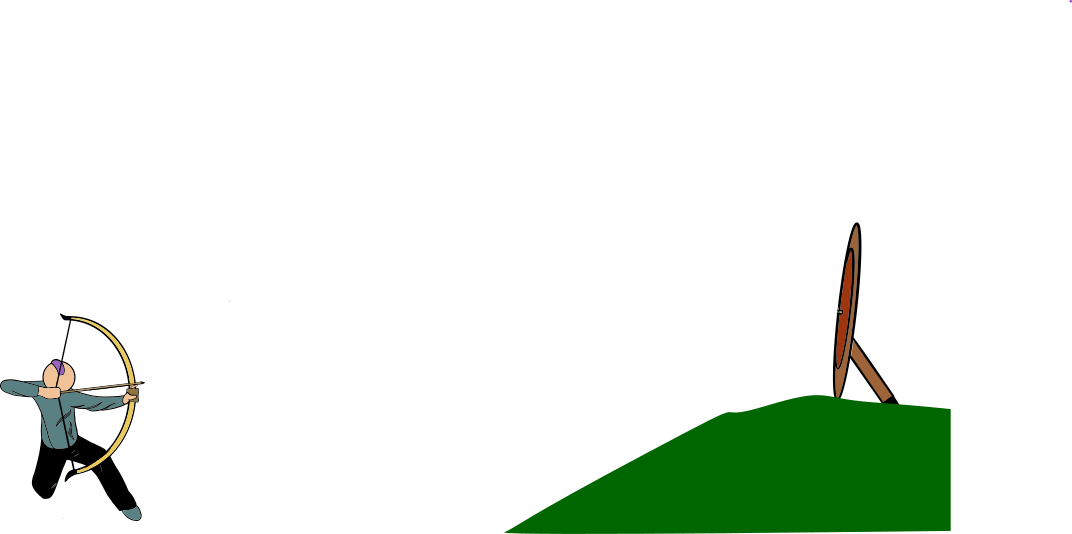
Ben is practicing archery for a Renaissance Fair, and practices shooting arrows at a target. It is important that Ben calibrates the bow and arrow to make sure that he does not hit a stray passerby to ensure the safety of everyone at the fair. Ben draws back the arrow, making sure that the bowstring is completely taut, and releases the arrow at a height of 1.5 m above the ground. The arrow sails through the air and hits the target at a final speed of 28 m/s; Ben notes that the height of the arrow is 2 m above the ground once stuck in the target. Assuming all of the bow’s elastic energy is transmitted to the arrow upon release, what is the elastic energy transferred to the arrow from the bow (assuming the mass of the arrow is 30 g)?
Use The Law of Conservation of Energy to solve for the Elastic Potential Energy.
To find the elastic energy of the bow we will use conservation of energy. Now, the mechanical energy of the arrow alone, or of the bow alone, is not conserved. The reason is that the bow is giving its energy to the arrow, so the arrow’s energy increases and the bow’s energy decreases. However, all the elastic energy of the bow is transmitted to the arrow, and so the energy gained by the arrow is exactly the energy lost by the bow. This means that the total mechanical energy of the bow-arrow system is indeed conserved, and so we can use conservation of energy to solve the problem (this illustrates that it is very important in energy problems to identify correctly the system whose conservation of energy we will study).
The total initial energy of the bow-arrow system is given by
where \(U_{elast}\) is the elastic energy of the bow (that we are solving for), \(U_{ig}\) is the gravitational potential energy of the arrow, \( K_i \) is the initial kinetic energy of the arrow (the bow does not have gravitational potential energy, nor kinetic energy because we are neglecting its mass, and both of these types of energies depend on the mass). But initially the arrow is not moving, and so \(K_i\) is zero:
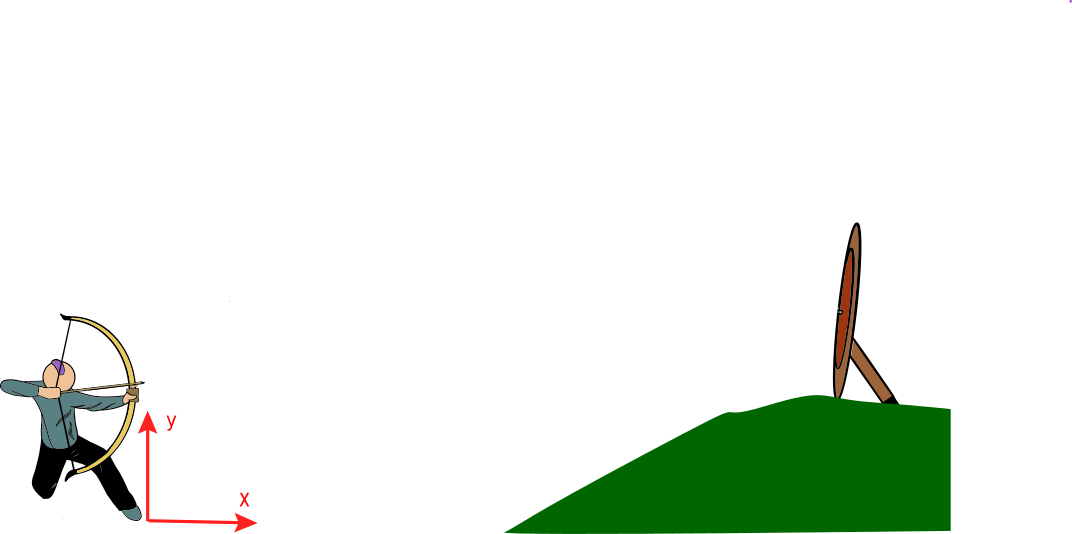
Also, we know that \(U_{ig}=mgh_i\), where \(h_i\) is the initial height (that we know). This height is measured with respect to the floor, which means that it is convenient to use a coordinate system located on the floor (see figure 1).
Figure 1: We place the coordinate system on the ground at Ben’s position where the initial height is \(h_i\).
Then equation \eqref{Arqueria_energiaElasticaInicialSinCinetica} becomes:
where \(K_f\) is the final kinetic energy (not zero anymore) and \(U_{fg}\) is the final potential energy of the arrow (notice that there is no longer elastic energy because the bow is no longer tensed). Since the kinetic energy is given by \(1/2mv_f^2\) and \(U_{fg}\) by \(mgh_f\), we can write equation \eqref{Arqueria_energiaElasticaFinal} as



Leave A Comment