
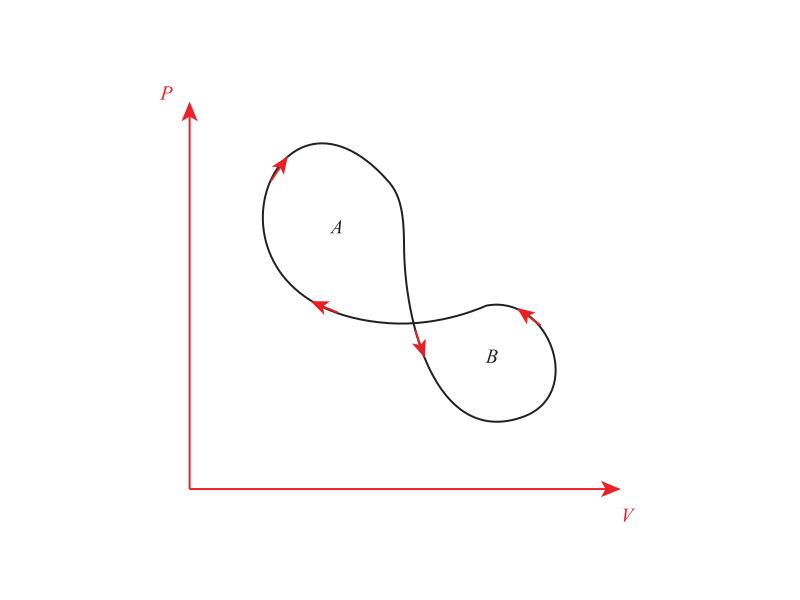
An ideal gas is taken through the cyclic process shown in the figure. It is known that \(A \) has an area of 360 square units, while \(B \) has an area of 280 square units. Assume that the pressure is measured in pascals and the volume in cubic meters.
a) What is the total work done by the gas?
b) What is the work done on each loop?
c) What is the net change in energy?
d) In which regions did the thermal energy do work on the gas?
a) The definition of work is directly related to the area under the curve.
b) The areas are given in the problem.
c) Use the First Law of Thermodynamics.
d) Relate each of the works found in part (b), and use again the First Law of Thermodynamics.
a) Since the work is:
\begin{equation*}
W=\int_C P dV,
\end{equation*}
implies is the area under the curve for the given graphs. Then:
\begin{equation*}
W=360\,\text{square units}-280\,\text{square units}=80\,\text{square units}.
\end{equation*}
b) For loop A:
\begin{equation*}
W_A=360\,\text{square units},
\end{equation*}
and for loop B:
\begin{equation*}
W_B=-280\,\text{square units}.
\end{equation*}
c) By first law of thermodynamics \(\Delta U = Q – W\), and since \(\Delta U = 0\) for a closed loop, then:
\begin{equation*}
Q=80\,\text{square units}.
\end{equation*}
d) A and B are closed loops. Then \(\Delta U = 0\), so the heat that enter the gas is:
\begin{equation*}
Q_A=360\,\text{square units},
\end{equation*}
and the heat that leaves the gas is:
\begin{equation*}
Q_B=-280\,\text{square units}.
\end{equation*}
For a more detailed explanation of any of these steps, click on “Detailed Solution”.
a) They ask us to find the total work done by the gas in this cyclic process. We’ll approach the solution to this problem by using the definition of the work done by a gas \(W\) following a path \(C\) in a Pressure-Volume graphic:
\begin{equation}
\label{workwork}
W=\int_C P dV,
\end{equation}
where \(P\) is the pressure of the gas and \(dV\) the infinitesimal volume change. The integral in \eqref{workwork} is the area under the path defined by \(C\). When the path encloses an area, the magnitude of the work is equal to the enclosed area and its sign can be determined by the direction in which the path is taken: if the direction in which the path is taken is clockwise then the work is positive, if the direction is counter-clockwise, then the work done by the gas is negative.
Now, let’s examine the path we are given by the problem. It consists of two loops: loop A and loop B. Notice that the direction of each loop is different; for loop A the direction is clockwise and for B is counter-clockwise. Therefore, the work done by the gas in loop A is positive while the work done by the gas in loop B is negative. The magnitude of such work is the area enclosed by each loop. Taking this into account, the total work done by the gas is
\begin{equation}
\label{workdone}
W=360\,\text{square units}-280\,\text{square units}=80\,\text{square units}.
\end{equation}
b) According to what was discussed before in (a), for loop A the work done by the gas is
\begin{equation}
\label{worka}
W_A=360\,\text{square units},
\end{equation}
and for loop B is
\begin{equation}
\label{workb}
W_B=-280\,\text{square units}.
\end{equation}
c) To find the total energy transferred from or to the gas as heat \(Q\), we must use the first law of thermodynamics, namely
\begin{equation}
\label{fisrtlawT}
\Delta U=Q-W,
\end{equation}
where \(\Delta U\) is the change in internal energy of the gas, \(Q\) the energy gained or lost as heat and \(W\) the work done by the gas. The internal energy only depends on the initial and final values of the state variables of the gas, such as temperature, pressure, volume, and number of moles. In a closed path, the initial point and the final point are the same; thus, the change of internal energy \(\Delta U\) is equal to zero. Using this in equation \eqref{fisrtlawT}, we obtain
\begin{equation}
0=Q-W,
\end{equation}
or equivalently
\begin{equation}
\label{closedloop}
Q=W.
\end{equation}
Because we know the work done by the gas in one cycle from \eqref{workdone}, then
\begin{equation}
Q=80\,\text{square units}.
\end{equation}
d) For the end of this problem, we need to find the regions where heat entered the gas. If we consider each loop separately, we can still apply the first law of thermodynamics and, because they are closed loops, equation \eqref{closedloop} is still valid. Then, we have
\begin{equation}
Q_A=W_A,
\end{equation}
and
\begin{equation}
Q_B=W_B.
\end{equation}
Using the numerical results given by equations \eqref{worka} and \eqref{workb}, we obtain
\begin{equation}
Q_A=360\,\text{square units},
\end{equation}
meaning that heat enters the gas and
\begin{equation}
Q_B=-280\,\text{square units},
\end{equation}
meaning that heat leaves the gas. To answer the question, only in loop A does the gas get energy via. heat.


Leave A Comment