
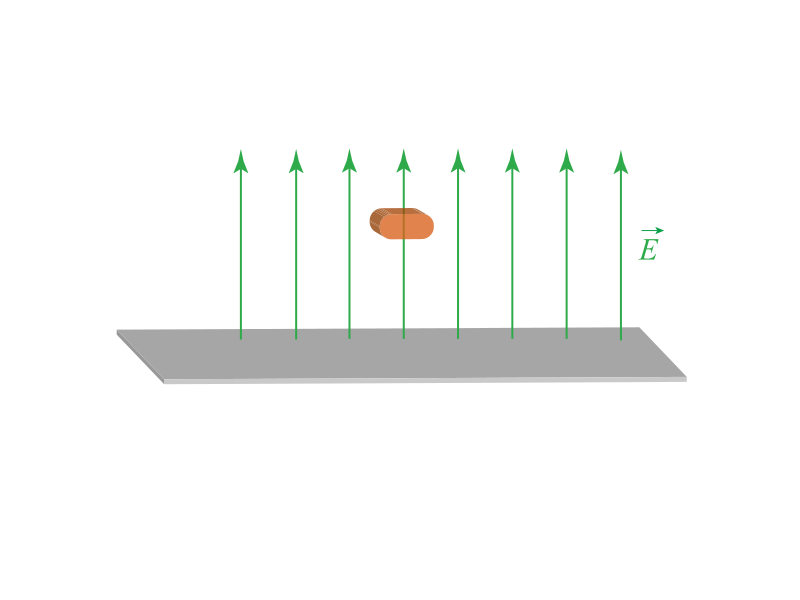
An object with charge \(30 \mu\)C floats above an infinite plane that generates a uniform electric field of magnitude 1,200 N/C directly upward. What is the mass of the object if it is kept in equilibrium?
Use Newton’s Second Law and the electrical force to get the mass.
Newton’s Second Law states:
\begin{equation*}
\sum{\vec{F}}=m\vec{a},
\end{equation*}
where, at equilibrium, \(a=0\). Then, by using the fact that the electrical force \(F = qE\), and by applying Newton’s Second Law along the \({y-}\)axis, we get:
\begin{equation*}
qE – mg=0.
\end{equation*}
Solving for \(m\):
\begin{equation*}
m = \frac{qE}{g},
\end{equation*}
which, with numerical values, gives us:
\begin{equation*}
m \approx 3.67 \times 10^{-3} \, \text{kg}.
\end{equation*}
For a more detailed explanation of any of these steps, click on “Detailed Solution”.
The problem asks us to find the mass of the object. Let’s start by writing
\begin{equation}
\label{efield}
\vec{E}=E\,\hat{\textbf{k}},
\end{equation}
where \(E\) is the magnitude of the electric field, a quantity given by the prompt.
If we want the object to be at equilibrium, we apply Newton’s second law and demand that the acceleration \(\vec{a}\) is zero. Newton’s second law reads,
\begin{equation}
\label{newton}
\sum{\vec{F}}=m\vec{a},
\end{equation}
where \(\sum \vec{F}\) is the sum of all forces exerted on the object. The relevant forces are the weight \(\vec{W}\) and the electric force \(\vec{F}_e\), as seen in figure 1.
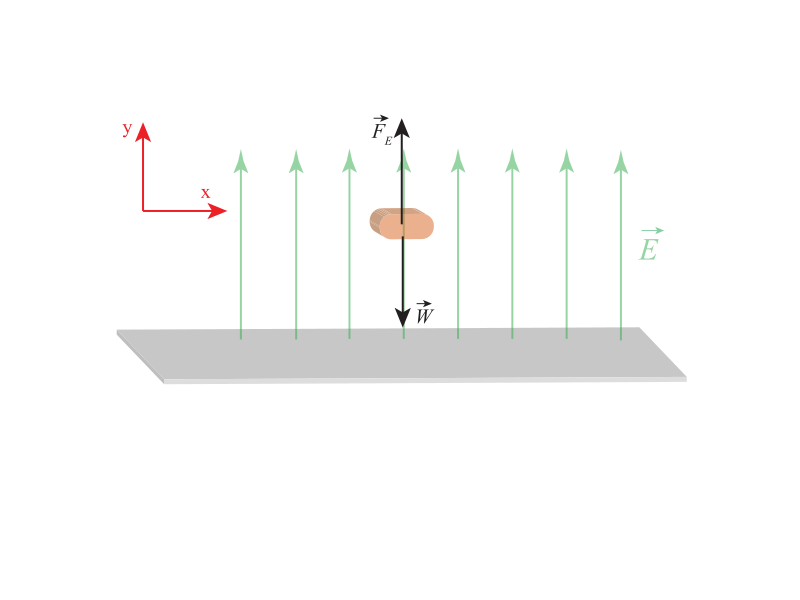
Figure 1: Free-body diagram for the object with the electric force \(\vec{F}_{E}\) upwards in the same direction as the electric field \(\vec{E}\) and the weight \(\vec{W}\) downwards, along the negative Y-axis.
Then, equation \eqref{newton} is:
\begin{equation}
\label{newton2}
\vec{W}+\vec{F}_e=m\vec{a}.
\end{equation}
Since the object is at equilibrium, we can demand the acceleration to be zero in equation \eqref{newton2}; hence, we get
\begin{equation}
\label{newton3}
\vec{W}+\vec{F}_e=\vec{0}.
\end{equation}
The electric force can be expressed in terms of the electric field \(\vec{E}\) and the charge of the object \(q\) as
\begin{equation}
\label{eforce}
\vec{F}_e=q\vec{E}.
\end{equation}
Using the result of equation \eqref{efield} into equation \eqref{eforce}, we obtain
\begin{equation}
\label{eforce2}
\vec{F}_e=qE\,\hat{\textbf{k}}.
\end{equation}
Furthermore, as seen in the figure, the force of weight \(\vec{W}\) points towards the negative Z axis, so we can write
\begin{equation}
\label{weight}
\vec{W}=-W\,\hat{\textbf{k}},
\end{equation}
where \(W\) is the magnitude of the weight, given by the multiplication of the mass of the object \(m\) by the gravitational acceleration of earth \(g\). Then, equation \eqref{weight} becomes
\begin{equation}
\label{weight2}
\vec{W}=-mg\,\hat{\textbf{k}}.
\end{equation}
Using the explicit expressions for the electric force and weight given in equations \eqref{eforce2} and \eqref{weight2} into equation \eqref{newton3}, we obtain
\begin{equation}
\label{newton4}
-mg\,\hat{\textbf{k}}+qE\,\hat{\textbf{k}}=\vec{0}.
\end{equation}
Focusing on the vector components in equation \eqref{newton4} we arrive to the following expression
\begin{equation}
-mg+qE=0.
\end{equation}
Solving for \(m\), we get
\begin{equation}
m=\frac{qE}{g}.
\end{equation}
Using the numerical values for each variable, we can write
\begin{equation}
m=\frac{(30\,\mu\text{C})(1200\,\text{N/C})}{9.81\,\text{m/s}^2},
\end{equation}
\begin{equation}
m\approx 3.67\times10^{-3}\,\text{kg}=3.67\,\text{g}.
\end{equation}


Leave A Comment