

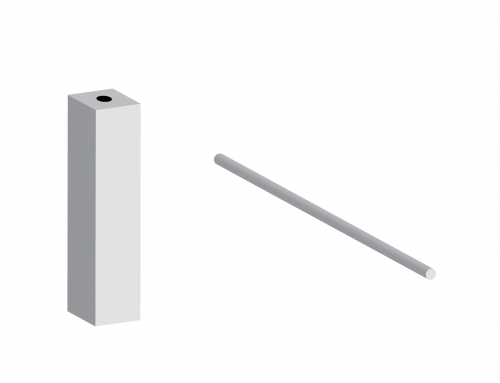
Stefano is hammering a 12 g aluminum nail with a 2.3 kg hammer. When the hammer is about to touch the nail, it has a speed of 8.5 m/s and \(10\%\) of the hammer’s kinetic energy is transferred to the nail in the form of heat. How much will the nail temperature increase if Stefano hits it 22 times? Take the specific heat of aluminum to be \(900 \text{ J/kg } {}^\circ \text{C}\)
Use Conservation of Energy, and assume the heat is a multiple of the kinetic energy. Solve for the change in temperature, and multiply by the number of hits.
The kinetic energy \(K\) of the hammer can be written as:
\begin{equation*}
K=\frac{1}{2}Mv^2,
\end{equation*}
and the heat absorbed by the nail is:
\begin{equation*}
Q = mc \Delta T.
\end{equation*}
Conservation of Energy for this case gives us:
\begin{equation*}
0.1\frac{1}{2}Mv^2=mc\Delta T.
\end{equation*}
Solving for \( \Delta T\) and plugging in numerical values, we get:
\begin{equation*}
\Delta T \approx 0.77\,{}^{\circ}\text{C},
\end{equation*}
and after 22 hits we obtain:
\begin{equation*}
\Delta T_{\text{total}} \approx 17\,{}^{\circ}\text{C}.
\end{equation*}
For a more detailed explanation of any of these steps, click on “Detailed Solution”.
The problem asks us to find the difference between the final temperature and the initial temperature of the nail if it is hit by the hammer 22 times. The first thing we must do is to find the kinetic energy of the hammer just before it hits the nail. Then, \(10\%\) of this energy is transferred to the nail as heat. With the mass, the material, and the amount of heat transferred to the nail, it is possible for us to find the change in temperature per hit. Multiplying the result by the number of hits will give us the total temperature increase.
To find the kinetic energy \(K\) of the hammer, we use the definition of kinetic energy, namely,
\begin{equation}
\label{kinener}
K=\frac{1}{2}Mv^2,
\end{equation}
where \(M\) is the mass of the hammer and \(v\) is its velocity. Now, the amount of heat transferred to the nail \(Q\) is the \(10\%\) of this kinetic energy, so we can write
\begin{equation}
Q=0.1K,
\end{equation}
or using equation \eqref{kinener}
\begin{equation}
\label{qtran}
Q=0.1\frac{1}{2}Mv^2.
\end{equation}
The heat absorbed by the nail \(Q\) changes its temperature \(T\) according to the following expression
\begin{equation}
\label{mcdt}
Q=mc\Delta T,
\end{equation}
where \(m\) is the mass of the nail, \(c\) is the specific heat of aluminum, and \(\Delta T\) is the change of temperature of the nail.
The expression of equations \eqref{qtran} and \eqref{mcdt} must be equal because all the heat transferred to the nail is used in the change of temperature, so
\begin{equation}
\label{deltaT}
0.1\frac{1}{2}Mv^2=mc\Delta T.
\end{equation}
Solving for \(\Delta T\) in equation \eqref{deltaT}, we obtain
\begin{equation}
\Delta T=0.1\frac{Mv^2}{2mc}.
\end{equation}
Using the numerical values, we have
\begin{equation}
\label{result}
\Delta T=0.1\frac{(2.3\,\text{kg})(8.5\,\text{m/s})^2}{2(12 \times 10^{-3}\,\text{kg})(900 \,\text{J/kg }\,{}^{\circ}\text{C})}\approx 0.77\,{}^{\circ}\text{C},
\end{equation}
which is the change of temperature per hit. If we want to final the total change of temperature after the 22 hits, we must multiply the result in equation \eqref{result} by 22; explicitly,
\begin{equation}
\Delta T_{\text{total}}=22\Delta T=22(0.77\,{}^{\circ}\text{C})\approx 17\,{}^{\circ}\text{C}.
\end{equation}


Leave A Comment