
Determine the gravitational acceleration of a body in free-fall near the surface of Mars. The mass of Mars is \(6.39 \times 10^{23} \,\text{kg}\), and its mean radius is \(3389.5 \,\text{km}\). Find the ratio of the gravitational constant on Earth and Mars.
To determine the gravitational constant on the surface of a spherical celestial body \(g\), we only need its mass \(M\) and the distance from the center of the planet, which is the radius of the planet \(R\). A body in free-fall near the surface of the planet will experience an acceleration \(g\) towards the center of the planet. Using Newton's second law, we can write,
\begin{equation}\label{n2l}
\sum \vec{F}=m\vec{a},
\end{equation}
where \(\vec{a}\) is the acceleration vector and \(\sum \vec{F}\) is the sum of all forces, which, in the case of free fall, the only force exerted is the gravitational attraction \(F_G\) from the planet to the body of mass \(m\).
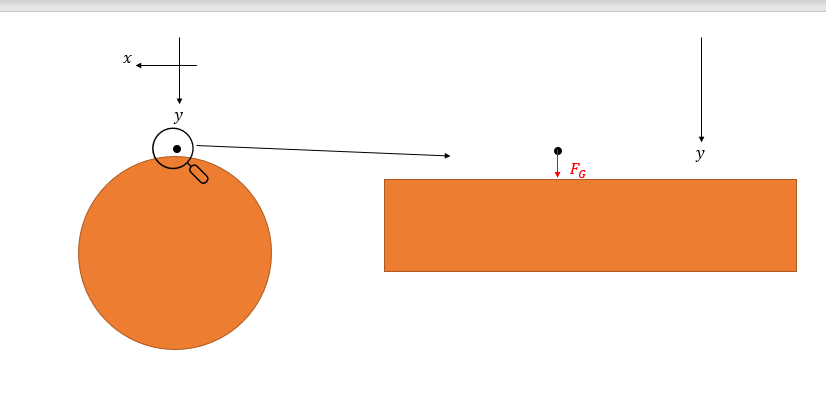
Therefore, we can write Newton's second law given in \eqref{n2l} along the direction towards the center of the planet, which we will denote with the unitary vector \(\hat{\textbf{j}}\); explicitly,
\begin{equation}\label{newton2}
F_{G}\,\hat{\textbf{j}}=mg\,\hat{\textbf{j}},
\end{equation}
where we used the fact that the acceleration in free fall is denoted by \(g\). The magnitude of the gravitational force \(F_G\) between two objects of mass \(m\) and \(M\) where their center of mass is separated a distance \(R\) is given by
\begin{equation}\label{fg}
F_{G}=\frac{GMm}{R^2},
\end{equation}
where \(G= 6.67430 \times 10^{-11}\, \text{m}^3\, \text{kg}
^{-1}\,\text{s}^{-2}\) is the Newtonian constant of gravitation. Hence, we can insert the expression given in \eqref{fg} into equation \eqref{newton2} to obtain
\begin{equation}
\frac{GMm}{R^2}\,\hat{\textbf{j}}=mg\,\hat{\textbf{j}}.
\end{equation}
Dropping the vector notation since all terms are along the same axis, we obtain from the equation above an equivalent expression:
\begin{equation}
mg=\frac{GMm}{R^2}
\end{equation}
which, after canceling the term \(m\), gives us
\begin{equation}
g=\frac{GM}{R^2},
\end{equation}
where, in the case of Mars, we have
\begin{equation}\label{mars}
g_{\text{Mars}}=\frac{G M_{\text{Mars}}}{R_{\text{Mars}}^2}.
\end{equation}
Using the numerical values (in SI units) given in the prompt, we obtain from \eqref{mars}
\begin{equation}
g_{\text{Mars}}=\frac{(6.67430 \times 10^{-11}\, \text{m}^3\, \text{kg}
^{-1}\,\text{s}^{-2})(6.39 \times 10^{23} \,\text{kg})}{(3.3895\times 10^{6} \,\text{m})^2},
\end{equation}
\begin{equation}
g_{\text{Mars}}\approx 3.71\,\text{m/s}^2.
\end{equation}
Making the ratio with the gravitational constant on the surface of the Earth \(g_{\text{Earth}}=9.81\,\text{m/s}^2\), we get
\begin{equation}
\frac{g_{\text{Earth}}}{g_{\text{Mars}}}=\frac{9.81\,\text{m/s}^2}{3.71\,\text{m/s}^2}\approx 2.64,
\end{equation}
Thus, the free fall acceleration on Earth is approximately \(2.64\) times larger than the free fall acceleration on Mars.
Leave A Comment