

A soccer ball rolls down a 70 m-high hillside with a tilt angle of 30\(^\circ\). The slope has no friction at the bottom, but the top is rough enough for the sphere to roll without slipping.
a) How fast is the soccer ball’s center of mass when it reaches the end of the slope?
b) Figure out if the same analysis done in (a) can be applied in the case where there is friction at the bottom and the top of the hill is smooth.
a) Apply Conservation of Energy. Consider that the slope has friction at the top, but not at its bottom, which means that the ball rolls along the first half of the hill, and then continues rolling with constant angular velocity along the second half of the trajectory.
b) The condition “without slipping” is key to this problem.
a) Conservation of Energy states:
\begin{equation*}
E_i = E_f,
\end{equation*}
This can be related to the top (\(A\)), the middle (\(B\)) and the bottom (\(C\)). From \(A\) to \(B\), we have:
\begin{equation*}
mgh = mg \frac{h}{2} + \frac{1}{2}mv_B^2 + \frac{1}{2}I \omega^2,
\end{equation*}
where \(v_B = \omega R\) and \(I = \frac{2}{3} mR^2\). Substituting these formulae into the last equation, and solving for \(\omega\), we get:
\begin{equation*}
\omega=\sqrt{\frac{3gh}{5R^2}}.
\end{equation*}
From \(A\) to \(C\), we have:
\begin{equation*}
mgh = \frac{1}{2}mv_C^2 + \frac{1}{2}I \omega^2,
\end{equation*}
where \(\omega\) was recently found. Substituting \(\omega\) and \(I\), and then solving for \(v_C\), we have:
\begin{equation*}
v_C = \sqrt{ \frac{8gh}{5} },
\end{equation*}
which, with numerical values, we have:
\begin{equation*}
v_C \approx 33.15 \, \text{m/s}.
\end{equation*}
b) The same analysis as performed in part (a) cannot be performed in part (b) because from A to B, the linear speed increases while the angular speed remains zero. When the ball passes point B, the rolling without slipping condition is not met because the angular speed is zero. The mechanical energy is therefore not conserved from \(B\) to \(C\).
For a more detailed explanation of any of these steps, click on “Detailed Solution”.
a) We need to find the speed of the soccer ball’s center of mass when it reaches the end of the slope. To approach this problem, we’ll use the fact that in the first half of the trajectory, the soccer ball rolls without slipping, so the friction does no work and mechanical energy \(E\) is conserved.
Mechanical energy \(E\) is the sum of potential energy \(U\), associated with conservative forces, and kinetic energy \(K\), namely
\begin{equation}
\label{emec}
E=U+K.
\end{equation}
When a rigid body makes a motion of translation and rotation, the kinetic energy is given by the translational kinetic energy of the center of mass \(K_{\text{cm}}\) plus the kinetic energy of rotation \(K_{\text{rot}}\), explicitly
\begin{equation}
K=K_{\text{cm}}+K_{\text{rot}}.
\end{equation}
The explicit expression for the translational kinetic energy of the center of mass is given by
\begin{equation}
\label{ktr}
K_{\text{cm}}=\frac{1}{2}m v_{\text{cm}}^2,
\end{equation}
where \(m\) is the mass of the body and \(v_{\text{cm}}\) is the speed of its center of mass. The expression for the rotational kinetic energy is
\begin{equation}
\label{krot}
K_{\text{rot}}=\frac{1}{2}I\omega^2,
\end{equation}
where \(I\) is the moment of inertia around the center of mass and \(\omega\) is the angular speed. The only conservative force exerted on the soccer ball is the gravitational force, whose potential energy is given by
\begin{equation}
\label{mgh}
U=mgh,
\end{equation}
where \(g\) is the gravitational constant and \(h\) is the height measured from a given coordinate system. In our case, the coordinate system is placed on the bottom of the hillside.
Putting the results of equations \eqref{ktr}, \eqref{krot}, and \eqref{mgh} together into equation \eqref{emec}, we obtain
\begin{equation}
\label{emec2}
E=mgh+\frac{1}{2}mv_{\text{cm}}^2+\frac{1}{2}I\omega^2.
\end{equation}
We’ll now divide the trajectory in three points: A, B, and C, as seen in figure 1.
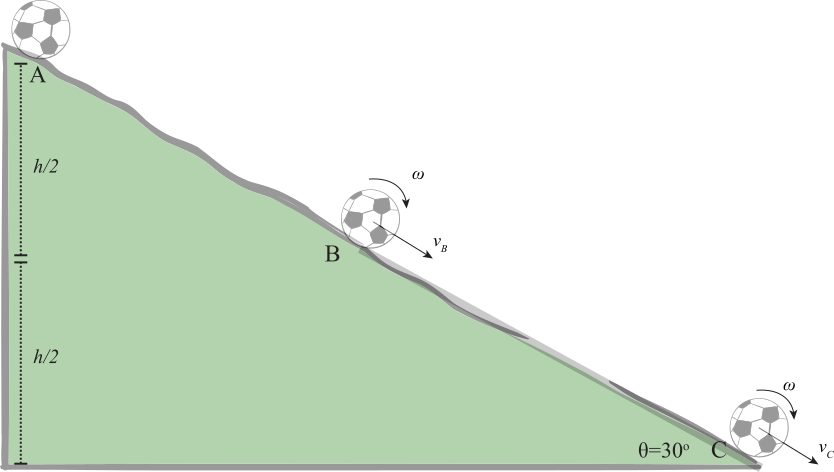
Figure 1: Soccer ball is depicted at different points of its trajectory. At point A, the soccer ball is on the top of the hill with no angular speed and no speed of the center of mass. At point B, the ball has acquired an angular speed \(\omega\) due to friction and a speed of the center of mass \(v_B\). At point C, the soccer ball still keeps the same angular speed \(\omega\) because from point B to C there is no friction. The speed of the center of mass \(v_C\) is greater than \(v_B\).
At point A, the speed of the center of mass and the angular speed is zero, and the height is \(h\). Thus, we can write an expression for the mechanical energy at point A using equation \eqref{emec2} as
\begin{equation}
\label{ea}
E_A=mgh.
\end{equation}
At point B, the speed of the center of mass is \(v_B\) and the angular speed is \(\omega\). The height at point B is \(h/2\). Hence, using equation \eqref{emec2}, we can write an expression for the mechanical energy at point B, namely
\begin{equation}
\label{eb1}
E_B=mg\frac{h}{2}+\frac{1}{2}mv_B^2+\frac{1}{2}I\omega^2.
\end{equation}
Because we have the condition for rolling without slipping, the angular speed and the speed of the center of mass fulfill the following relation
\begin{equation}
v_B=\omega R,
\end{equation}
where \(R\) is the radius of the soccer ball. Using this relation into equation \eqref{eb1}, we obtain
\begin{equation}
E_B=mg\frac{h}{2}+\frac{
1}{2}m(\omega R)^2+\frac{1}{2}I\omega^2,
\end{equation}
\begin{equation}
\label{eb2}
E_B=mg\frac{h}{2}+\frac{1}{2}mR^2\omega^2+\frac{1}{2}I\omega^2.
\end{equation}
From point B to C there is no friction; so, there is no torque applied to the ball, and the angular acceleration \(\vec{\alpha}\) is zero. This implies that the angular speed \(\omega\) does not change from point B to point C. The speed of the center of mass at C is \(v_C\), and the height is zero. Therefore, we can write, with the help of equation \eqref{emec2} an expression for the mechanical energy at point C, that is
\begin{equation}
\label{ec}
E_C=\frac{1}{2}mv_C^2+\frac{1}{2}I\omega^2.
\end{equation}
To find \(v_C\), we must first calculate \(\omega\). We use the conservation of mechanical energy principle to write the following equality
\begin{equation}
E_A=E_B.
\end{equation}
Which, after using the explicit expressions for both energies given in equations \eqref{ea} and \eqref{eb2}, we have
\begin{equation}
\label{eaeb}
mgh=mg\frac{h}{2}+\frac{1}{2}mR^2\omega^2+\frac{1}{2}I\omega^2.
\end{equation}
We’ll treat the soccer ball as if it was a spherical shell, for which the moment of inertia is
\begin{equation}
\label{inertia}
I=\frac{2}{3}mR^2.
\end{equation}
Using the result above in equation \eqref{eaeb} gives us
\begin{equation}
mgh=mg\frac{h}{2}+\frac{1}{2}mR^2\omega^2+\frac{1}{2}\left(\frac{2}{3}mR^2\right)\omega^2,
\end{equation}
where we can cancel out the mass \(m\) and sum the last two terms on the right-hand side to get
\begin{equation}
gh=g\frac{h}{2}+\frac{5}{6}R^2\omega^2.
\end{equation}
Solving for \(\omega\), we obtain
\begin{equation}
gh-g\frac{h}{2}=\frac{5}{6}R^2\omega^2,
\end{equation}
\begin{equation}
g\frac{h}{2}=\frac{5}{6}R^2\omega^2,
\end{equation}
\begin{equation}
\label{omega2}
\frac{gh}{2}\frac{6}{5R^2}=\omega^2.
\end{equation}
Taking the square-root o the equation above gives us
\begin{equation}
\label{omega}
\omega=\sqrt{\frac{3gh}{5R^2}}.
\end{equation}
Now we can use the principle of conservation of mechanical energy between point A and C to write
\begin{equation}
E_A=E_C,
\end{equation}
which, after using the explicit expressions for the energies given by equations \eqref{ea} and \eqref{ec}, we get
\begin{equation}
mgh=\frac{1}{2}mv_C^2+\frac{1}{2}I\omega^2.
\end{equation}
Using the explicit expression for \(I\) and \(\omega^2\) given in equations \eqref{inertia} and \eqref{omega2} respectively, we obtain
\begin{equation}
mgh=\frac{1}{2}mv_C^2+\frac{1}{2}\left(\frac{2}{3}mR^2\right)\left(\frac{gh}{2}\frac{6}{5R^2}\right),
\end{equation}
which, after some simplifications and canceling out the mass \(m\), is
\begin{equation}
gh=\frac{1}{2}v_C^2+\frac{gh}{5}.
\end{equation}
Solving for \(v_C\) in the equation above, we get
\begin{equation}
gh-\frac{gh}{5}=\frac{1}{2}v_C^2,
\end{equation}
\begin{equation}
\frac{4gh}{5}=\frac{1}{2}v_C^2,
\end{equation}
\begin{equation}
\frac{8gh}{5}=v_C^2.
\end{equation}
Hence, by taking the square-root, we find our result
\begin{equation}
v_C=\sqrt{\frac{8gh}{5}}.
\end{equation}
Using the numerical values, we get
\begin{equation}
v_C=\sqrt{\frac{8(9.81\,\text{m/s}^2)(70\,\text{m})}{5}},
\end{equation}
\begin{equation}
v_C\approx 33.15\,\text{m/s}.
\end{equation}
b) If the friction is only present at the bottom, the same analysis cannot be performed. The reason for this is that as the soccer ball goes from A to B, its center of mass acquires certain speed while the angular speed is zero. This is a result of the angular acceleration being zero due to the lack of net torque applied to the soccer ball in this part of the trajectory.
From point A to point B, the mechanical energy is conserved; however, as the ball passes point B, the rolling without slipping condition is not met, mainly because the angular speed is zero, while the speed of the center of mass is different than zero. Thus, after point B, the ball slips and the angular speed increases. It continues to increase until a point in which the condition
\begin{equation}
v_{\text{cm}}=\omega R
\end{equation}
is fulfilled. Because the ball slips, the friction does negative work, and mechanical energy is lost. Thus,
\begin{equation}
E_B\neq E_C,
\end{equation}
which is equivalent to
\begin{equation}
E_A\neq E_C.
\end{equation}
Hence, due to the mechanical energy being dissipated by friction, we conclude that the same analysis we completed before cannot be performed in this particular case.



Leave A Comment