
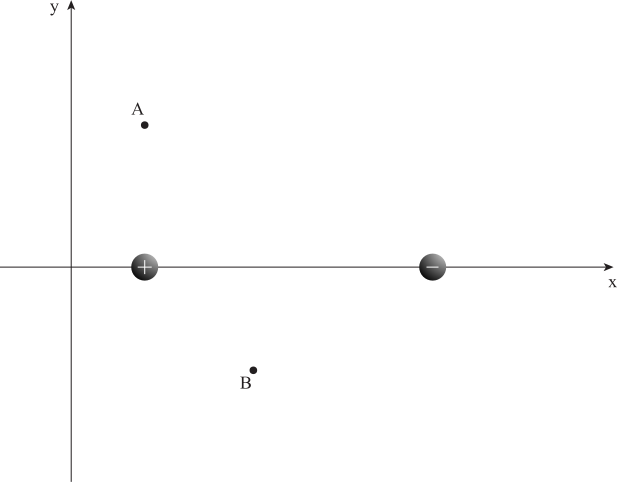
Two charges, \(q_1 = 5 \, \mu \text{C} \) and \(q_2 = -8 \, \mu \text{C} \), are placed along the \({x-}\)axis and are 1 m apart from one other, as shown in the figure. Point \(A\) is located 0.5 m above charge \(q_1\), and point \(B\) is located 0.4 m from \(q_1\) and 0.85 m from \(q_2\).
a) Find the electric potential at point \(A\).
b) Find the electric potential at point \(B\).
c) Consider an electron located at point \(B\) moving directly towards point \(A\). If the electron arrives at \(A\) with a speed of 820 m/s, what was its speed at point \(B\)?
a) Use the equation for electric potential, and plug in each charge and its corresponding distance to point A.
b) The same hint as given in part (b).
c) Use the conservation of energy to get the speed at B.
a) The definition for electric potential of a point charge is:
\begin{equation*}
V=\frac{1}{4\pi\epsilon_0}\frac{q}{r},
\end{equation*}
[mepr-show rules=”4409″ unauth=”both”]
where, at point A, the total electric potential is merely the sum of all charges. Then:
\begin{equation*}
V_A=\frac{1}{4\pi\epsilon_0}\frac{q_1}{r_{1A}}+\frac{1}{4\pi\epsilon_0}\frac{q_2}{r_{2A}},
\end{equation*}
which, with numerical values, gives us:
\begin{equation*}
V_A \approx 2.56 \times 10^{4} \, \text{J/C}.
\end{equation*}
b) At point B, the same analysis applies:
\begin{equation*}
V_B=\frac{1}{4\pi\epsilon_0}\frac{q_1}{r_{1B}}+\frac{1}{4\pi\epsilon_0}\frac{q_2}{r_{2B}},
\end{equation*}
which, with numerical values, is:
\begin{equation*}
V_B \approx 2.78 \times 10^{4} \, \text{J/C}.
\end{equation*}
c) By Conservation of Energy, we can write:
\begin{equation*}
U_A + K_A = U_B + K_B.
\end{equation*}
Using the fact that \(U= qV\), and \(K = \frac{1}{2}mv^2\), then we may write:
\begin{equation*}
qV_A + \frac{1}{2}mv_A^2 = qV_B + \frac{1}{2}mv_B^2,
\end{equation*}
which, after solving for \(v_B\), gives us:
\begin{equation*}
v_B=\sqrt{\frac{2q}{m}(V_A-V_B)+v_A^2},
\end{equation*}
which, with numerical values, is:
\begin{equation*}
v_B \approx 2.78 \times 10^{7} \, \text{m/s}.
\end{equation*}
For a more detailed explanation of any of these steps, click on “Detailed Solution”.
[/mepr-show]
For the first two questions, we need to find the electric potential at points \(A\) and \(B\). The strategy we’ll follow is to use the definition of the electric potential for point charges and the superposition principle.
a) Let’s begin by recalling the definition of electric potential for a point charge
\begin{equation}
\label{potelec}
V=\frac{1}{4\pi\epsilon_0}\frac{q}{r},
\end{equation}
[mepr-show rules=”4409″ unauth=”both”]
where \(q\) is the magnitude of the charge, \(r\) is the distance from the charge to the point where we want to calculate the electric potential, and \(\epsilon_0\) is the permittivity of vacuum, a physical constant. Notice that the electric potential is a scalar quantity, not a vector one. In order to find the electric potential at \(A\) \((V_A)\), we may use the superposition principle, that is, the electric potential at \(A\) is equal to the sum of the electric potential due to charges \(q_1\) \((V_1)\) and \(q_2\) \((V_2)\); explicitly,
\begin{equation}
\label{va}
V_A=V_1+V_2.
\end{equation}
We begin by calculating \(V_1\), using equation \eqref{potelec}
\begin{equation}
\label{v1}
V_1=\frac{1}{4\pi\epsilon_0}\frac{q_1}{r_{1A}},
\end{equation}
where \(r_{1A}\) is the distance between the charge \(q_1\) and the point \(A\), according to the problem this distance is \begin{equation}
r_{1A}=0.5\,\text{m}.
\end{equation}
We can do the same for charge \(q_2\) and obtain the expression
\begin{equation}
\label{v2}
V_2=\frac{1}{4\pi\epsilon_0}\frac{q_2}{r_{2A}},
\end{equation}
where \(r_{2A}\) is the distance between charge \(q_2\) and point \(A\), which can be found using geometry, specifically, Pythagoras theorem, as seen in figure 1.
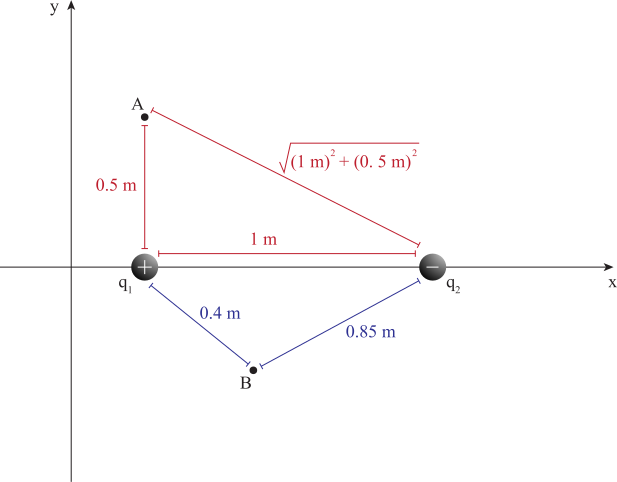
Figure 1: Distances measured from the charges to points A and B.
Then,
\begin{equation}
r_{2A}=\sqrt{(1\,\text{m})^2+(0.5\,\text{m})^2}\approx1.12\,\text{m}.
\end{equation}
Using equations \eqref{v1} and \eqref{v2} into equation \eqref{va} we finally get
\begin{equation}
\label{va2}
V_A=\frac{1}{4\pi\epsilon_0}\frac{q_1}{r_{1A}}+\frac{1}{4\pi\epsilon_0}\frac{q_2}{r_{2A}},
\end{equation}
where we can factorize some the term \(\frac{1}{4\pi\epsilon_0}\) to simplify the expression in \eqref{va2} to
\begin{equation}
\label{va2fac}
V_A=\frac{1}{4\pi\epsilon_0}\left(\frac{q_1}{r_{1A}}+\frac{q_2}{r_{2A}}\right)
\end{equation}
which numerically is
\begin{equation}
V_A=\frac{1}{4\pi (8.854\times 10^{-12}\, \text{C}^2/\text{N m}^2)}\left(\frac{5\times10^{-6}\,\text{C}}{0.5\,\text{m}}+\frac{(-8\,\times 10^{-6}\,\text{C})}{1.12\,\text{m}}\right),
\end{equation}
\begin{equation}
V_A\approx 2.56\times 10^{4}\,\text{J}/\text{C}.
\end{equation}
b) To calculate the electric potential at \(B\), we can do the same analysis performed in part (a) and obtain a similar equation as in \eqref{va2fac}; namely,
\begin{equation}
\label{vb}
V_B=\dfrac{1}{4\pi\epsilon_0}\left(\frac{q_1}{r_{1B}}+\frac{q_2}{r_{2B}}\right),
\end{equation}
where \(r_{1B}\) and \(r_{2B}\) are the distances between point \(B\) and charges \(q_1\) and \(q_2\), respectively. These distances are given by the problem \(r_{1B}=0.4\,\text{m}\) and \(r_{2B}=0.85\text{m}\); hence, we can calculate explicitly the electric potential at \(B\) following equation \eqref{vb}
\begin{equation}
V_B=\frac{1}{4\pi (8.854\times 10^{-12}\, \text{C}^2/\text{N m}^2)}\left(\frac{5\times10^{-6}\,\text{C}}{0.4\,\text{m}}+\frac{(-8\,\times 10^{-6}\,\text{C})}{0.85\,\text{m}}\right),
\end{equation}
\begin{equation}
V_B\approx2.78\times 10^{4}\,\text{J}/\text{C}.
\end{equation}
c) Now, let’s consider an electron traveling from \(B\) to \(A\). Given that it arrives to \(A\) with a speed of 820 m/s, we need to find the speed it had at \(B\). In this part of the problem, we’ll use the relation between electric potential and electric potential energy so that we can then use the principle of energy conservation. Since we have the electric potential at points \(A\) and \(B\) and we know the charge of the particle moving between these points, we can calculate the electric potential energy \(U\) using the relation
\begin{equation}
\label{potential}
U=qV,
\end{equation}
where \(q\) in our case is the charge of the electron, namely, \(q=-1.602\times 10^{-19}\,\text{C}\). Then, we can use that the mechanical energy of the particle is conserved because there are no dissipative forces (such as friction) acting on the particle; hence, the sum of all kinds of potential energy plus the kinetic energy \(K\) must be conserved; explicitly:
\begin{equation}
\label{conservation}
U_A+K_A=U_B+K_B,
\end{equation}
where \(U_A\) and \(K_A\) are the electric potential energy and kinetic energy at point \(A\), respectively, and \(U_B\) and \(K_B\) are the electric potential energy and kinetic energy at point \(B\). We can now use the expression for the kinetic energy
\begin{equation}
\label{kinetic}
K=\frac{1}{2}mv^2,
\end{equation}
where \(m\) is the mass and \(v\) is the speed. Using the definition of equation \eqref{kinetic} into equation \eqref{conservation}, we obtain
\begin{equation}
\label{cons2}
U_A+\frac{1}{2}mv_A^2=U_B+\frac{1}{2}mv_B^2.
\end{equation}
Now, we use the definition of potential energy given in equation \eqref{potential} in equation \eqref{cons2} to get
\begin{equation}
qV_A+\frac{1}{2}mv_A^2=qV_B+\frac{1}{2}mv_B^2,
\end{equation}
where the only unknown variable is \(v_B\). Solving for \(v_B\), we have
\begin{equation}
\frac{1}{2}mv_B^2=qV_A-qV_B+\frac{1}{2}mv_A^2,
\end{equation}
and then multiplying by \( 2/m \), we obtain
\begin{equation}
v_B^2=\frac{2}{m}\left(qV_A-qV_B+\frac{1}{2}mv_A^2\right),
\end{equation}
which is equivalent to
\begin{equation}
v_B^2=\frac{2q}{m}(V_A-V_B)+v_A^2.
\end{equation}
Finally, taking the square root on both sides:
\begin{equation}
v_B=\sqrt{\frac{2q}{m}(V_A-V_B)+v_A^2}.
\end{equation}
Using the numerical values given and the ones calculated in previous parts of the problem, we have
\begin{equation*}
v_B=\sqrt{\frac{2(-1.602\times 10^{-19}\,\text{C})(2.57\times 10^{4}\,\text{J}/\text{C}-2.78\times 10^{4}\,\text{J}/\text{C}}{(9.11\times 10^{-31}\,\text{kg})}+(820\,\text{m}/\text{s})^2)},
\end{equation*}
\begin{equation}
v_B\approx 2.78 \times 10^7\,\text{m}/\text{s}.
\end{equation}
This means that the electron reduced its speed by 5 orders of magnitude!
[/mepr-show]


Leave A Comment